Air Pollution Increases Diabetes Risk In Delhi, Chennai: CARRS Study
Relevance: GS2 - Issues related to Health; GS3 - Conservation, environmental pollution and degradation
(Source: The Hindu, 11/02/2023)
Click here for Daily Current Affairs
Why in the news?
- In recent years, the detrimental effects of air pollution on public health have garnered significant attention worldwide.
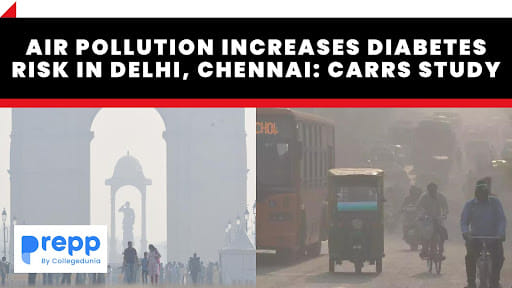
- Recently, two studies, conducted as part of the Centre for cArdiometabolic Risk Reduction in South Asia (CARRS) Surveillance Study, have unveiled a compelling link between air pollution levels and the incidence of type 2 diabetes in two major Indian cities, Chennai and Delhi.
- This is the first study from India establishing a quantitative link between PM2.5 and diabetes risk in a highly polluted environment.
Table of Contents
Key Findings of the Study
- Increased risk of Diabetes: The study indicates that long-term exposure to fine particulate matter (PM2.5) is associated with increased risk of developing type 2 diabetes mellitus (T2DM).
- The South Asian nation is estimated to be home to 7.7 crore adults with diabetes as of 2019, and air pollution could be fueling this crisis.
- Although diabetes is a complex metabolic disorder caused by multiple reasons, the study shows that air pollution could be a key contributing factor in urban areas.
- Vulnerable Groups: It was found that hypertensive individuals in Chennai were more susceptible to developing type 2 diabetes due to long-term exposure to PM2.5. In Delhi, younger participants were more susceptible to the disease.
- Blood Sugar Levels: People living in areas with higher PM2.5 levels had higher fasting plasma glucose (FPG) and glycated hemoglobin (HbA1c) on average compared to those living in less polluted areas. HbA1c is considered an important indicator of long-term blood sugar management.
What are the concerns?
- Noncommunicable Diseases (NCDs): India has a large burden of noncommunicable diseases, which accounted for 64% of the national disease burden in 2021, including diabetes and cardiovascular conditions. The linkage between air pollution and these NCDs further exacerbates the health challenges in the country.
- Impact of increased exposure to PM2.5: Increased exposure to PM2.5, or fine particulate matter can have a wide range of negative impacts on human health and the environment.
- For example, a model-based study published in The Lancet Planetary Health in 2021 estimated that increasing PM2.5 exposure by 10 μg/m3 could also increase the risk of pregnancy loss by 3% in India, Pakistan, and Bangladesh.
- Environmental and Societal Impact: It affects the quality of life, contributes to climate change, and can lead to economic burdens due to healthcare costs and lost productivity.
What is Diabetes?
- Diabetes mellitus is a chronic, non-communicable condition that arises when the pancreas fails to produce sufficient insulin or when the body is unable to effectively utilize the insulin it does produce.
- Insulin is a vital hormone responsible for maintaining blood sugar or glucose levels within a healthy range.
- It achieves this by facilitating the uptake of glucose by cells, regulating the metabolism of carbohydrates, lipids, and proteins, and promoting cell growth and division.
- Insulin's pivotal role in metabolism involves assisting the liver, muscles, and fat cells in storing excess glucose that the body doesn't immediately need, preserving it as an energy source for later use.
Types of Diabetes
- Type 1 Diabetes: In this type, the body produces very little or no insulin. Therefore, a daily injection of insulin is required for the body to maintain blood glucose levels under control. It can develop at any age but mostly it affects children and adolescents.
- Type 2 Diabetes: In this type, the body is not able to use the insulin that it produces. The remedy for this is a healthy lifestyle, increased physical activity, and a healthy diet. Some people with time may take oral drugs or insulin to keep their blood glucose levels under control. It is more common in adults and 90% mostly cases of Diabetes are Type 2 only.
Government Initiatives
- India’s National non-communicable disease (NCD) Target is to prevent the rise in obesity and diabetes prevalence.
- National Programme for Prevention and Control of Cancers, Diabetes, Cardiovascular Diseases and Stroke (NPCDCS)
About CARRS
|
Initiatives taken for Controlling Air Pollution in India
- National Clean Air Programme (NCAP)
- Graded Response Action Plan (GRAP)
- System of Air Quality and Weather Forecasting and Research (SAFAR)
- National Air Quality Index (AQI)
- Push for Electric Vehicles (EVs)
Way Ahead
- Stringent Air Quality Regulations: India needs to enforce and strengthen air quality standards and regulations, making them more in line with the World Health Organization (WHO) guidelines.
- Promote Clean Energy Sources: Transitioning to cleaner energy sources, such as renewable energy and natural gas, can help reduce the emissions of pollutants that contribute to air pollution. Encouraging the adoption of electric vehicles can also play a significant role in reducing air pollution from the transportation sector.
- Urban Planning and Green Spaces: Cities should focus on better urban planning, including increased green spaces and trees, which can act as natural air filters and improve air quality.
- Waste Management: Implementing effective waste management practices, such as recycling and waste-to-energy projects, can reduce the release of pollutants from landfills and incinerators.
- Industrial Emission Controls: Ensuring industries adhere to strict emission control measures, and encouraging the use of cleaner technologies and processes can significantly reduce industrial emissions.
- Awareness and Education: Public awareness campaigns and education about the health risks associated with air pollution can help individuals make informed choices and put pressure on policymakers to take action.
- Monitoring and Data Sharing: Continuous air quality monitoring and data sharing with the public can help raise awareness and enable people to take precautions on days with high pollution levels.
(*Click this link to read prelims specific weekly current affairs articles)
FAQs
Question: What is Air Pollution?
Answer:
Air pollution is the contamination of air due to the presence of substances in the atmosphere that are harmful to the health of humans and other living beings, or cause damage to the climate or to materials.
Question: What is Particulate Matter?
Answer:
Particulate matter is the term for particles found in the air, including dust, dirt, soot, smoke, and liquid droplets. Particles can be suspended in the air for long periods of time.
Question: What is Diabetes?
Answer:
Diabetes mellitus is a chronic, non-communicable condition that arises when the pancreas fails to produce sufficient insulin or when the body is unable to effectively utilize the insulin it does produce.
UPSC Mains Practice Question:
|
MCQ
Question: Consider the following statements: (UPSC 2017)
- Climate and Clean Air Coalition (CCAC) to Reduce Short Lived Climate Pollutants is a unique initiative of G20 group of countries.
- The CCAC focuses on methane, black carbon and hydrofluorocarbons.
Which of the statements given above is/are correct?
(a) 1 only
(b) 2 only
(c) Both 1 and 2
(d) Neither 1 nor 2
Answer: (b) See the Explanation
- The Climate and Clean Air Coalition is a voluntary partnership of governments, intergovernmental organizations, businesses, scientific institutions and civil society organizations committed to improving air quality and protecting the climate through actions to reduce short-lived climate pollutants. Hence, statement 1 is not correct.
- The Coalition’s initial focus is on methane, black carbon, and hydrofluorocarbons (HFCs). Hence, statement 2 is correct.
Therefore, option (b) is the correct answer.
Question: In the cities of our country, which among the following atmospheric gases are normally considered in calculating the value of the Air Quality Index? (UPSC 2016)
- Carbon dioxide
- Carbon monoxide
- Nitrogen dioxide
- Sulphur dioxide
- Methane
Select the correct answer using the code given below:
(a) 1, 2 and 3 only
(b) 2, 3 and 4 only
(c) 1, 4 and 5 only
(d) 1, 2, 3, 4 and 5
Answer: (b) See the Explanation
National Air Quality Index (AQI) is a tool for effective communication of air quality status to people in terms which are easy to understand. It transforms complex air quality data of various pollutants into a single number (index value), nomenclature and colour. There are six AQI categories, namely Good, Satisfactory, Moderately Polluted, Poor, Very Poor, and Severe. It considers eight pollutants namely:
- Carbon Monoxide (CO), Nitrogen Dioxide (NO2), Sulphur Dioxide (SO2), Ozone (O3), PM 2.5, PM 10, Ammonia (NH3), Lead (Pb).
Therefore, option (b) is the correct answer.
Download the PREPP App and attempt FREE IAS Exam Mock Tests and get complete study material!

Full Test - 04: UPSC CSE Prelims CSAT (Paper-II)
Full Test - 03: UPSC CSE Prelims CSAT (Paper-II)
UPSC CSE Prelims 2026 GS Paper 1 Question Paper (24-May-2026)
UPSC CSE Prelims 2026 CSAT Paper 2 Question Paper (24-May-2026)

17 February 2025 | The Hindu Must Read Articles | Current Affairs

16 February 2026 | The Hindu Must Read Articles | Current Affairs

13 February 2026 | The Hindu Must Read Articles | Current Affairs









Comments