Air-breathing Propulsion System – Science & Technology Notes
Air Breathing Propulsion is a technological key to developing a low-cost space transportation system. They eliminate the need for oxidizer by using atmospheric air, resulting in a significant increase in payload fraction. In this article, we will discuss in detail regarding Air Breathing Propulsion System which will be helpful for UPSC exam preparation.
Table of Contents
What is an Air Breathing Propulsion System?
- An air-breathing engine is one that uses air from its surroundings to burn fuel.
- Internal combustion engines that directly heat the air by burning fuel are used for propulsion via a propulsive nozzle in all practical air breathing engines.
- The air-breathing engine is fed by a steady stream of air. The compressed air is mixed with fuel, ignited, and expelled as exhaust gas.
- A typical air-breathing engine produces thrust that is approximately eight times greater than its weight.
- The thrust is produced by the expulsion of working gases from the exhaust nozzle.
| Other Relevant Links | |
|---|---|
| Space Organisations | Space race/Space junk |
| South Asia Satellite: Significance | Solar Mission- ADITYA |
| Spitzer Space Telescope | Chandra X-Ray Observatory |
| Multi Application Solar Telescope | Thirty Metre Telescope |
| Resourcesat-2A | Astrosat |
| Sunspot | Magnetars |
| Neutron stars | Space Junk |
| Graveyard Orbit | Supercluster of galaxies known as “Saraswati” |
Types of Air Breathing Engines
1) Ramjet Engine
- A ramjet is a type of air-breathing jet engine that compresses incoming air for combustion without the use of a rotating compressor.
- Ramjets operate most efficiently at supersonic speeds, but not at hypersonic speeds.
- A ramjet engine is a simple, light propulsion system that allows for high-speed flight. They are primarily employed in supersonic missiles.
- They are made up of three parts: an inlet to compress incoming air, a combustor to inject and burn fuel, and a nozzle to expel hot gases and generate thrust.
- Ramjets require a relatively high speed to compress the incoming air efficiently, so they cannot operate at a standstill and are most efficient at supersonic speeds.
- Ramjet engines are distinguished by their use of subsonic combustion.

Ramjet Engine
2) Scramjet Engine
- A scramjet engine outperforms a ramjet engine by operating at hypersonic speeds and allowing supersonic combustion. As a result, it is known as a Scramjet (Supersonic Combustion Ramjet).
- A scramjet, like a ramjet, relies on high vehicle speed to compress and decelerate incoming air before combustion (hence jet), but unlike a ramjet, which decelerates the air to subsonic velocities before combustion, airflow in a scramjet is supersonic throughout the engine.
- This enables the scramjet to operate efficiently at extremely high speeds: theoretical projections place a scramjet's top speed between Mach 12 and Mach 24.
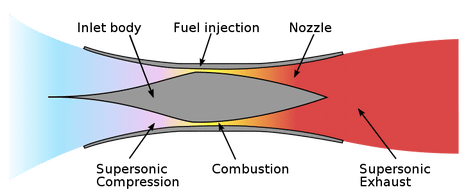
Scramjet Engine
3) Dual Mode Ramjet (DMRJ)
It is a type of jet engine in which a ramjet transforms into a scramjet over a Mach 4-8 range, allowing it to operate efficiently in both subsonic and supersonic combustion modes.
Significance of Air Breathing Engines
- The Air Breathing Engine is a technological foundation for a low-cost space transportation system.
- The technology is a significant step towards the development of reusable launch vehicles.
- Essentially, 86% of the total launch vehicle mass is made up of propellant mass. 70% of the propellant is oxidiser.
- Because these engines use atmospheric oxygen, which is available up to 50 kilometres above the earth's surface, they can save nearly 70% of the propellant carried in the vehicles.
- This system would help to reduce the vehicle's lift-off mass because there would be no need to carry liquefied oxygen on board.
- As a result, the rocket's energy efficiency improves and it becomes more cost-effective.
Applications of Air-breathing Propulsion System
- A spaceplane is a plane that can enter orbit or travel through space but takes off and lands like any other plane.
- Missile: A hypersonic missile launcher.
- Rockets: Used to launch satellites into orbit.
- ISRO intends to combine the engine with a reusable launch vehicle.
What is Hypersonic Air Breathing Technology (HAVA)?
- The Indian Space Research Organisation (ISRO) is set to make another splash in the world of space exploration with an exciting announcement about its hypersonic air breathing vehicle, 'HAVA.'
- Hypersonic air breathing vehicles are engineering marvels that use atmospheric air to burn fuel, similar to conventional jet engines.
- These vehicles are capable of exceeding supersonic speeds and flying at incredible speeds for extended periods of time.
- While air-breathing engines may appear counterintuitive for space travel, ISRO is investigating this cutting-edge technology as proof of its prowess and versatility in the aerospace domain.
- 'HAVA,' the hypersonic rocket, is a testament to ISRO's unwavering pursuit of pushing boundaries and exploring new frontiers.
- This rocket, designed to exceed hypersonic speeds for more than 200 seconds, represents a significant advancement in India's space technology capabilities.
- The acronym 'HAVA' stands for Hypersonic Air Breathing Vehicle with Air Integration System, and it perfectly captures the essence of this revolutionary project.
- ISRO's efforts in air breathing technology extend beyond direct rocket applications. The development of this cutting-edge technology is consistent with ISRO's overarching goal of remaining at the forefront of aerospace innovation and maintaining a competitive edge on the global stage.
- ISRO's Mahendragiri facility, which boasts a state-of-the-art hypersonic test facility, serves as the nerve centre for HAVA engine testing.
- These tests will validate and fine-tune the engine's performance, ensuring it meets the stringent hypersonic flight requirements.
- This meticulous testing procedure demonstrates ISRO's dedication to precision and excellence in all of its endeavours.
Conclusion
Air breathing propulsion is a solution for reusable launch vehicles that require a powered long return cruise flight. DRDO has been working on developing the Brahmos II Cruise Missile using the same scramjet technology. This necessitates the rapid development of ramjet or scramjet technologies, which will enable India to carry out advanced space missions in the future.
| Other Relevant Links | |
|---|---|
| Science & Technology Policy in India | Scientific Policy Resolution 1958 |
| Science & Technology Policy of 1983 | Science & Technology Policy of 2003 |
| Science, Technology and Innovation Policy 2013 | New Initiatives Aligned with the National Agenda |
| India and World collaboration in science projects | Technology Vision Document 2035 |
Air Breathing Propulsion System - Science and Technology Notes
The Air Breathing Propulsion System is a cutting-edge technology designed for advanced propulsion mechanisms, particularly in high-speed aircraft, satellites, and space missions. This system operates by using atmospheric air for combustion rather than carrying oxidizers like conventional rocket propulsion systems. The innovation in air-breathing propulsion systems promises to revolutionize aerospace engineering by offering more efficient, sustainable, and cost-effective solutions for hypersonic speeds. With growing interest in hypersonic flight technologies, these systems are a vital aspect of the aerospace industry’s future. In this article, we will explore the principles, developments, and significance of air-breathing propulsion systems, with a focus on their role in modern space missions and future aircraft design.
FAQs
Question: What is an air-breathing propulsion system?
Answer: An air-breathing propulsion system uses atmospheric air for combustion to generate thrust. It includes systems like jet engines and ramjets, commonly used in aircraft for efficient propulsion at high speeds and altitudes.
Question: What are the types of air-breathing propulsion systems?
Answer: The main types of air-breathing propulsion systems include turbojet engines, turbofan engines, ramjets, and scramjets. These systems work by compressing air, mixing it with fuel, and igniting it to produce thrust.
Question: How does a ramjet engine work?
Answer: A ramjet engine operates by compressing incoming air through high-speed motion without rotating parts. The compressed air mixes with fuel, and combustion occurs, creating high-pressure gases that are expelled for thrust.
Question: What is the difference between a ramjet and a scramjet engine?
Answer: A ramjet engine compresses air subsonically before combustion, while a scramjet compresses air at supersonic speeds. Scramjets are more efficient at higher speeds, typically used in hypersonic flight.
Question: What role does air-breathing propulsion play in space exploration?
Answer: Air-breathing propulsion systems, like scramjets, can be used in the initial stages of spaceflight to efficiently accelerate spacecraft through Earth's atmosphere, before switching to rocket propulsion once the atmosphere is too thin.
MCQs
1. Which of the following is a characteristic feature of an air-breathing propulsion system?
A) Uses external fuel sources
B) Requires atmospheric air for combustion
C) Does not produce thrust
D) Uses electric power for propulsion
Answer: (B) See the Explanation
Explanation: An air-breathing propulsion system requires atmospheric air for combustion. It operates by drawing in air, mixing it with fuel, and igniting the mixture to produce thrust. This is characteristic of jet and ramjet engines.
2. Which of the following propulsion systems is most suitable for hypersonic flight?
A) Turbojet
B) Turbofan
C) Scramjet
D) Ramjet
Answer: (C) See the Explanation
Explanation: Scramjets are designed for hypersonic speeds, where air enters the engine at supersonic speeds and remains supersonic throughout the combustion process. This makes them ideal for flight at speeds greater than Mach 5.
3. What is the primary function of a ramjet engine?
A) To accelerate spacecraft beyond Earth's orbit
B) To compress air subsonically for combustion
C) To convert electrical energy into thrust
D) To operate in space
Answer: (B) See the Explanation
Explanation: The primary function of a ramjet engine is to compress incoming air subsonically using high-speed motion, mix it with fuel, and ignite the mixture to produce thrust. There are no moving parts in a ramjet engine.
4. Which of the following is not a type of air-breathing propulsion system?
A) Turbojet
B) Scramjet
C) Rocket engine
D) Ramjet
Answer: (C) See the Explanation
Explanation: A rocket engine is not an air-breathing propulsion system because it does not rely on atmospheric air. It carries its own oxidizer and fuel to function in space, unlike air-breathing systems like turbojets and ramjets.
5. What is a major advantage of using air-breathing propulsion systems in aircraft?
A) Lower fuel consumption at high speeds
B) Ability to operate in space
C) Lower maintenance cost
D) Enhanced thrust at low speeds
Answer: (A) See the Explanation
Explanation: Air-breathing propulsion systems, like turbofans, are more fuel-efficient at high speeds and altitudes due to their reliance on atmospheric air for combustion, making them ideal for high-speed flight in the Earth's atmosphere.
GS Mains Questions and Model Answers
Q1: Analyze the significance of air-breathing propulsion systems in modern aerospace technology. How do these systems contribute to sustainable aviation and hypersonic flight?
Answer: Air-breathing propulsion systems, such as turbojets, ramjets, and scramjets, are crucial in modern aerospace technology for their efficiency and power. These systems are more fuel-efficient than rocket propulsion at certain speeds, contributing to sustainable aviation by reducing fuel consumption. In hypersonic flight, scramjets enable propulsion at speeds greater than Mach 5, facilitating rapid air travel and potential space exploration. The development of these systems also supports the evolution of commercial aviation by offering environmentally friendlier solutions that lower carbon footprints.
Q2: Discuss the challenges associated with the development of scramjet engines for hypersonic flight. What technological advancements are necessary to overcome these challenges?
Answer: Scramjet engines face several challenges, including extreme temperature conditions, air compression issues at hypersonic speeds, and material limitations. At Mach 5 and above, the frictional heat generated can damage the engine. Advances in heat-resistant materials, efficient cooling systems, and reliable hypersonic flow management are crucial for overcoming these challenges. Additionally, achieving stable combustion at hypersonic speeds is another hurdle, requiring breakthroughs in aerodynamics and engine design. Research into hypersonic flight continues, focusing on making scramjets viable for sustained, practical use.
Q3: How does the transition from air-breathing propulsion to rocket propulsion affect space missions? Discuss the advantages and limitations of this dual approach.
Answer: The transition from air-breathing propulsion to rocket propulsion is crucial in space missions. Air-breathing engines like scramjets are effective in the atmosphere but become inefficient in space, where there is no air. Rocket engines, which carry their own oxidizers, are required once the vehicle leaves the Earth's atmosphere. This dual approach maximizes efficiency during atmospheric flight and provides the necessary thrust for space travel. The challenge lies in developing systems that can seamlessly transition between the two, balancing the benefits of each propulsion method.
Previous Year Questions on Air Breathing Propulsion Systems
1. UPSC CSE Prelims 2023:
Question: What type of propulsion system is primarily used in supersonic aircraft for efficient high-speed flight within Earth's atmosphere?
A) Ramjet
B) Turbojet
C) Scramjet
D) Rocket engine
Answer: (A)
Explanation: Ramjet engines are primarily used for high-speed flight within Earth's atmosphere. They are efficient at supersonic speeds and do not require rotating parts, making them ideal for aircraft flying at speeds exceeding Mach 2.
2. UPSC CSE Mains 2022 (GS Paper 3):
Question: Evaluate the potential of air-breathing propulsion systems in revolutionizing future space exploration missions. How do they complement rocket propulsion?
Answer: Air-breathing propulsion systems, especially scramjets, can revolutionize space exploration by enabling efficient flight through the atmosphere at hypersonic speeds. They complement rocket propulsion by reducing fuel requirements during the atmospheric phase of flight, increasing the efficiency and sustainability of space missions.
Download the PREPP App and attempt FREE IAS Exam Mock Tests and get complete study material!

Full Test - 04: UPSC CSE Prelims CSAT (Paper-II)
Full Test - 03: UPSC CSE Prelims CSAT (Paper-II)
UPSC CSE Prelims 2026 GS Paper 1 Question Paper (24-May-2026)
UPSC CSE Prelims 2026 CSAT Paper 2 Question Paper (24-May-2026)

17 February 2025 | The Hindu Must Read Articles | Current Affairs

16 February 2026 | The Hindu Must Read Articles | Current Affairs

13 February 2026 | The Hindu Must Read Articles | Current Affairs









Comments