AI And The Issue Of Human-Centricity In Copyright Law
Relevance: GS3 - Science and Technology- developments and their applications and effects in everyday life, Issues relating to intellectual property rights GS2 - Government policies and interventions for development in various sectors and issues arising out of their design and implementation.
(Source: The Hindu, 11/02/2023)
Click here for Daily Current Affairs
Why in the news?
- Recently, the U.S. President issued an executive Order on Safe, Secure, and Trustworthy AI indicating how countries are stepping up regulation of AI as unregulated AI could pose severe risks to humanity.
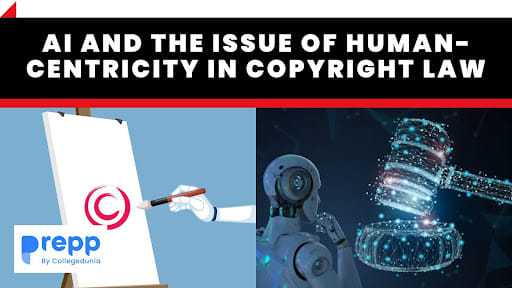
- This article discusses the implications of AI-generated work and copyright concerns related to it.
Table of Contents
How is AI creating new copyright concerns?
- Traditionally, computer-generated works did not have any significant Intellectual Property Rights (IPR) implications as the computer was just a tool that supported the human-led creative process.
- According to copyright laws in most countries, originality was a necessity for copyright protection for creative works with human authorship key to originality.
- Advancements in technology such as the development of generative AI technologies like ChatGPT have resulted in computers not remaining just a tool to support the creative process.
- Now, computers make many of the creative decisions without requiring active human involvement.
- This has resulted in concerns about whether work autonomously generated by AI and computer systems is eligible for protection under copyright law.
Intellectual Property Rights
International Conventions
India’s Acts and Conventions related to IPR
To learn more, click the link. |
Ownership and enforcement of IPR
- People with minimal creative skills can now use generative AI tools like ChatGPT and Midjourney to develop creative works raising new copyright-related concerns.
- Violation of copyrights of humans: The use of copyrighted materials like text and images to train AI tools has been criticized as an infringement of the protected intellectual property rights of authors, artists, and other content creators.
- Recently famous authors including David Baldacci, Mary Bly, Michael Connelly, John Grisham, Jodi Picoult, Scott Turow, and Rachel Vail, filed a suit against OpenAI, the creators of ChatGPT, for using pirated copies of their works to train their GPT3.5 and GPT4 tools.
- Another petition has been filed against Meta, the owner of Facebook, for violating the copyrights of authors to train its large language mode called LLaMA.
- Copyright ownership of AI-generated works: The second major concern faced in this area is whether output generated by AI autonomously or with human input is eligible for copyright ownership claims.
- According to the ‘Copyright Registration Guidance: Works Containing Material Generated by Artificial Intelligence’ released by the U.S. Copyright Office, only material that is produced through human creativity is eligible for copyright protection.
- Both the U.S. Constitution and the Copyright Act exclude nonhumans in the term ‘author’.
Stephen Thaler vs Shira Perlmutter
- The Stephen Thaler vs Shira Perlmutter case before the United States District Court for the District of Columbia consisted of a petition challenging the U.S. Copyright Office’s rejection of a copyright application for a work developed by an AI system.
- The case involved a copyright application filed by Mr. Thaler for an autonomous piece of visual art developed by his AI system called Creativity Machine.
- He also claimed that the copyright of the work should be transferred to him as the owner of the AI system.
- The U.S. Copyright Office rejected the application on the basis that the work in question lacked any human authorship.
- It also clarified that copyright applicants must disclose the inclusion of AI-generated content in any applications.
- The court reviewed the relevant statutory provisions, case laws, and theoretical justifications for copyright protection to conclude that human creativity was essential to copyright protection.
Indian perspective on copyrights for AI
- In 2020, the Indian Copyright Office registered a work of art called ‘Suryast’, with the “RAGHAV Artificial Intelligence Painting App” as a co-author.
- A previous application in which RAGHAV was the sole author was rejected by the office.
- The office later decided to withdraw the registration since Indian copyright law mandates a human authorship requirement in applications with AI systems as a co-author.
- However, according to data from the Indian Copyright Office website, the work is still registered.
- India has not introduced any legislative changes to the Copyright Act 1957 while the Copyright Office has not specified any mandatory disclosure requirements on the use of AI.
- ‘Review of the Intellectual Property Rights Regime in India’: The 161st Report of the Department-Related Parliamentary Standing Committee on Commerce released in 2021 recommended a review of the Copyright Act 1957 and the Patent Act 1970
- It suggested that emerging technologies like AI and related inventions should be incorporated within the scope of the two acts.
- It also recommended a relaxation in the standards for securing copyrights and patents.
Concerns
- Monopoly rights: Intellectual Property rights provide monopoly protection which could have extensive negative consequences on society.
- Therefore, the extension of IP protections to AI-generated work must only be enacted following a proper study of its implications.
- Incentivization: Unlike, authors and inventors, AI does not require economic incentives.
- This eliminates the need for the economic incentives provided by copyrights and patents with the development of AI-generated content.
- Lack of proper research: The recommendations of the Parliamentary committee have been criticized for not being based on a property study of the AI innovation ecosystem in India.
- The Committee has also been criticized for not conducting proper research into the challenges associated with IPR in India and the potential adverse implications of granting copyrights to AI-generated work.
Conclusion
- Indian policymakers and courts must adopt a cautious and well-considered approach to the issue of copyrights for AI-generated content especially in terms of diluting the human-participation requirements.
Click the link to learn more about copyright concerns associated with ChatGPT.
(*Click this link to read prelims specific weekly current affairs articles)
FAQs
Question: What is a copyright?
Answer:
Copyright is a legal term used to describe the rights enjoyed by creators over their literary and artistic works. It covers creative works such as books, music, paintings, sculptures, films, computer programs, databases, advertisements, maps, etc.
Question: What is the TRIPS Agreement?
Answer:
The Trade Related Intellectual Property Rights Agreement (TRIPS) is an international legal agreement between all the WTO member nations. It establishes minimum standards for the regulation of intellectual property rights by the member nations. It was negotiated at the end of the Uruguay Round of the General Agreement on Tariffs and Trade (GATT) and introduced intellectual property law into the multilateral trading system.
UPSC Mains Practice Question:
|
MCQs
Question: Consider the following statements: (UPSC 2019)
- According to the Indian Patents Act, a biological process to create a seed can be patented in India.
- In India, there is no Intellectual Property Appellate Board.
- Plant Varieties are not eligible to the patented in India.
Which of the statements given above is/ are correct?
(a) 1 and 3 only
(b) 2 and 3 only
(c) 3 only
(d) 1,2, and 3
Answer: (c) See the Explanation
- According to Section 3(J) of the Indian Patent Act, “plants and animals in whole or in any part thereof other than microorganisms, including seeds, varieties, and species, and essentially biological processes for production or propagation of plants and animals” are excluded from patentability. Hence, statement 1 is incorrect.
- The Intellectual Property Appellate Board (IPAB) was constituted in 2003 by the Government of India to hear and resolve the appeals against the decisions of the registrar under the Indian Trademarks Act, 1999 and the Geographical Indications of Goods (Registration and Protection) Act, 1999. Hence, statement 2 is incorrect.
- In India, the Protection of Plant Varieties and Farmers’ Rights (PPVFR) Act, 2001 provides for the protection of plant varieties and the rights of plant breeders and farmers.
- It is a sui generis system which is an alternative to the patent system. Hence, statement 3 is correct.
Therefore, option (c) is the correct answer.
Question: With reference to the ‘National Intellectual Property Rights Policy’, consider the following statements: (UPSC 2017)
- It reiterates India’s commitment to the Doha Development Agenda and the TRIPS Agreement.
- The Department of Industrial Policy and Promotion is the nodal agency for regulating intellectual property rights in India.
Which of the above statements is/are correct?
(a) 1 only
(b) 2 only
(c) Both 1 and 2
(d) Neither 1 nor 2
Answer: (c) See the Explanation
- The National Intellectual Property Rights (IPR) Policy recognizes that India has a well-established TRIPS compliant legislative, administrative and judicial framework to safeguard IPRs, which meets its international obligations while utilizing the flexibilities provided in the international regime to address its developmental concerns.
- It reiterates India’s commitment to the Doha Development Agenda and the TRIPS Agreement. Hence, statement 1 is correct.
- The DIPP under the Union Ministry of Commerce and Industry (now DPIIT i.e. Department for Promotion of Industry and Internal Trade) is recognized as the nodal department to coordinate, guide, and oversee the implementation and future development of IPRs in India. Hence, statement 2 is correct.
Therefore, option (c) is the correct answer.
Download the PREPP App and attempt FREE IAS Exam Mock Tests and get complete study material!

Full Test - 04: UPSC CSE Prelims CSAT (Paper-II)
Full Test - 03: UPSC CSE Prelims CSAT (Paper-II)
UPSC CSE Prelims 2026 GS Paper 1 Question Paper (24-May-2026)
UPSC CSE Prelims 2026 CSAT Paper 2 Question Paper (24-May-2026)

17 February 2025 | The Hindu Must Read Articles | Current Affairs

16 February 2026 | The Hindu Must Read Articles | Current Affairs

13 February 2026 | The Hindu Must Read Articles | Current Affairs









Comments