After Four Years of Survey, India's Snow Leopard Count Put at 718
Primary Source: The Hindu
Click here for Daily Current Affairs
Why in the news?
Conducted over four years, India's first extensive survey to estimate the snow leopard population was completed recently, which found that there are approximately 718 snow leopards in the wild across the country.
Table of Contents
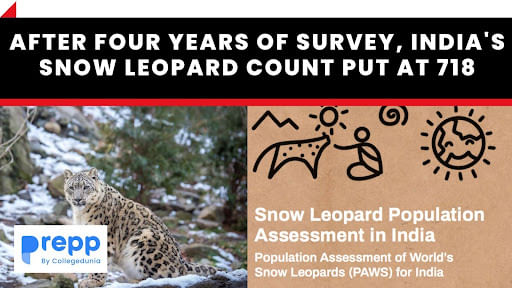
Snow Leopard Population Assessment in India (SPAI)
- The Snow Leopard Population Assessment in India (SPAI) is a comprehensive survey aimed at estimating the number of snow leopards in India.
- This assessment, which began in 2019, marks the first time that a systematic effort has been made to establish a baseline for the population of snow leopards in the country.
- The SPAI involves collaboration between the Wildlife Institute of India (WII), the World Wide Fund for Nature-India, and the Nature Conservation Foundation, Mysuru.
Key Findings of SPAI
- Total Population Estimate: The assessment estimated that there are approximately 718 snow leopards in the wild in India. This figure represents about 10% to 15% of the global population of snow leopards.
- Regional Distribution: The highest number of snow leopards was found in Ladakh (477), followed by Uttarakhand (124), Himachal Pradesh (51), Arunachal Pradesh (36), Sikkim (21), and Jammu and Kashmir (9).
- Methodology: The survey methodology included the use of camera traps set up in 1,971 locations and the surveying of 13,450 km of trails. Teams recorded signs of snow leopard presence such as scat, hair, and other body markers. This approach is similar to the one used in tiger population surveys.
- Statistical Approach: The Wildlife Institute of India utilized software and statistical methods to estimate the number of individual snow leopards present, including those not captured on camera.
- Baseline for Future Surveys: The SPAI has established a scientifically grounded baseline that will serve as a reference point for future surveys and assessments of the snow leopard population in India.
About Snow Leopard
| Aspect | Details |
|---|---|
| About |
|
| Characteristics |
|
| Habitat |
|
| Conservation Status |
|
| Conservation Efforts |
|
| Threats |
|
Conclusion
This population assessment enhances our understanding of snow leopards in India and provides a basis for developing informed conservation strategies and policies. These efforts are crucial for protecting these magnificent creatures against a range of challenges.
(*Click this link to read prelims specific weekly current affairs articles)
FAQs
Question: What is the significance of the Snow Leopard Population Assessment in India (SPAI)?
Answer:
The Snow Leopard Population Assessment in India (SPAI), initiated in 2019, is significant as it marks the first comprehensive survey to estimate the snow leopard population in India. It establishes a scientifically sound baseline for future conservation efforts and monitoring of this species.
Question: Which regions in India have the highest estimated populations of snow leopards according to the recent survey?
Answer:
The recent survey indicates that the highest number of snow leopards in India is found in Ladakh (477), followed by Uttarakhand (124), Himachal Pradesh (51), Arunachal Pradesh (36), Sikkim (21), and Jammu and Kashmir (9).
Question: What is the IUCN status of Snow Leopard?
Answer:
The snow leopard is classified as ‘vulnerable’ by the International Union for the Conservation of Nature (IUCN). It faces threats from factors such as free-ranging dogs, human-wildlife conflicts, and poaching.
UPSC Mains Practice Question:
|
MCQs
Question: Consider the following: (2012)
1) Black-necked crane
2) Cheetah
3) Flying squirrel
4) Snow leopard
Which of the above are naturally found in India?
(a) 1, 2 and 3 only
(b) 1, 3 and 4 only
(c) 2 and 4 only
(d) 1, 2, 3 and 4
Answer: (b) See the Explanation
Black-necked cranes
- They breed mostly in high-altitude marshes on the Tibetan plateau.
- These wetlands, complete with tiny mounds, provide ideal breeding habitat for birds.
- These birds spend their winters at lower altitudes, feeding primarily on leftovers from rice and potato farms.
- This species is distributed in India, China, and Bhutan, and it breeds in high-altitude wetlands on the Tibetan plateau at elevations ranging from 2950 to 4900 meters above sea level.
- Black-necked cranes are reported to breed in high-altitude marshes and lakes in the Tibetan Plateau (Tibet, Qinghai, Xinjiang, Gansu), Sichuan (China), and eastern Ladakh (India). Hence, statement 1 is correct.
- There is also a minor wintering population in Arunachal Pradesh's Sangti and Zimithang valleys.
Flying Squirrel
- It is one of the largest flying squirrels, similar in size to the Red Giant Flying Squirrel found in Northeast India and East Asia, measuring over 43cm long with a 50cm tail. Hence, statement 3 is correct.
- They have a rufous coat, grey undersides, and huge, round eyes.
- Their flying membrane extends from their wrists to their ankles, allowing them to glide between trees.
- Despite its name, the Indian Giant Flying Squirrel is fairly widespread in Asia, including China, Laos, Myanmar, Sri Lanka, China, Thailand, and Vietnam.
- They can be found in dry deciduous and evergreen woods, as well as plantations, where they are tolerant of human interference.
Snow Leopards
- They inhabit hilly areas in central and southern Asia.
- In India, their geographical range includes much of the western Himalayas, including the states of Jammu and Kashmir, Himachal Pradesh, Uttarakhand, and Sikkim, as well as Arunachal Pradesh in the east. Hence, statement 4 is correct.
- The final three states are part of the Eastern Himalayas, a priority global region for WWF and the Living Himalayas Network Initiative.
- The snow leopard is classified as vulnerable on the IUCN-World Conservation Union's Red List of Threatened Species.
- Furthermore, the snow leopard, like all big cats, is classified on Appendix I of the Convention on International Trade in Endangered Species (CITES), making the trade of animal body parts (fur, bones, and flesh) illegal in signatory countries.
- In addition, various national laws protect it in the nations where it is found.
Cheetahs
- Cheetahs are currently rated as vulnerable on the IUCN Red List.
- In Namibia, they are protected species. They are listed as Endangered under the United States' Endangered Species Act.
- They are classified as Appendix 1 species under the Convention on International Trade in Endangered Species (CITES).
- The majority of wild cheetahs live in dispersed groups throughout Africa, accounting for only 9% of their original range. In Iran, less than 50 Asiatic Cheetahs remain. Hence, statement 2 is incorrect.
- The largest cheetah population is spread across six countries: Namibia, Botswana, South Africa, Angola, Mozambique, and Zambia.
- Namibia has the highest population of any country, earning it the nickname "The Cheetah Capital of the World."
- More than 75% of the remaining wild cheetahs reside on rural farmlands amid human communities.
Therefore, option (b) is the correct answer.
Question: Which one of the following groups of animals belongs to the category of endangered species? (UPSC 2012)
(a) Great Indian Bustard, Musk Deer, Red Panda and Asiatic Wild Ass
(b) Kashmir Stag, Cheetal, Blue Bull and Great Indian Bustard
(c) Snow Leopard, Swamp Deer, Rhesus Monkey and Saras (Crane)
(d) Lion-tailed Macaque, Blue Bull, Hanuman Langur and Cheetal
Answer: (a) See the Explanation
International Union for Conservation of Nature
- Since its inception in 1964, the International Union for Conservation of Nature's Red List of Threatened Species has evolved into the world's most comprehensive repository of information on the global extinction risk status of animal, fungal, and plant species.
- The IUCN Red List is an important indicator of the state of the world's biodiversity.
- Far more than a list of species and their condition, it is a powerful instrument for informing and catalyzing biodiversity conservation and policy change, both of which are vital to safeguarding the natural resources we rely on for survival.
- It offers data on a species' range, population size, habitat and ecology, use and/or commerce, threats, and conservation activities to help influence conservation decisions.
- Option 1 comprises all species of the Endangered group that are either Critically Endangered or Endangered on the IUCN red list, hence it is the right answer.
Therefore, option (a) is the correct answer.
Download the PREPP App and attempt FREE IAS Exam Mock Tests and get complete study material!
UPSC IAS : GS - Indian Economy - Subject Knowledge Test

Live Test : UPSC CSE Prelims CSAT (Paper-II) (July 22 - 25)
UPSC CSE Prelims 2026 GS Paper 1 Question Paper (24-May-2026)
UPSC CSE Prelims 2026 CSAT Paper 2 Question Paper (24-May-2026)

17 February 2025 | The Hindu Must Read Articles | Current Affairs

16 February 2026 | The Hindu Must Read Articles | Current Affairs

13 February 2026 | The Hindu Must Read Articles | Current Affairs









Comments