African Union Becomes Permanent Member of G-20
Relevance: GS2 - Bilateral, regional and global groupings and agreements involving India and/or affecting India’s interests
(Source: The Hindu,09/09/2023)
Click here for Daily Current Affairs
Why in the news?
Recently, the African Union was granted full membership to the G-20, becoming the second regional bloc with membership in the grouping.
Table of Contents
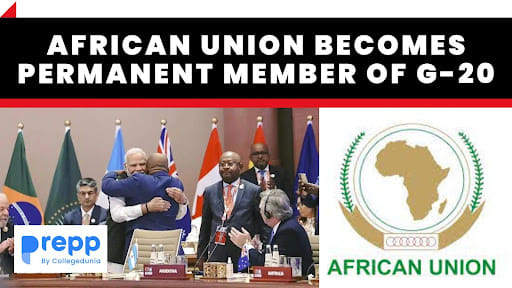
Africa’s addition to the G-20
- Under India’s Presidency, the G-20 added a new member - the African Union - in a move that is expected to strengthen the G-20 and strengthen the voice of the Global South.
- The addition of the AU represents the diplomatic shift and expanding influence of the region in geopolitics.
- The decision to admit the AU was supported by G-20 members like China, Russia, the U.S.A., and France despite differences on other issues.
- According to the Prime Minister, the addition of the AU was part of India’s strategy of “Sabka Saath” and was a step towards establishing a just, fair, inclusive, and representative global architecture and governance system.
- This was an opportunity for India to showcase its soft and hard power and contribute to building its global influence.
Response of African nations
- The African Union was represented at the G-20 by the President of Comoros, Azaly Assouman, who is serving as the Chairperson of the AU.
- He claimed that Africa has the potential to deal with its challenges and urged G-20 member countries to invest in the industrialization of the continent and to encourage the manufacture of goods using African resources.
- He recognized that African countries would have to cooperate with the rest of the world to provide training for its citizens, in order to develop job security and raise the standard of living of the people.
What is the African Union?
- The African Union (AU) is an intergovernmental organization in Africa that consists of 55 member states.
- It was established in 2002 as a successor to the Organization of African Unity (OAU).
- It has a GDP of $3 trillion with some 1.4 billion people.
- Objectives:
- Promoting unity, cooperation, and development across the continent.
- Address social, political, and economic challenges faced by African nations.
- Promoting peace, security, and stability in Africa.
- Members: Algeria, Angola, Benin, Botswana, Burkina Faso (suspended), Burundi, Cameroon, Cape Verde, Central African Republic, Chad, Comoros, Republic of the Congo, the Democratic Republic of the Congo, Djibouti, Egypt, Equatorial Guinea, Eritrea, Eswatini, Ethiopia, Gabon (suspended), Gambia, Ghana, Guinea (suspended), Guinea-Bissau, Ivory Coast, Kenya, Lesotho, Liberia, Libya, Madagascar, Malawi, Mali (suspended), Mauritania, Mauritius, Morocco, Mozambique, Namibia, Niger (suspended), Nigeria, Rwanda, Sahrawi Arab Democratic Republic, São Tomé and Príncipe, Senegal, Seychelles, Sierra Leone, Somalia, South Africa, South Sudan, Sudan (suspended), Tanzania, Togo, Tunisia, Uganda, Zambia, Zimbabwe.
- Structure:
- Assembly: It is the highest decision-making body and is made up of the Heads of state and governments of the member countries.
- Executive Council: It is composed of the Foreign affairs ministers of the member nations.
- It handles policy matters and makes recommendations to the Assembly.
- AU Commission: It is the Secretariat or administrative arm of the African Union.
- It is responsible for implementing decisions taken by the Assembly and the Executive Council and is headquartered in Addis Ababa.
- The Peace and Security Council: It is responsible for maintaining peace and security on the continent.
- The AU encourages the participation of African citizens and civil society through the Pan-African Parliament and the Economic, Social & Cultural Council (ECOSOCC).
- Other key bodies: The Regional Economic Communities (RECs) and the African Peer Review Mechanism.
- The AU also possesses bodies to handle judicial and legal matters, including human rights such as the African Commission on Human and Peoples’ Rights (ACHPR), African Court on Human and Peoples’ Rights (AfCHPR), AU Commission on International Law (AUCIL), AU Advisory Board on Corruption (AUABC) and the African Committee of Experts on the Rights and Welfare of the Child.
- It is also working to establish continental financial institutions such as the African Central Bank, The African Investment Bank, and the African Monetary Fund.
Impact of AU’s inclusion in the G-20
- The AU’s entry into the G-20 as a permanent seat gives it an opportunity to participate in the redesigning of the global trade, finance, and investment frameworks.
- It reaffirmed India’s commitment to its stated goal of empowering the Global South and becoming the voice of the Global South.
- The young population of AU countries is expected to double from 1.3 billion by 2050 and make up a quarter of the planet’s people.
- The AU member states have been demanding more meaningful roles in multilateral bodies such as the UN that represent a post-World War II order,
- They have also recommended reforms in the global financial system under which African countries are forced to pay more than others to borrow money, deepening their debt.
- Africa is attracting new geopolitical and economic partnerships besides its long-standing partners - U.S.A., and Europe - such as China (Africa’s largest trading partner and lender), Russia (leading arms provider), and West Asian nations (largest investors).
- The addition of the African Union as a permanent member will contribute to the redefinition of the region as a global power instead of one that is affected by war, extremism, hunger, and disasters.
- With full G20 membership, the AU can represent a continent that’s home to the world’s largest free trade area. It’s also enormously rich in the resources the world needs to combat climate change, which Africa contributes to the least but is affected by the most.
- Africa hosts 60% of the world’s renewable energy assets and more than 30% of the minerals key to renewable and low-carbon technologies.
- The admission of the African Union to the G-20 will allow it to take advantage of the continent’s resources and ensure industrial development that benefits their economies instead of foreign countries reaping the benefits.
- The AU’s member states include economic powers such as Nigeria and Ethiopia as well as some of the world’s poorest nations.
- This will allow the G-20 to reflect the position of the Global South in a more effective manner.
- The African Union will be able to present a unified position on global issues such as the inequitable sharing of vaccines and medical supplies in the aftermath of the COVID-19 pandemic.
How is Africa significant for India?
- Geostrategic: The Horn of Africa is in close proximity to India and is a critical element of India’s security interests in the Indian Ocean.
- This is extremely significant due to concerns over radicalism, piracy, and organized crime which can adversely impact India’s maritime trade.
- India requires Africa’s support if it aims to achieve its ambition of a permanent seat on the UN Security Council.
- India actively participates in UN peacekeeping operations and capacity building in African countries, it is necessary to strengthen bilateral ties.
- Economic: Diversifying energy sources: Africa can help India diversify its energy sources, aligning with the Integrated Energy Policy.
- Africa is rich in valuable minerals, metals, and abundant agricultural land which can help India address its food security and resource requirements.
- Indian investments and trade expansion with African countries can also foster economic cooperation.
- Apart from supporting the inclusion of the African Union as a permanent member of G-20, India also invited Nigeria, Egypt, and Mauritius as part of the ‘Guest Countries’ at the G-20 summit.
G-20
|
(*Click this link to read prelims specific weekly current affairs articles)
FAQs
Question: What is the Global South?
Answer:
The Global South refers to countries that are usually described as developing, less developed, or underdeveloped. They are primarily located in Africa, Asia, and Latin America and experience higher levels of poverty, income inequality, and poor living conditions in comparison to the wealthier nations of the Global North.
Question: What is the Horn of Africa?
Answer:
The Horn of Africa is a peninsular region in northeast Africa along the Gulf of Aden. It extends for kilometers into the Arabian Sea. Countries of the region are Sudan, Eritrea, Ethiopia, Djibouti and Somalia. It is locally known as Bilad al Barbar meaning land of the Berbers.
UPSC Mains Practice Question:
|
MCQs
Question: In which one of the following groups are all four countries members of G20? (UPSC CSE 2020)
(a) Argentina, Mexico, South Africa and Turkey
(b) Australia, Canada, Malaysia and New Zealand
(c) Brazil, Iran, Saudi Arabia and Vietnam
(d) Indonesia, Japan, Singapore, and South Korea
Answer: (a) See the Explanation
- The G-20 is an informal group of 19 countries and the European Union, with representatives of the International Monetary Fund and the World Bank.
- Its members include Argentina, Australia, Brazil, Canada, China, France, Germany, India, Indonesia, Italy, Japan, Mexico, Republic of Korea , Russia, Saudi Arabia, South Africa, Turkey, the United Kingdom, the United States and the European Union (EU).
- Singapore, Vietnam, and Malaysia are not members of the G-20.
Therefore, option (a) is the correct answer.
Download the PREPP App and attempt FREE IAS Exam Mock Tests and get complete study material!

Full Test - 04: UPSC CSE Prelims CSAT (Paper-II)
Full Test - 03: UPSC CSE Prelims CSAT (Paper-II)
UPSC CSE Prelims 2026 GS Paper 1 Question Paper (24-May-2026)
UPSC CSE Prelims 2026 CSAT Paper 2 Question Paper (24-May-2026)

17 February 2025 | The Hindu Must Read Articles | Current Affairs

16 February 2026 | The Hindu Must Read Articles | Current Affairs

13 February 2026 | The Hindu Must Read Articles | Current Affairs









Comments