Adivasis At Bottom Rung Of India’s Development Pyramid, Finds Tribal Development Report 2022 (UPSC Current Affairs)
Relevance: GS2 - Issues related to SCs & STs, Government policies and interventions for development in various sectors.
(Source: Down to Earth, 11/29/2022)
Click here for Daily Current Affairs
Why in the news?
- According to the 2011 Census, tribal communities in India account for 8.6 percent of the country's population.
- According to a new report released, even after 75 years of independence, they remain at the bottom of the country's development pyramid.
- The Tribal Development Report 2022, published in two volumes by the Bharat Rural Livelihood Foundation (BRLF), claims to be the first of its kind since 1947.
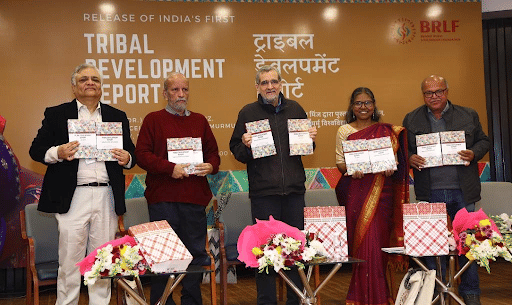
Tribal Development Report 2022
- The Bharat Rural Livelihoods Foundation published the first Tribal Development Report 2022, which was written by prominent academics, thematic experts, and practitioners and published by Routledge and CRC Press.
- The first-of-its-kind Tribal Development Report is published in two volumes. It focuses on the status of tribal communities in India and Central India in terms of livelihoods, agriculture, natural resources, economy, migration, governance, human development, gender, health, education, art, and culture. Central India is home to 80 percent of the country's tribal communities.
- This report combines data from government sources, case studies, archival research, and interviews on critical aspects of tribal lives and livelihoods. The goal is to educate stakeholders, including key policymakers, practitioners, activists, and academics, about the scope of tribal issues.
- The Tribal Development Report focuses on the overarching theme of Livelihoods for tribal communities in central India and provides a status report on the overall macroeconomic situation, agriculture, land, energy, and water use, particularly groundwater management.
Highlights of the Report
- The report focuses on the status of tribal communities across India, with a particular emphasis on central India, in terms of livelihoods, agriculture, natural resources, economy, migration, governance, human development, gender, health, education, art, and culture.
- Central India is home to 80% of India's tribal communities.
Themes of the Tribal Development Report - Volume One
- Provides a broad overview of tribal communities' current macroeconomic situation, with a particular emphasis on the challenges of agriculture, land, energy, and water use, particularly groundwater management.
- Highlights the need for local institutions to lead the transition to a new paradigm of agroecology-based, nature-positive farming and sustainable water use.
- Examine tribal areas' neglect in developing infrastructure in various dimensions, from irrigation to energy.
- Shares insights on the invisibility of tribal voices in policy processes and how political empowerment will enable socioeconomic changes for tribal people at the grassroots level.
- Discusses tribal communities in the informal sector and migration.
Themes of the Tribal Development Report - Volume Two
- Discusses the human development challenges that tribal communities face, with a focus on the state of health, education, and nutrition in tribal regions.
- Explores key issues concerning gender and development in tribal contexts, as well as the impact of the loss of traditional rights to land and forest resources.
- Describes the progress made so far in implementing the Panchayat (Extension to Scheduled Areas) Act (or PESA), 1996, and the Forest Rights Act (FRA).
- Examines the current status of "Denotified Tribes" in India, the state's policy response post-independence, and their place in the current socioeconomic context.
- Provides an overview and policy recommendations for preserving tribal arts, crafts, language and literature, and knowledge systems.
Findings of the Report
- The BRLF was established by the Union Cabinet on September 3, 2013 as an independent society under the Union Ministry of Rural Development to scale up civil society action in collaboration with central and state governments.
- The chief executive member of the Bodoland Territorial Council in Assam, stated that it is critical to understand the unique characteristics of tribal communities in order to develop policies for them.
- Many tribal communities prefer isolation and silence. They are shy and will not reach out to the outside world on their own. Policymakers and leaders in the country must understand this trait and then work for the welfare of Adivasis in order to better connect with them.
- Tribal areas have also seen a lot of disruption and conflict. This is one of the reasons why many government welfare schemes and policies fail to take off in these areas. The area's distress affects both sides.
- According to the report, indigenous communities in India have been pushed further away from alluvial plains and fertile river basins, into the country's harshest ecological regions, such as hills, forests, and drylands.
- Of the 257 Scheduled Tribe districts, 230 (90%) are forested, hilly, or dry. However, they constitute 80% of India's tribal population.
Adivasi Sub-Districts
- Adivasi sub-districts are part of a larger contiguous backward region or Adivasi belt that extends beyond the state, district, and sub-district administrative categories.
- Mapping of predominantly Adivasi-concentrated sub-districts "indicates a continuum of pockets of underdevelopment that are linked to one another and to the larger development processes around them."
- During British colonial rule, the bond between Adivasis and their symbiotic relationship with their immediate environment was severed.
- After the Forest Conservation Act was passed in 1980, the conflict was framed as one between environmental protection and the needs of local Adivasi communities, creating a schism between people and forests.
- Domestic needs of local people were explicitly recognized for the first time in the National Forest Policy of 1988.
- The Policy emphasized the importance of preserving their customary rights and involving Adivasis in forest protection. However, the shift toward a people-centered perspective has not been matched by reality on the ground.
Significance of the report
- The report combines data from government sources, case studies, archival research, and interviews to examine critical aspects of tribal life and livelihoods.
- The goal is to educate stakeholders, such as key policymakers, practitioners, activists, and academics, about the breadth of tribal issues.
- The overall theme of the report is livelihoods for tribal communities in central India. It provides an update on the macroeconomic situation, agriculture, land, energy, and water use, with a focus on groundwater management.
(*Click this link to read prelims specific weekly current affairs articles)
FAQs
Question: Who are Adivasis?
Answer:
The term Adivasi refers to people from the Indian subcontinent, generally tribal people. The term is a Sanskrit term coined in the 1930s by political activists to give tribal people an indigenous identity by claiming indigenous origin.
Question: What is Bharat Rural Livelihood Foundation (BRLF)?
Answer:
The Bharat Rural Livelihoods Foundation (BRLF) was established by the Government of India as an independent society under the Ministry of Rural Development to scale up civil society action in collaboration with the central and state governments.
Question: Who released the Tribal Development Report 2022?
Answer:
The Tribal Development Report 2022, published in two volumes by the Bharat Rural Livelihood Foundation (BRLF), claims to be the first of its kind since 1947.
MCQ
Question: Under the Scheduled Tribes and Other Traditional Forest Dwellers (Recognition of Forest Rights) Act, 2006, who shall be the authority to initiate the process for determining the nature and extent of individual or community forest rights or both? (2013)
(a) State Forest Department
(b) District Collector/Deputy Commissioner
(c) Tahsildar/Block Development Officer/Mandal Revenue Officer
(d) Gram Sabha
Answer: (d) See the Explanation
As the Gram Sabha has the "authority to initiate the process for determining the nature and extent of individual or community forest rights or both," the process must be initiated by the Gram Sabha rather than the Forest Rights Committee.
Therefore, option (d) is the correct answer.
Download the PREPP App and attempt FREE IAS Exam Mock Tests and get complete study material!

Full Test - 04: UPSC CSE Prelims CSAT (Paper-II)
Full Test - 03: UPSC CSE Prelims CSAT (Paper-II)
UPSC CSE Prelims 2026 GS Paper 1 Question Paper (24-May-2026)
UPSC CSE Prelims 2026 CSAT Paper 2 Question Paper (24-May-2026)

17 February 2025 | The Hindu Must Read Articles | Current Affairs

16 February 2026 | The Hindu Must Read Articles | Current Affairs

13 February 2026 | The Hindu Must Read Articles | Current Affairs









Comments