Adaptation Gap Report 2023 - Funding to Developing Nations Declines 15% Despite International Pledges, Rising Costs
Click here for Daily Current Affairs
Why in the news?
- The 2023 Adaptation Gap Report highlights a 15% decline in climate adaptation finance to developing nations, contrary to pledges made at COP26.
- Public multilateral and bilateral sources have reduced funding to around $21 billion in 2021 despite their commitment to double adaptation finance support to $40 billion annually by 2025.
Table of Contents
What is Adaptation Financing?
|
Key Findings of the Report
1) Decline in Funding
- Current Financing State: The report by UNEP shows a significant drop in funding from developed countries.
- Domestic Budgets: Developing nations primarily rely on their own government budgets for climate adaptation, ranging from 0.2% to over 5%.
2) Inadequate Support
- Gap in Financing: Domestic and private funding sources are insufficient to cover the adaptation finance gaps, particularly in the poorest nations.
- Adaptation Efforts: Despite the funding challenges, 85% of countries have national-level adaptation plans in place.
3) Finance Gap and Needs
- Global Adaptation Finance Gap: The current annual gap is between $194-366 billion.
- Developing Countries' Needs: These countries require 10-18 times more than what they receive in international public finance.
- Cost of Adaptation: Annually, developing nations need $215 billion for adaptation measures.
4) Regional Analysis
- Regional Costs: East Asia, the Pacific, Latin America, and the Caribbean face the highest adaptation costs.
- Income and Adaptation Costs: Low-income countries have a higher adaptation cost burden relative to their GDP compared to middle-income countries.
5) Costs for Vulnerable Nations
- Least Developed and Small Island Nations: These countries have an estimated cost of $25 billion and $4.7 billion annually, respectively.
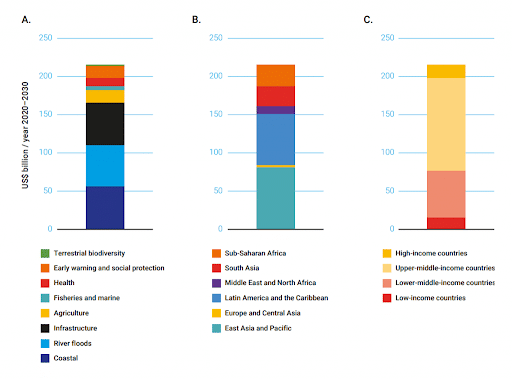
Estimated Cost of Adaptation for Developing Countries by Sector (A), Region (B) and Income Group (C) for 2030
What are the Global Efforts Towards Climate Adaptation Financing?
International Agreements and Commitments
- The Paris Agreement, adopted in 2015, requires all parties to plan and implement adaptation efforts and has called for a balance between adaptation and mitigation financing.
- The Green Climate Fund (GCF), established within the framework of the UNFCCC, is one of the primary mechanisms for transferring money from developed countries to developing nations to assist in adaptation and mitigation practices.
Climate Conferences and Pledges
- Annual UN Climate Change Conferences (COPs) serve as a platform where countries discuss and negotiate commitments, including financing for climate adaptation.
- The pledge made at COP26 in Glasgow to double adaptation finance by 2025 from 2019 levels is an example of the commitments made in these international forums.
Multilateral Development Banks (MDBs)
- Institutions such as the World Bank, African Development Bank, and Asian Development Bank provide funding for climate change adaptation projects through loans, grants, and other financial instruments.
Bilateral Aid
- Developed countries often provide adaptation financing to developing countries through bilateral agreements, either directly or through agencies such as the United States Agency for International Development (USAID) or the UK’s Foreign, Commonwealth & Development Office (FCDO).
Private Sector Involvement
- Increasingly, there is an acknowledgment of the need for private sector investment in adaptation projects. Efforts to engage private investors include green bonds, insurance schemes, and public-private partnerships.
National Adaptation Plans and Strategies
- Developing countries are encouraged to formulate and implement National Adaptation Plans (NAPs) that articulate their priority adaptation needs.
Technology Transfer
- Technology Mechanism under the UNFCCC aims to facilitate the transfer of technology and know-how to developing countries to help them adapt to climate change.
Capacity-Building and Knowledge Sharing
- Various international organizations and networks focus on building the capacities of developing nations to plan for and respond to climate impacts.
- Initiatives include knowledge exchange programs, workshops, and training sessions.
Innovative Financing Mechanisms
- Efforts are being made to develop new financial instruments and mechanisms that can help leverage additional funds for adaptation, such as climate risk insurance, catastrophe bonds, and resilience bonds.
Civil Society and NGO Engagement
- NGOs and civil society organizations play a critical role in advocacy, project implementation, and monitoring the effective use of adaptation finance.
Benefits of Adaptation Financing
- Reducing Vulnerability: Adaptation financing helps communities, sectors, and countries become more resilient to the impacts of climate change by reducing their vulnerability to extreme weather events, sea-level rise, and other climate-related risks.
- Cost-Effectiveness: Investing in adaptation measures can be significantly more cost-effective in the long term than bearing the full costs of climate impacts. For instance, building flood defenses is far less expensive than the economic losses that would result from unmitigated flood damage.
- Sustainable Development: Effective adaptation contributes to sustainable development by ensuring that climate risks are accounted for in the planning and execution of development projects.
- Food Security: Adaptation financing in agriculture can help ensure food security by developing more resilient agricultural practices and crop varieties that can withstand changing climate conditions.
- Protecting Biodiversity: Financing adaptation actions can help protect ecosystems and biodiversity that are threatened by climate change, maintaining the services they provide to humanity.
- Health Benefits: Climate adaptation measures in public health can reduce the burden of climate-sensitive diseases and health conditions, and protect communities from the health impacts of extreme weather events.
- Economic Stability: By reducing the impacts of climate change, adaptation finance can contribute to economic stability in vulnerable regions, helping to prevent loss of livelihoods and displacement.
- Infrastructure Resilience: Building resilient infrastructure with adaptation finance can ensure that roads, buildings, and other critical infrastructure can withstand the impacts of climate change.
- Global Collaboration: Adaptation finance fosters international cooperation, as it often involves partnerships between developed and developing nations, international organizations, and the global community.
Challenges in Adaptation Financing
- Insufficient Funds: The amount that is currently being allocated for climate adaptation is far below what is needed, especially in the most vulnerable countries.
- Unfulfilled Pledges: Developed countries have frequently failed to meet their funding pledges, which leads to unpredictability and insufficient financial flows for adaptation initiatives.
- Imbalance Between Adaptation and Mitigation Financing: There is a significant imbalance in favor of mitigation over adaptation in the allocation of climate finance, despite the increasing importance of adaptation for many vulnerable regions.
- Complex Access Procedures: Accessing adaptation funds can be complicated and bureaucratic, making it difficult, especially for the poorest and most vulnerable nations, to obtain the necessary finance.
- Lack of Private Sector Engagement: There is a challenge in attracting private investment in adaptation projects, which are often seen as less profitable than mitigation projects like renewable energy.
- Limited Capacity to Plan and Implement: Developing countries may lack the institutional and technical capacities required to effectively plan, apply for, and implement adaptation projects.
- Transparency and Accountability: There are concerns about the transparency and accountability of how adaptation finance is used, which can lead to inefficiencies and corruption.
- Climate and Economic Shocks: Global economic downturns, pandemics, or large-scale climate disasters can suddenly redirect attention and resources away from long-term adaptation needs.
- Measuring Adaptation Outcomes: It is challenging to measure the effectiveness of adaptation interventions, which makes it difficult to assess and justify the allocation of funds.
- Integrating Adaptation into Development: There is a need for better integration of adaptation into broader development strategies and financial planning, which has been difficult to achieve.
Conclusion
The widening adaptation finance gap indicates years of neglect, with affluent nations compounding the issue with continued fossil fuel investments. Urgent need for policymakers to consider the Adaptation Gap Report seriously and increase finance to protect low-income countries from the detrimental effects of climate change.
(*Click this link to read prelims specific weekly current affairs articles)
FAQs
Question: What is adaptation financing?
Answer:
Adaptation financing refers to the flow of funds to developing countries to help them adapt to the adverse effects of climate change. It is a key element of the broader climate finance landscape, which includes investments in both mitigation (to reduce greenhouse gas emissions and halt global warming) and adaptation (to deal with the impacts of climate change that are already happening or are expected to occur).
Question: What is the key finding of 2023 Adaptation Gap Report?
Answer:
The 2023 Adaptation Gap Report highlights a 15% decline in climate adaptation finance to developing nations, contrary to pledges made at COP26. Public multilateral and bilateral sources have reduced funding to around $21 billion in 2021 despite their commitment to double adaptation finance support to $40 billion annually by 2025.
Question: Who publishes the Adaptation Gap Report?
Answer:
The Adaptation Gap Report is published by the United Nations Environment Programme (UNEP).
UPSC Mains Practice Question:
|
MCQs
Question: Consider the following statements: (UPSC 2023)
Statement-I: Carbon markets are likely to be one of the most widespread tools in the fight against climate change.
Statement-II: Carbon markets transfer resources from the private sector to the State.
Which one of the following is correct in respect of the above statements?
(a) Both Statement-I and Statement-II are correct and Statement-II is the correct explanation for Statement-I
{b) Both Statement-I and Statement-II are correct and Statement-II is not the correct explanation for Statement-I
(c) Statement-I is correct but Statement-II is incorrect
(d) Statement-I is incorrect but Statement-II is correct
Answer: (c) See the Explanation
Carbon markets are widely regarded as one of the most effective strategies in the battle against climate change. Hence, statement 1 is correct.
Carbon markets operate on the carbon pricing principle, which seeks to assign a monetary value to carbon dioxide (CO2) emissions. The main concept is to establish a market for trading carbon credits or permits in which corporations or institutions that emit greenhouse gases can purchase or sell these permits.
Carbon markets seek to create economic incentives for decreasing greenhouse gas emissions. Companies that can reduce their emissions more efficiently and cheaply can sell their excess permits to companies who find it more costly to reduce emissions. This provides enterprises with a financial incentive to embrace greener technology, enhance energy efficiency, and minimize their carbon footprint.
Carbon markets offer a flexible and market-driven strategy to reduce emissions. They support the adoption of cleaner technology, promote investments in renewable energy, and incentivize emission reduction initiatives across all sectors of the economy by putting a price on carbon.
It is not correct to suggest that carbon markets move resources from the private to the public sector. Carbon markets, in fact, work on the idea of establishing a market-based mechanism through which the private sector can participate in emissions trading and accept responsibility for their carbon emissions. Hence, statement 2 is incorrect.
Therefore, option (c) is the correct answer.
Question: “Climate Action Tracker” which monitors the emission reduction pledges of different countries is a: (UPSC 2022)
(a) Database created by coalition of research organisations
(b) Wing of “International Panel of Climate Change”
(c) Committee under “United Nations Framework Convention on Climate Change”
(d) Agency promoted and financed by United Nations Environment Programme and World Bank
Answer: (a) See the Explanation
The Climate Action Tracker (CAT) is an impartial scientific analysis that follows government climate action and compares it to the Paris Agreement's goal of "holding warming well below 2°C and pursuing efforts to limit warming to 1.5°C." Since 2009, the CAT, a collaboration of two organizations, Climate Analytics and NewClimate Institute, has provided this impartial study to policymakers. The Climate Action Tracker (CAT) initiative aims to give policymakers, civil society, and the media an up-to-date assessment of countries' specific reduction targets as well as an overview of their combined global effects.
Therefore, option (a) is the correct answer.
Question: The ‘Common Carbon Metric’, supported by UNEP, has been developed for: (UPSC 2021)
(a) assessing the carbon footprint of building operations around the world
(b) enabling commercial farming entities around the world to enter carbon emission trading
(c) enabling governments to assess the overall carbon footprint caused by their countries
(d) assessing the overall carbon foot-print caused by the use of fossil fuels by the world in a unit time
Answer: (a) See the Explanation
The Common Carbon Metric is a computation that is used to describe the measurement, reporting, and verification of GHG emissions linked with the operation of specific building types in specific climate areas. It lays the groundwork for realistic performance baselines, national targets, and carbon trading on a fair playing field.
The goal of a Common Carbon Metric for Buildings is to provide information to a sector that accounts for 40% of worldwide energy consumption and a third of global greenhouse gas (GHG) emissions.
Therefore, option (a) is the correct answer.
Question: “Momentum for Change: Climate Neutral Now” is an initiative launched by: (UPSC 2018)
(a) The Intergovernmental Panel on Climate Change
(b) The UNEP Secretariat
(c) The UNFCCC Secretariat
(d) The World Meteorological Organisation
Answer: (c) See the Explanation
In 2015, the UNFCCC secretariat established the Climate Neutral Now project. It is a campaign that encourages individuals, businesses, and governments to assess their carbon footprint and cut their greenhouse gas emissions as much as feasible.
As part of a bigger effort to highlight successful climate action around the world, the secretariat introduced a new pillar within its Momentum for Change campaign centered on Climate Neutral Now in 2016.
Climate neutrality is a three-step procedure that requires individuals, businesses, and governments to: measure their carbon footprint; decrease emissions as much as possible; and offset what they can't lower with UN-certified emission reductions.
Therefore, option (c) is the correct answer.
Question: The term ‘Intended Nationally Determined Contributions’ is sometimes seen in the news in the context of: (UPSC 2016)
(a) pledges made by the European countries to rehabilitate refugees from the war-affected Middle East
(b) plan of action outlined by the countries of the world to combat climate change
(c) capital contributed by the member countries in the establishment of Asian Infrastructure Investment Bank
(d) plan of action outlined by the countries of the world regarding Sustainable Development Goals
Answer: (b) See the Explanation
Intended Nationally Determined Contributions (INDCs) represent each country's efforts to reduce national emissions and adapt to climate change impacts. The United Nations Framework Convention on Climate Change (UNFCCC) uses the phrase "intended nationally determined contributions" (INDCs).
INDCs are parties' post-2020 climate action commitments to strengthen their ability to adapt to the adverse effects of climate change, develop climate resilience, and reduce greenhouse gas emissions.
Therefore, option (b) is the correct answer.
Download the PREPP App and attempt FREE IAS Exam Mock Tests and get complete study material!

Full Test - 04: UPSC CSE Prelims CSAT (Paper-II)
Full Test - 03: UPSC CSE Prelims CSAT (Paper-II)
UPSC CSE Prelims 2026 GS Paper 1 Question Paper (24-May-2026)
UPSC CSE Prelims 2026 CSAT Paper 2 Question Paper (24-May-2026)

17 February 2025 | The Hindu Must Read Articles | Current Affairs

16 February 2026 | The Hindu Must Read Articles | Current Affairs

13 February 2026 | The Hindu Must Read Articles | Current Affairs









Comments