Acts for Prevention of Crime Against Women - Social Justice Notes
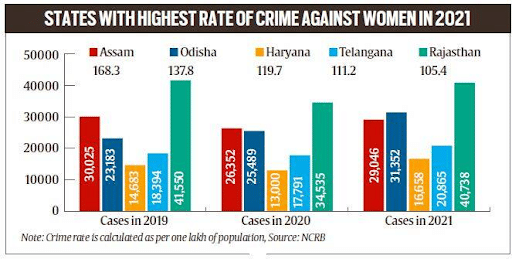
Crimes against women is a global phenomenon & it is a need of an hour to take steps & protect women against crimes. According to NCRB data, crime against women increased by 15.3 percent in 2021 compared to the previous year, with 4,28,278 instances reported last year, up from 3,71,503 in 2020.
In India, there are a number of Acts and Laws, to prevent Crimes against women. Also there are several international instruments in place to combat violence against women. The United Nations General Assembly resolution affirmed the urgent need for women's rights to equality, security, liberty, integrity, and dignity to be universally applied. But in the present scenario, violence and crimes against women can be witnessed increasing in many ways around the world.
This article explains the Acts for Prevention of Crime Against Women is important for UPSC IAS exam preparation.
|
Table of Contents |
Acts for Prevention of Crime Against Women
- The government places the highest focus on the safety, security, and general development of every person.
- An essential governmental policy is to safeguard women and children and to stop the increase in crimes against them.
- Along with the Indian Penal Code and Criminal Procedure Code, which are India's universal criminal laws, the Ministry of Women and Child Development has been in charge of administering a number of particular legislation pertaining to women.
- The regulations for criminal penalties are outlined in the Indian Penal Code of 1860 (Section376 - Rape, Section376A - Death due to rape, Section304B - Dowry death, Section509 - Act to Insult the modesty of women. etc are some provisions).
- The Criminal Procedure Code of 1973, however, governs the trial proceedings.
- Various Acts/laws exist to protect women against crime, including the following:
|
|
|
|---|---|
| Constitutional provisions for Women in India | Institutions and Bodies related to Women |
| Issues faced by Scheduled Castes | Laws Related To Scheduled Caste |
| Institutions and Bodies related to Scheduled Castes | Schemes for Minorities |
| Institutions and Bodies for Scheduled Tribes | Challenges faced by Scheduled Tribes |
| Laws Related to Differently abled | Institutions and bodies for Protection of children |
| Schemes For Migrant Workers | Laws Related To LGBTQ Community |
| Acts/laws | Description |
|---|---|
| The Immoral Traffic (Prevention) Act, 1956 |
|
| Dowry Prohibition Act, 1961 |
|
| Medical Termination of Pregnancy Act, 1971 |
|
| Indecent Representation of Women (Prohibition) Act, 1986 |
|
| The Commission of Sati (Prevention) Act, 1987 |
|
| National Commission of Women Act 1990 |
|
| Protection of Women from Domestic Violence Act, 2005 |
|
| Prohibition of Child Marriage Act, 2006 |
|
| Indecent Representation of Women (Prohibition) bill, 2012 |
|
| Protection of Women from Sexual Harassment (POSH) Act, 2013. |
|
| Criminal Law (Amendment) Act, 2013 |
|
Women and Cyber crimes
- Cybercrime refers to crimes committed online in which the offender stays anonymous behind a computer screen and is not necessary to make eye contact with the victim.
- Cybercrime is regulated by the Indian Penal Code of 1860 and the Information Technology Act of 2000 in India (which was amended in 2008 and outlined the definition and punishment of cybercrime).
- Cyber blackmail, threats, cyberpornography, uploading and publishing obscene sexual content, stalking, bullying, defamation, morphing, and the creation of phoney profiles are the most typical cybercrimes conducted against women.
- According to the National Crime Record Bureau, A total of 52,974 cases were registered under Cyber Crimes, representing a 5.9% rise in registration over 2020 (50,035 cases in 2020), while the number of cybercrime occurrences in 2021 has increased by 18.4% when compared to 2019 statistics.
Information Technology Act of 2008 - Provisions to Prevent the Crimes Against Women
- Section 66E: It addresses a person's privacy violation. Capturing, publishing, or sending a photograph of a person's private region without her agreement under circumstances that violate her privacy is punishable by imprisonment for up to three years and/or a fine.
- Section 67: Publishing, transfer, and cause of the transmission of obscene content are prohibited, and they are punishable by imprisonment for up to three years and a fine for a first offence, and by five years and a fine for a second offence. The definition of obscenity in Section 292 of the IPC has been followed, hence the standard for obscenity must also follow that rule.
- Section 67A: It makes the publishing, transfer, or inducing the transmission of sexually explicit material criminal by imprisonment for up to five years and a fine for the first offence, and seven years and a fine for the second offence.
- Section 67B: The publication or transmission of sexually explicit content portraying children is criminal under Section 67B.
Other Steps to Reduce the Crime Against Women
- Gender-based crimes necessitate a whole different strategy in terms of how they are seen, analysed, and comprehended.
- The offences enumerated in legislation and the penal code, as well as those that demand further consideration, cannot be handled by focusing solely on punitive and security measures.
- Improvements in educational quality and career possibilities for youngsters.
- Parents and instructors must educate their children about the sensitivity and bounds of man-woman interactions.
- A code of behaviour for interacting with people of the opposite sex should be defined and implemented in the workplace, school, and home.
- Control over the media: Sexual content should be restricted. Good concepts that condemn violence and glorify victim healing should be portrayed. Pornography should be completely prohibited. The websites might be restricted.
- Law enforcement apparatus that is efficient and responsible at all levels (administration, government, police, and court) is required.
- Community Initiative: Community initiatives aimed at reducing violence against women are the most effective strategy to combat domestic abuse and other crimes against women.
- The Nari Adalat programme, implemented by the Uttar Pradesh Department of Education, has proven to be effective in decreasing domestic violence against women.
- Safe Transportation: Many instances of sexual assault against women are performed in trains or buses, especially late at night. Offenders take advantage of the isolated car and the lack of police officers. During late-night hours, at least one female police officer should be deployed aboard buses or rail coaches.
- Increase police activity: Police presence should be reinforced in all locations, particularly in isolated places at night.
- The presence of police minimises the likelihood of a woman being attacked or harassed by others on the road. Police personnel must be stationed in congested areas such as marketplaces, where women are more vulnerable to offences such as eve teasing and groping.
Crimes Against Women in India - Causes
|
Suggestions for Improving Law Implementation and Women's Rights
- Fast Track Courts - Every case involving women should be heard in a fast track court. Cases involving violence against women should be prioritised. There should be an increase in the number of fast track courts.
- Strict Punishment - The fear of punishment deters lawbreakers from breaking the law. Every perpetrator should face severe punishment. Most offences should be classified as non-bailable.
- Increase Case Reporting and Women's Awareness - Women should be informed of their rights. State governments should take the initiative to educate women about the legislation. Women's empowerment is also essential.
- Effective Planning - Law enforcement authorities should develop proper plans to aid in the reduction of violence against women. They should establish strategies for women's empowerment.
- Police Department - The police department plays a vital role in the enforcement of laws. They should be more accommodating to victims. Women should be encouraged to report crimes by police.
Conclusion
Violence against women in India is increasing with the pace of the modern era. Every single woman faces such horrible crimes every day in her neighbourhood, public transportation, public areas, employment, and so on. But now is the time to break the silence and give them the respect they deserve, as well as a discrimination-free atmosphere devoid of abuse and torture. New acts and proper implementation of existing acts need to be done in order to make women secure.
|
|
|
|---|---|
| Vulnerable Sections of Population | Other Backward Classes |
| LGBTQ Community | Critical Analysis on Child Rights in India |
| Scheduled Castes | Important Court Judgements related to LGBTQ Community |
| Constitutional Provisions for Scheduled Caste | Laws Related To Migrant Workers |
| Issues Relating to Development & Management of Social Sector/Services | Issues Relating to Poverty & Hunger |
FAQs
Question: What are the key laws for the prevention of crimes against women in India?
Answer: India has several significant laws aimed at preventing crimes against women, including:
- The Protection of Women from Domestic Violence Act, 2005: Protects women from domestic violence, including physical, emotional, and financial abuse.
- The Sexual Harassment of Women at Workplace (Prevention, Prohibition and Redressal) Act, 2013: Ensures protection from workplace harassment.
- The Criminal Law (Amendment) Act, 2013: Introduced stringent punishments for sexual offenses like rape and acid attacks.
- The Dowry Prohibition Act, 1961: Prohibits the giving or receiving of dowry.
- The Indian Penal Code (IPC): Covers crimes like rape, kidnapping, and acid attacks with clear punitive measures.
Question: How does the Protection of Women from Domestic Violence Act, 2005, work?
Answer: This act provides legal recourse for women facing domestic violence. Key provisions include:
- Right to reside in the shared household.
- Protection orders to prevent further violence.
- Compensation orders for harm caused by the abuser.
- Relief extended to children and dependents affected by domestic violence.
Question: What is the significance of the Criminal Law (Amendment) Act, 2013?
Answer: This act reformed sexual offense laws in India. Key highlights:
- Enhanced punishments for rape, including life imprisonment or death.
- Expanded the definition of sexual offenses, including stalking and voyeurism.
- Introduced stringent punishment for acid attacks.
- Mandated victim compensation to aid recovery.
Question: How does the Sexual Harassment of Women at Workplace Act, 2013 protect women?
Answer:
- Requires employers to ensure a harassment-free workplace.
- Mandates the creation of an Internal Complaints Committee (ICC).
- Provides a clear redressal mechanism for complaints.
- Emphasizes regular training and awareness programs to prevent harassment.
Question: What role does the Dowry Prohibition Act, 1961 play in preventing crimes against women?
Answer:
- Prohibits the giving or receiving of dowry in any form.
- Makes dowry-related offenses cognizable, enabling police to act without a warrant.
- Imposes fines and imprisonment for dowry offenses.
MCQs
- Which act protects women from domestic violence in India?
A) The Protection of Women from Domestic Violence Act, 2005
B) The Criminal Law (Amendment) Act, 2013
C) The Dowry Prohibition Act, 1961
D) The Sexual Harassment of Women at Workplace Act, 2013
Answer: (A) See the Explanation
The Protection of Women from Domestic Violence Act, 2005 is designed to safeguard women from domestic abuse of all forms.
- What is the key provision of the Criminal Law (Amendment) Act, 2013?
A) Dowry prohibition
B) Increased punishment for sexual offenses
C) Protection from workplace harassment
D) Legal framework for divorce
Answer: (B) See the Explanation
This act significantly enhanced punishments for sexual offenses, addressing rape, acid attacks, and harassment.
- Which of the following is prohibited under the Dowry Prohibition Act, 1961?
A) Sexual harassment at the workplace
B) Domestic violence
C) Dowry demand and its receipt
D) Rape
Answer: (C) See the Explanation
The act specifically prohibits dowry demand and transactions, aiming to curb dowry-related crimes.
- What does the Sexual Harassment of Women at Workplace Act, 2013 mandate employers to do?
A) Set up a Women's Welfare Fund
B) Provide women with legal support during a court case
C) Create an Internal Complaints Committee (ICC)
D) Establish shelters for women
Answer: (C) See the Explanation
The act requires employers to establish an ICC to address and resolve sexual harassment complaints.
- Under which act can a woman seek legal protection from domestic violence?
A) The Protection of Women from Domestic Violence Act, 2005
B) The Dowry Prohibition Act, 1961
C) The Sexual Harassment of Women at Workplace Act, 2013
D) The Criminal Law (Amendment) Act, 2013
Answer: (A) See the Explanation
The Protection of Women from Domestic Violence Act, 2005 provides legal recourse and protection for victims of domestic abuse.
GS Mains Questions and Model Answer
Q1: Discuss the significance of the Protection of Women from Domestic Violence Act, 2005, in ensuring women's safety in India.
Answer: The act provides legal protection against physical, emotional, and economic abuse, ensuring women can seek safety and justice. Provisions such as the right to residence, protection orders, and compensation ensure comprehensive support for victims. The act also empowers women and creates awareness about their rights, playing a crucial role in addressing domestic violence and promoting gender equality.
Q2: Evaluate the effectiveness of the Criminal Law (Amendment) Act, 2013, in addressing crimes against women.
Answer: The act strengthened the legal framework by introducing harsher punishments, expanding the definition of sexual offenses, and ensuring victim compensation. However, challenges such as implementation gaps, slow legal processes, and societal attitudes persist. Overall, it marks significant progress but requires continuous efforts for effective enforcement.
Q3: How do the Dowry Prohibition Act, 1961, and related laws contribute to social justice for women in India?
Answer: These laws address dowry-related violence and exploitation, empowering women in marital relationships. By prohibiting dowry practices and penalizing offenders, they promote gender equality and protect women's rights. However, enforcement challenges necessitate societal awareness and proactive legal mechanisms to achieve the intended goals.
Previous Year Questions on Acts for Prevention of Crime Against Women
1. UPSC CSE 2021
Question: Explain the significance of the Dowry Prohibition Act, 1961, in promoting gender equality in India.
Answer: This question emphasizes the act's role in curbing dowry practices, reducing exploitation in marriages, and advancing women's rights.
2. UPSC CSE 2020
Question: Discuss the legal provisions and their effectiveness in addressing sexual harassment at the workplace under Indian laws.
Answer: This question focuses on the Sexual Harassment of Women at Workplace Act, 2013, its implementation, and its role in creating safer work environments for women.
Download the PREPP App and attempt FREE IAS Exam Mock Tests and get complete study material!

Live Test : UPSC CSE Prelims CSAT (Paper-II) (Oct 20 - 23)
Full Test - 04: UPSC CSE Prelims CSAT (Paper-II)
Full Test - 03: UPSC CSE Prelims CSAT (Paper-II)
UPSC CSE Prelims 2026 GS Paper 1 Question Paper (24-May-2026)
UPSC CSE Prelims 2026 CSAT Paper 2 Question Paper (24-May-2026)

17 February 2025 | The Hindu Must Read Articles | Current Affairs

16 February 2026 | The Hindu Must Read Articles | Current Affairs

13 February 2026 | The Hindu Must Read Articles | Current Affairs









Comments