‘80% Funds Allocated For Semiconductor Manufacturing Scheme Remain Unused’
Relevance: GS3 - Indigenization of technology and developing new technology. GS2 - Government policies and interventions for development in various sectors and issues arising out of their design and implementation, Bilateral, regional and global groupings and agreements involving India and/or affecting India’s interests.
(Source: The Hindu, 11/08/2023)
Click here for Daily Current Affairs
Why in the news?
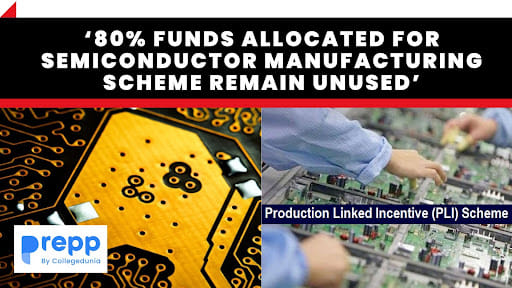
- Recently, a top official from the Industry Ministry claimed that $8 billion of the $10 billion allocated for the production of semiconductors under the production-linked incentive (PLI) scheme was unused.
- This article also discusses South Korea’s potential for involvement in semiconductor manufacturing in India.
Table of Contents
- What is the status of the PLI scheme for semiconductors?
- Why is domestic manufacturing of semiconductor important?
- How can South Korea participate in the semiconductor manufacturing industry in India?
- India’s economic ties with South Korea
- What are the challenges faced by the semiconductor industry in India?
- FAQs
- MCQs
What is the status of the PLI scheme for semiconductors?
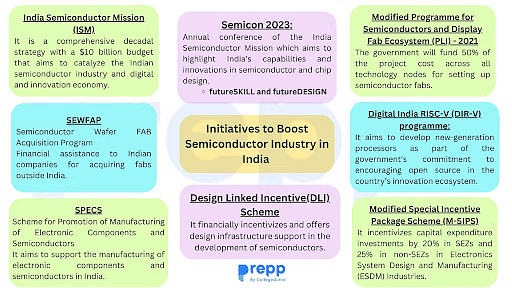
- The Modified Programme for Semiconductors and Display Fab Ecosystem was announced in December 2021 with a total outlay of ₹76,000 crore.
- The scheme was updated in September 2022, as a result of which the government funds 50% of the project cost across all technology nodes for setting up of semiconductor fabs.
- India is offering incentives of more than $10 billion to encourage semiconductor manufacturing in India.
- However, $8 billion of the total $10 billion earmarked for the Production Linked Scheme (PLI) for semiconductors was unused so far.
Why is domestic manufacturing of semiconductor important?
- Universal use: Semiconductors are used in almost all electronic hardware in use today. Therefore, domestic manufacturing will help insulate the supply chain and reduce dependence on imports.
- Import dependence: India is heavily dependent on imports to meet its domestic requirements.
- As a result, the country is vulnerable to coercions and supply chain disruptions.
- Geopolitical tensions: The Russia-Ukraine conflict has disrupted the global supply chain as Ukraine is a key supplier of neon which is used in semiconductor manufacturing.
- Similarly, the EU and the USA refused to sell advanced equipment to China which resulted in China imposing export controls on gallium and germanium which are inputs in semiconductor manufacturing.
- China: China is one of the leading manufacturer of semiconductors across the world.
- However, China has tense ties with India due to the border clashes.
- Security risk: Externally manufactured semiconductor chips can pose a potential security risk due to their embedded instructions which may contain hard-to-identify malware.
- This is a major risk for national security due to the use of semiconductors in sectors like telecommunication and defense equipment.
How can South Korea participate in the semiconductor manufacturing industry in India?
- The Secretary for the Department for Promotion of Industry and Internal Trade recommended that Korean investors invest in the manufacture of semiconductors under the PLI scheme.
- Since April 2000, Korean investors have invested around $5.6 billion in India.
- He highlighted the upcoming bid for over 20 gigawatt hours of storage and mobility battery capacity in India.
- Korean enterprises which are leaders in sectors such as microprocessors, consumer electronics, automobiles, etc.
- South Korea’s investment in the scheme would contribute to improving economic ties between the two countries.
- This would assist in upgrading and enhancing the Comprehensive Economic Partnership Agreement between India and South Korea.
India’s economic ties with South Korea
- The trade relationship between India and the Republic of South Kore reached $27.8 billion in 2022.
- The countries have set a target of enhancing bilateral trade to $50 bn by 2030.
- South Korea is the 13th largest FDI investor in India between April 2000 and September 2022.
- Major sectors of investment are: metallurgy, automobile, electronics, prime movers, machine tools, hospitals and diagnostic centres
- In 2009, a Comprehensive Econmic Partnership Agreement was signed by the two countries.
- It was equivalent to a Free Trade Agreement and will enhance access for the Indian service industry in South Korea, reduce restrictions on FDI, and boost trade.
- India’s exports to Korea: Mineral fuels/oil distillates (mainly naphtha), cereals, iron, and steel.
- India’s imports from Korea: Automobile parts, telecommunication equipment, hot rolled iron products, petroleum refined products, base lubricating oils, nuclear reactors, mechanical appliances, electrical machinery & parts, and iron and steel products.
- India and South Korea launched the ‘Korea Plus’ initiative in 2016 to promote and facilitate Korean Investments in India.
- This has enabled major Korean conglomerates like Samsung, Hyundai, and LG to make significant investments in India.
- India, and South Korea have also committed to collaborating on building resilient and robust global supply chains in the aftermath of the COVID-19 pandemic and the over-reliance on China.
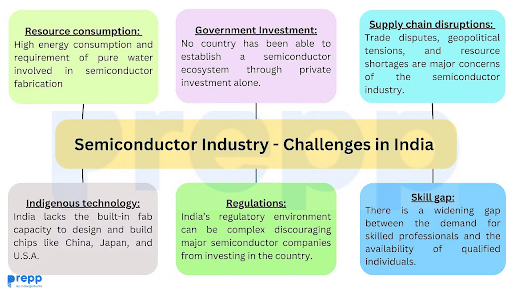
What are the challenges faced by the semiconductor industry in India?
(*Click this link to read prelims specific weekly current affairs articles)
FAQs
Question: What is the Production Linked Incentive scheme?
Answer:
The Production Linked Incentive (PLI) scheme is a performance-linked incentive to incentivize companies to make incremental sales from products manufactured in domestic units. This will boost the manufacturing sector and reduce imports while boosting exports in India.
Question: What are semiconductors?
Answer:
A semiconductor consists of transistors made from selected materials like silicon, gallium, arsenide, etc. They display conductivity between that of conductors and insulators, which increases with increase in temperature.
MCQs
Question: Consider the following statements:
- India is self-sufficient in semiconductor production and is the leading exporter of semiconductor devices.
- The India Semiconductor Mission is a decadal strategy to develop the Indian semiconductor industry.
- At present, incentives for semiconductor fabs are based on the size of the node.
How many of the above statements is/are correct?
(a) Only 1 statement
(b) Only 2 statements
(c) All 3 statements
(d) None
Answer: (a) See the Explanation
- India is at present not self-sufficient in semiconductor production and is reliant on countries like Japan, Taiwan, and China for its semiconductors. Hence statement 1 is incorrect.
- The India Semiconductor Mission is a decadal strategy to encourage semiconductor and screen manufacturing unit production in the country. Hence statement 2 is correct.
- In 2022, the PLI scheme was amended to allow for a uniform fiscal support of 50% of project cost for semiconductor fabs across technology nodes and display manufacturing.
- Earlier incentives for semiconductor fabs are based on the size of the node with only nodes from 28 nm and below offered 50% fiscal support. Hence statement 3 is incorrect.
Therefore, option (a) is the correct answer.
Download the PREPP App and attempt FREE IAS Exam Mock Tests and get complete study material!

Full Test - 04: UPSC CSE Prelims CSAT (Paper-II)
Full Test - 03: UPSC CSE Prelims CSAT (Paper-II)
UPSC CSE Prelims 2026 GS Paper 1 Question Paper (24-May-2026)
UPSC CSE Prelims 2026 CSAT Paper 2 Question Paper (24-May-2026)

17 February 2025 | The Hindu Must Read Articles | Current Affairs

16 February 2026 | The Hindu Must Read Articles | Current Affairs

13 February 2026 | The Hindu Must Read Articles | Current Affairs









Comments