
Which type of charge carriers mainly control current in a Field Effect Transistor (FET)?
Majority carriers only
To determine the type of charge carriers that mainly control current in a Field Effect Transistor (FET), we need to understand how a FET operates.
A Field Effect Transistor is a type of transistor that regulates the flow of electrons (or holes) in a semiconductor channel using an electric field. There are two main types of FETs:
- Junction FET (JFET)
- Metal-Oxide-Semiconductor FET (MOSFET)
In both JFETs and MOSFETs, the operation is primarily carried out by the majority charge carriers:
- N-channel FET: Here, electrons are the majority carriers.
- P-channel FET: Here, holes are the majority carriers.
The FET operates by controlling the width of the channel through which the majority carriers flow, thereby controlling the current. This is achieved by applying a voltage to the gate, which modulates the conductivity of the channel.
Now, let's analyze the provided options to determine the correct one:
- Electrons and holes together: This is not correct because FET operation is primarily controlled by one type of charge carrier, either electrons or holes, but not both simultaneously.
- Minority carriers only: This is incorrect as FETs predominantly rely on majority carriers to conduct current.
- Both minority and majority carriers: This is incorrect as FET operation does not involve both types at the same time.
- Majority carriers only: This is the correct answer because FET operation hinges on the flow of majority carriers within the channel.
Therefore, the correct answer is Majority carriers only.
Similar Questions
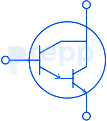
Identify the component shown in the image below:
The emitter current of a transistor is 1 mA. If 1% of the emitted current carriers are lost in the base recombination, what is the value β? Identify from the given options.
Heat sink of a power transistor can be used for:
In case of an AC input signal in CE Transistor Load line can be given by a plot of
How does the construction of a MOSFET help to achieve high input impedance?
While diagnosing an NPN BJT in a SOT-23 package, your multimeter positive probe (+) is locked on the Base (Pin 1). Measuring to Pin 3 reads 0.6 V, while measuring to Pin 2 reads 0.68 V. Which pin is the Emitter?
What is the purpose of the base region in an NPN transistor?
Why are transistors preferred over mechanical switches for rapid switching operations?
In the output characteristics of a common-emitter configuration, a family of curves is obtained by varying VCE while keeping which quantity fixed? (Symbols have their usual meaning.)
The common-emitter (CE) configuration of a transistor is most widely used as a/an:
Important Questions from Transistors
A transistor has ______ PN junctions
Which of the following is not true for a BJT?
A transistor amplifier with proper biasing has the following measured parameters:
Input resistance = 1 kΩ, Output resistance = 10 kΩ, Current gain = 90.
Identity the biasing configuration.
The change of output wave shape from the input wave shape of an amplifier is known as
Identify the component shown in the image below:



