
Which step is essential before using an inch tap to obtain the correct internal thread size?
Drill a hole of correct size for the tap
A tap does not create a hole; it only cuts a thread into the wall of a hole that already exists. So the internal thread size is decided before the tap ever turns.
For the finished thread to have the correct size and full-depth crests, the starting hole must equal the tapping-drill (tap-drill) diameter, which is close to the thread's root diameter.
That leaves exactly the right amount of metal for the tap to cut away into threads; drilling this correct-size hole first is the essential preparatory step.
If the hole is too large the threads come out shallow and weak, and if too small the tap binds or breaks, so the hole diameter directly fixes the thread size.
Marking the centre with a prick punch only positions the hole, lubricant merely eases cutting, and a die produces external threads, so none of these sets the internal thread size.
Getting the correct tapping-size hole is what guarantees the right internal thread.
Hence, the answer is Drill a hole of correct size for the tap.
Similar Questions
When cutting an ISO Metric thread for a coarse pitch, by how many degrees should the compound rest be swiveled to?
Taps are re-sharpened by grinding:
The type of thread used in lead screw of a lathe is ______
The surface connecting crest and root of a thread is termed as
Angle of Knuckle thread is ______
Which one of the following is used to rectify damaged or rusted threads?
The resistance of fine thread unscrewing is ______
Lead is equal to double the pitch value then this type of thread is called as _____.
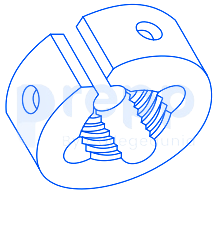
Identify the type of Die in the above Fig.
- The distance from a point on a thread to the corresponding point on the next thread of a screw is called ______.
Important Questions from Screw Threads
When cutting an ISO Metric thread for a coarse pitch, by how many degrees should the compound rest be swiveled to?
What is the blank size (diameter) for preparing a bolt of M12 × 1.5?
What is the relation between the lead (L) and pitch (P) of a two-start thread screw?
Taps are re-sharpened by grinding:
The form of thread in a saw tooth thread is



