
Taps are re-sharpened by grinding:
Understanding Tap Re-sharpening
Taps are essential tools used in machining to cut internal threads in a workpiece. Over time and use, the cutting edges of a tap become dull. A dull tap requires more force to cut, produces poor quality threads, and can even break. To restore the tap's cutting ability and extend its lifespan, it needs to be re-sharpened.
The Critical Part for Re-sharpening Taps
The process of re-sharpening taps involves grinding specific areas to create new sharp cutting edges. The question asks which part is ground for re-sharpening. Let's look at the options:
- Diameter: Grinding the major or minor diameter would change the size of the thread the tap produces, not primarily sharpen the cutting edges.
- Threads: The threads are the form that cuts the helical groove. While the leading edge of the threads forms the cutting edge, simply grinding the entire thread form isn't the standard method for re-sharpening the primary cutting action.
- Flutes: The flutes are the grooves that run along the tap. They form the cutting edges where the flutes intersect the thread form. Grinding the face of the flutes at the cutting edge is the standard and effective way to re-sharpen the tap. Flutes also provide channels for chips to escape and for lubricant or coolant to reach the cutting zone.
- Relief: Relief refers to the clearance angle provided behind the cutting edge to reduce friction. While relief is crucial for cutting performance, grinding the relief area alone does not create a new sharp cutting edge on the face of the flute.
Therefore, grinding the flutes is the correct method for re-sharpening taps.
Why Grinding Flutes Works for Tap Sharpening
The cutting action of a tap primarily occurs at the leading edge of the threads where they are formed by the flutes. By grinding material from the face of the flutes, typically at the chamfer or lead section of the tap, a fresh, sharp edge is created where the flute face meets the thread crest. This process restores the tap's ability to cut efficiently.
| Tap Part | Function | Relevant for Primary Sharpening? | Reason | ||||
|---|---|---|---|---|---|---|---|
| Diameter | Determines thread size | No | Grinding changes size, not cutting edge sharpness directly. | ||||
| Threads | Form the helical groove | Indirectly, but not primary area | Grinding the flute face sharpens the leading edge of the thread. | Flutes | Form cutting edges, chip evacuation, lubrication | Yes | Grinding the flute face creates new sharp cutting edges. |
| Relief | Provides clearance behind cutting edge | No | Grinding only relief doesn't sharpen the main cutting face. |
Revision Table: Key Tap Concepts
- Tap: Tool for cutting internal screw threads.
- Flutes: Grooves in the tap body that form cutting edges, evacuate chips, and carry coolant.
- Chamfer (Lead): Tapered section at the front of the tap where most of the cutting occurs.
- Cutting Edges: Formed where the flutes meet the thread profile, particularly on the chamfer.
- Re-sharpening: Process of grinding cutting edges to restore sharpness.
Additional Information on Tap Grinding
Tap re-sharpening is often done using specialized grinding machines that can accurately control the angle and geometry of the flute face grinding. The specific angle and amount of material removed depend on the tap size, material, and the material being threaded. Proper re-sharpening ensures that the tap cuts freely and produces accurate threads, significantly saving on tool costs compared to frequent replacement.
Similar Questions
When cutting an ISO Metric thread for a coarse pitch, by how many degrees should the compound rest be swiveled to?
The type of thread used in lead screw of a lathe is ______
The surface connecting crest and root of a thread is termed as
Angle of Knuckle thread is ______
Which one of the following is used to rectify damaged or rusted threads?
The resistance of fine thread unscrewing is ______
Lead is equal to double the pitch value then this type of thread is called as _____.
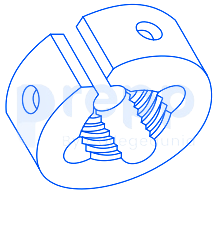
Identify the type of Die in the above Fig.
- The distance from a point on a thread to the corresponding point on the next thread of a screw is called ______.
- The head shape of a thumb screw is:
Important Questions from Screw Threads
When cutting an ISO Metric thread for a coarse pitch, by how many degrees should the compound rest be swiveled to?
What is the blank size (diameter) for preparing a bolt of M12 × 1.5?
What is the relation between the lead (L) and pitch (P) of a two-start thread screw?
The form of thread in a saw tooth thread is
The angle between the flanks in an Acme thread is



