
Angle of Knuckle thread is ______
30°
Understanding Knuckle Threads and Their Angle
Let's discuss knuckle threads, a specific type of screw thread, focusing on their characteristic angle. Screw threads are essential components in many engineering applications, used for fastening or transmitting power. Different thread profiles have different angles and shapes tailored for specific purposes.
What is a Knuckle Thread?
A knuckle thread is a thread profile that has a rounded form at both the root and the crest. Unlike sharp V-threads, the rounded shape gives it certain advantages in specific environments.
Angle of Knuckle Threads
The question asks about the angle of a knuckle thread. This angle refers to the angle between the flanks of the thread profile, measured in an axial plane. For a standard knuckle thread, this angle is well-defined.
The standard angle for a knuckle thread is 30°. This angle, combined with the rounded profile, makes knuckle threads suitable for applications where they might encounter rough handling, dirt, or corrosion.
Comparison with Other Thread Types
It's helpful to compare the knuckle thread angle with other common thread types:
- ISO Metric Thread: Has a V-profile with a 60° angle. Widely used for general fastening.
- Whitworth Thread: Has a V-profile with a 55° angle and rounded roots and crests. Historically significant, still used in some applications.
- ACME Thread: Has a trapezoidal profile with a 29° angle. Primarily used for power transmission.
- Buttress Thread: Has an asymmetrical profile, typically with one flank perpendicular to the axis and the other at an angle (often 45° or 7°), designed for high axial loads in one direction.
The 30° angle of the knuckle thread is smaller than that of common V-threads (like Metric or Whitworth) and distinct from trapezoidal or buttress threads.
Applications of Knuckle Threads
Due to their rounded profile and 30° angle, knuckle threads are less prone to damage from impacts and are easier to clean. This makes them ideal for applications such as:
- Railway carriage couplings
- Hydrant connectors
- Bulb bases (like Edison screw fittings, although the exact profile can vary)
- Coarse applications where robustness is required
Determining the Correct Angle
Based on engineering standards and common knowledge regarding thread forms, the specific angle associated with the knuckle thread profile is 30°.
The options provided are 55°, 60°, 30°, and 45°. Comparing these to the standard knuckle thread angle, 30° is the correct value.
| Thread Type | Profile Shape | Standard Angle | Common Applications |
|---|---|---|---|
| Knuckle Thread | Rounded Crest & Root | 30° | Rough handling, dirt exposure (e.g., railway couplings, fire hydrants) |
| ISO Metric Thread | V-profile | 60° | General fastening |
| Whitworth Thread | V-profile with rounded root & crest | 55° | Pipes, some historical machinery |
| ACME Thread | Trapezoidal | 29° | Power transmission (lead screws) |
| Buttress Thread | Asymmetrical | Typically 45° or 7° (load bearing flank) | High axial loads in one direction |
Therefore, the angle of a knuckle thread is 30°.
Revision Table: Common Thread Angles
| Thread Type | Thread Angle (\(\theta\)) |
|---|---|
| Knuckle Thread | 30° |
| ISO Metric | 60° |
| British Standard Whitworth (BSW) | 55° |
| ACME | 29° |
| Unified (UNC, UNF) | 60° |
Additional Information: Knuckle Thread Characteristics
Knuckle threads are often used in situations where cleanliness and precision are less critical than robustness and ease of engagement. Their rounded profile makes them more tolerant of wear and less susceptible to damage than threads with sharp roots and crests. They are typically manufactured by rolling or casting rather than cutting, which is suitable for the often coarse pitch of these threads. While they don't offer the same load-carrying capacity or self-locking properties as some other thread forms, their durability in harsh conditions makes them invaluable for specific heavy-duty applications.
Similar Questions
When cutting an ISO Metric thread for a coarse pitch, by how many degrees should the compound rest be swiveled to?
Taps are re-sharpened by grinding:
The type of thread used in lead screw of a lathe is ______
The surface connecting crest and root of a thread is termed as
Which one of the following is used to rectify damaged or rusted threads?
The resistance of fine thread unscrewing is ______
Lead is equal to double the pitch value then this type of thread is called as _____.
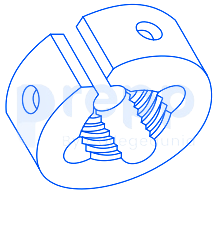
Identify the type of Die in the above Fig.
- The distance from a point on a thread to the corresponding point on the next thread of a screw is called ______.
- The head shape of a thumb screw is:
Important Questions from Screw Threads
When cutting an ISO Metric thread for a coarse pitch, by how many degrees should the compound rest be swiveled to?
What is the blank size (diameter) for preparing a bolt of M12 × 1.5?
What is the relation between the lead (L) and pitch (P) of a two-start thread screw?
Taps are re-sharpened by grinding:
The form of thread in a saw tooth thread is



