
The type of thread used in lead screw of a lathe is ______
Square thread
Understanding Lathe Lead Screws and Thread Types
A lathe is a machine tool used for shaping metal or wood by rotating the workpiece while a cutting tool is moved into the workpiece. One of the crucial components in a lathe is the lead screw. The lead screw is responsible for providing the automatic linear movement of the carriage along the bed of the lathe. This movement is essential for operations like thread cutting.
Function and Requirements of a Lead Screw Thread
The primary function of a lead screw is to convert rotational motion from the lathe's gearbox into precise linear motion of the carriage. This conversion requires a thread profile that is efficient in transmitting power and can handle the loads involved in cutting operations, especially during threading.
Key requirements for a lead screw thread include:
- High Efficiency: Minimal power loss during transmission from rotation to linear movement.
- Load Carrying Capacity: Able to withstand forces exerted during cutting.
- Minimal Radial Pressure: Reduces wear on the nut and the screw itself.
- Durability: Long lifespan under repeated use.
- Ease of Machining: Practical to manufacture accurately.
Analyzing Different Thread Types for Lathe Lead Screws
Let's examine the given options and their suitability for a lathe lead screw:
- Knuckle thread: This thread has a rounded profile. It is robust and used where rough handling is expected or dirt might be present, like railway couplings. However, it is less efficient for power transmission compared to other types due to more friction. It is not typically used for precision lead screws.
- Square thread: This thread has a square profile where the flank angle is 0 degrees. Square threads are known for their high efficiency in transmitting power and their ability to carry heavy loads. They generate minimal radial pressure or bursting force on the nut. This makes them highly suitable for applications requiring power transmission and linear motion, such as lead screws and jack screws. They can transmit power effectively in both directions of motion, which is important for a lead screw that needs to move the carriage forward for cutting and backward for returning.
- Worm thread: A worm thread is essentially a screw profile used in a worm gear set, where a worm (the screw) meshes with a worm wheel. Worm threads are designed for high speed reduction ratios and often for applications requiring non-reversibility (preventing the worm wheel from driving the worm). While it's a type of screw thread, it's used in a gear configuration, not as a direct lead screw profile for linear motion on a lathe carriage in the context of threading operations.
- Buttress thread: This thread has one flank perpendicular to the screw axis and the other angled. It is designed to transmit heavy loads in one direction only with high efficiency in that direction. It generates less radial thrust than a square thread when loaded in the preferred direction. However, a lathe lead screw needs to move the carriage in both directions (for cutting and rapid return), making a buttress thread less ideal compared to a thread efficient in both directions.
Why Square Thread is Used in Lathe Lead Screw
Based on the characteristics, the Square thread is the most suitable type for a lathe lead screw. Its key advantages include:
- High efficiency in converting rotational to linear motion.
- Good load-carrying capacity.
- Low radial pressure on the nut, leading to less wear.
- Ability to transmit power efficiently in both directions of travel, necessary for moving the carriage forward during cutting and backward quickly.
While Acme threads (a trapezoidal thread type) are also common for lead screws due to easier manufacturing and compensation for wear, the classic choice and often cited type known for high efficiency in both directions is the Square thread.
| Thread Type | Profile | Key Characteristics | Typical Use Cases | Suitability for Lathe Lead Screw |
|---|---|---|---|---|
| Knuckle | Rounded | Robust, tolerant to dirt, low efficiency | Railway couplings, rough handling | Low (Inefficient, not for precision) |
| Square | Square | High efficiency, low radial pressure, bidirectional load | Lead screws, jack screws, presses | High (Efficient, bidirectional, good load) |
| Worm | Specialized for worm gears | High reduction ratio, often non-reversible | Gearboxes | Low (Different application) |
| Buttress | Asymmetric | High efficiency in one direction, high unidirectional load | Vices, screw jacks (unidirectional) | Medium/Low (Inefficient in reverse) |
Conclusion
Considering the requirements for efficient and bidirectional power transmission with good load capacity and minimal wear, the Square thread is the type traditionally and ideally suited for the lead screw of a lathe, especially for operations like thread cutting where precise linear movement is derived directly from the screw's rotation.
Revision Table: Lathe Lead Screw Threads
Review the key features of threads used for power transmission:
- Square Thread: Best for high efficiency and bidirectional power transmission.
- Acme Thread: Good compromise between efficiency and ease of manufacturing/nut engagement, often used in modern lead screws.
- Buttress Thread: Best for high unidirectional loads.
Additional Information: Other Lathe Components
Beyond the lead screw, a lathe has several other important parts that work together:
- Headstock: Contains the main spindle and the drive mechanism.
- Tailstock: Supports the other end of the workpiece or holds drilling/reaming tools.
- Carriage: Moves along the bed, carrying the cross slide and tool post.
- Cross Slide: Moves the tool perpendicular to the lathe bed.
- Compound Rest: Swivels to allow cutting at angles.
- Feed Rod: Provides automatic feed for turning and facing operations (separate from the lead screw).
- Bed: The base structure providing guidance for the carriage and tailstock.
Understanding these components helps in appreciating the role of the lead screw in specific operations like thread cutting.
Similar Questions
When cutting an ISO Metric thread for a coarse pitch, by how many degrees should the compound rest be swiveled to?
Taps are re-sharpened by grinding:
The surface connecting crest and root of a thread is termed as
Angle of Knuckle thread is ______
Which one of the following is used to rectify damaged or rusted threads?
The resistance of fine thread unscrewing is ______
Lead is equal to double the pitch value then this type of thread is called as _____.
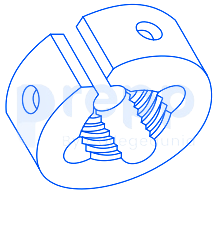
Identify the type of Die in the above Fig.
- The distance from a point on a thread to the corresponding point on the next thread of a screw is called ______.
- The head shape of a thumb screw is:
Important Questions from Screw Threads
When cutting an ISO Metric thread for a coarse pitch, by how many degrees should the compound rest be swiveled to?
What is the blank size (diameter) for preparing a bolt of M12 × 1.5?
What is the relation between the lead (L) and pitch (P) of a two-start thread screw?
Taps are re-sharpened by grinding:
The form of thread in a saw tooth thread is



