
Which one of the following is used to rectify damaged or rusted threads?
Die nut
Understanding Tools for Rectifying Damaged Threads
Threads on bolts, screws, or in nuts can sometimes get damaged due to rust, cross-threading, or impact. When this happens, it's often possible to repair or "rectify" the damaged threads instead of replacing the entire part. Different tools are used for cutting new threads (tapping and threading) versus repairing existing, damaged threads.
Analyzing the Options for Damaged Thread Rectification
Let's look at the given options and determine which one is specifically designed for rectifying damaged or rusted threads:
- Two-piece die: This type of die consists of two adjustable halves held in a die stock. It's primarily used for cutting new external threads on a rod or bolt, especially when precise adjustment is needed. While they cut threads, they are not the most convenient tool for simply cleaning up or repairing existing damaged threads.
- Die nut: A die nut looks like a standard nut but has cutting edges like a die. It's specifically designed to run over existing threads to clean them up, remove rust, burrs, and re-form slightly damaged threads. It's used by screwing it onto the bolt or stud, effectively chasing the threads. This is ideal for rectifying damaged or rusted threads without cutting deeply into the material.
- Circular split die: This is a common type of die used in a die stock to cut new external threads. The 'split' allows for slight adjustment of the thread size. Like the two-piece die, its primary function is cutting new threads, not repairing existing damaged ones, although it could potentially be used cautiously for cleaning.
- Die plate: Also known as a screw plate, a die plate is a flat plate with a series of threaded holes of different sizes. It's an older tool format used for cutting small external threads, particularly for instrument or clockmaking screws. It's for cutting new threads, not rectifying damaged ones.
Why Die Nut is Used for Rectifying Damaged Threads
Based on their functions, the die nut is the tool specifically intended for repairing or rectifying damaged and rusted threads. Its design allows it to follow the existing thread pattern, cleaning and reshaping it without removing excessive material, which is the goal when rectifying damaged threads.
| Tool | Primary Use | Suitable for Rectifying Damaged Threads? |
|---|---|---|
| Two-piece die | Cutting new external threads | Less suitable; designed for cutting, not just cleaning/repairing |
| Die nut | Cleaning, repairing, and rectifying existing external threads | Yes, this is its specific purpose |
| Circular split die | Cutting new external threads | Less suitable; designed for cutting |
| Die plate | Cutting new external threads (often small sizes) | No; designed for cutting new threads |
Therefore, the tool specifically used to rectify damaged or rusted threads is the die nut.
Revision Table: Thread Repair Tools
| Term | Definition/Function |
|---|---|
| Die nut | Tool resembling a nut, used to clean and repair existing external threads. |
| Die | General term for a tool used to cut external threads (on bolts, rods). Examples include circular split dies and two-piece dies. |
| Tap | Tool used to cut internal threads (in nuts, holes). |
| Die stock | Handle or holder for dies (like circular split dies or two-piece dies). |
Additional Information on Thread Rectification
When rectifying damaged threads, lubrication is often used to help the die nut cut or clean smoothly. Care must be taken to ensure the die nut is started straight on the thread to avoid further damage. For severely damaged threads, simple rectification might not be sufficient, and re-threading (cutting new threads, potentially of a slightly larger size if material allows) or replacement might be necessary.
Similar Questions
When cutting an ISO Metric thread for a coarse pitch, by how many degrees should the compound rest be swiveled to?
Taps are re-sharpened by grinding:
The type of thread used in lead screw of a lathe is ______
The surface connecting crest and root of a thread is termed as
Angle of Knuckle thread is ______
The resistance of fine thread unscrewing is ______
Lead is equal to double the pitch value then this type of thread is called as _____.
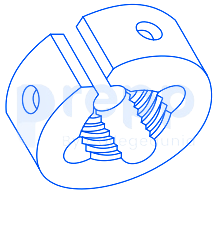
Identify the type of Die in the above Fig.
- The distance from a point on a thread to the corresponding point on the next thread of a screw is called ______.
- The head shape of a thumb screw is:
Important Questions from Screw Threads
When cutting an ISO Metric thread for a coarse pitch, by how many degrees should the compound rest be swiveled to?
What is the blank size (diameter) for preparing a bolt of M12 × 1.5?
What is the relation between the lead (L) and pitch (P) of a two-start thread screw?
Taps are re-sharpened by grinding:
The form of thread in a saw tooth thread is



