
When cutting an ISO Metric thread for a coarse pitch, by how many degrees should the compound rest be swiveled to?
Understanding Compound Rest Angle for ISO Metric Thread Cutting
Thread cutting on a lathe is a fundamental machining operation used to create screw threads on the external or internal surface of a workpiece. This process requires precise control over the tool's movement relative to the rotating workpiece. A crucial aspect of cutting threads, especially ISO Metric threads, is correctly setting the angle of the compound rest.
The Role of the Compound Rest
The compound rest is a component of the lathe that sits atop the cross slide. It can be swiveled to any angle in the horizontal plane. This allows the cutting tool, which is held in the tool post on the compound rest, to be fed into the workpiece at an angle. While the cross slide is used for diameter control and the carriage for longitudinal movement, the compound rest is primarily used for feeding the tool into the work when turning short tapers or, as in this case, when cutting threads.
Compound Rest Angle for ISO Metric Threads
ISO Metric screw threads have a V-shaped profile with an included angle of \(60^\circ\). When cutting these threads using a single-point tool, the traditional and most efficient method is to feed the tool predominantly into one flank of the thread. This helps in:
- Controlling the chip formed during cutting, directing it away from the cutting action.
- Reducing the load on the cutting tool by primarily cutting on one edge rather than forcing the tool directly into the root with both flanks cutting simultaneously.
- Producing a better surface finish on the thread flanks.
To achieve this single-flank feeding, the compound rest is typically swiveled to an angle equal to half of the included thread angle. For ISO Metric threads with a \(60^\circ\) included angle, this means the compound rest is set to \(30^\circ\). The tool is then fed into the workpiece using the compound rest handle.
| Thread System | Included Angle | Standard Compound Rest Angle |
|---|---|---|
| ISO Metric | \(60^\circ\) | \(30^\circ\) |
| Unified (UNC, UNF, etc.) | \(60^\circ\) | \(29.5^\circ\) or \(30^\circ\) (common practice is \(29.5^\circ\) or \(30^\circ\)) |
| Whitworth (BSW, BSF) | \(55^\circ\) | \(27.5^\circ\) |
While other methods exist (like feeding straight in with the cross slide at \(0^\circ\), which cuts on both flanks simultaneously), setting the compound rest at \(30^\circ\) is the standard practice for cutting ISO Metric threads, including coarse pitch ones, to ensure efficient cutting and good thread quality.
Analyzing the Options
- \(45^\circ\): Setting the compound rest to \(45^\circ\) is not the standard practice for cutting ISO Metric threads. This angle is larger than half the thread angle and would not effectively feed the tool along one flank.
- \(60^\circ\): Setting the compound rest to \(60^\circ\) is equal to the full thread angle. This would mean the tool feeds parallel to one of the thread flanks, which is not the method for cutting the V-profile itself.
- \(30^\circ\): Setting the compound rest to \(30^\circ\) is exactly half the \(60^\circ\) included angle of an ISO Metric thread. This is the standard and recommended angle for feeding the tool predominantly into one flank, which is the most common and efficient method for cutting these threads.
- \(15^\circ\): Setting the compound rest to \(15^\circ\) is less than half the thread angle. While it would still feed into one flank, it's not the optimal angle for standard ISO Metric thread cutting and wouldn't align the feed direction properly with the flank geometry compared to \(30^\circ\).
Based on standard machining practices for cutting ISO Metric threads, the compound rest should be swiveled to \(30^\circ\) for feeding the cutting tool.
Revision Table: Key Concepts
| Concept | Explanation |
|---|---|
| ISO Metric Thread Angle | \(60^\circ\) included angle. |
| Compound Rest Role | Allows angled feeding of the cutting tool. |
| Standard Thread Cutting Method | Feed tool primarily into one flank. |
| Compound Rest Angle for Metric | Half of included angle, i.e., \(60^\circ / 2 = 30^\circ\). |
Additional Information: Thread Cutting on Lathes
When cutting threads on a lathe, several factors are critical:
- Lead Screw Engagement: The lead screw must be engaged using the half-nut lever to move the carriage longitudinally at the correct rate determined by the gearbox setting (for the desired thread pitch).
- Tool Grinding: The cutting tool must be ground precisely to the correct thread angle (\(60^\circ\) for Metric) and must have the correct relief angles. The nose of the tool should have a slight radius for external threads or be sharp for internal threads, depending on the specific thread standard requirements (e.g., flat crest/root for ISO Metric).
- Tool Alignment: The tool must be set exactly on the centerline of the workpiece and perpendicular to the axis of rotation. A thread gauge is used to check the tool angle and alignment relative to the workpiece.
- Depth of Cut: Threads are cut incrementally by taking successive passes. The depth of cut for each pass is controlled by the compound rest (when set at an angle) or the cross slide.
- Multiple Passes: Cutting a full thread depth requires many light passes rather than a single deep cut, especially for coarse pitches, to manage heat, chip load, and tool wear.
- Pitch vs. Lead: For single-start threads, pitch and lead are the same. The lathe gearing is set based on the required pitch.
Understanding these elements, along with the correct compound rest angle, is essential for successfully cutting ISO Metric threads on a lathe.
Similar Questions
Taps are re-sharpened by grinding:
The type of thread used in lead screw of a lathe is ______
The surface connecting crest and root of a thread is termed as
Angle of Knuckle thread is ______
Which one of the following is used to rectify damaged or rusted threads?
The resistance of fine thread unscrewing is ______
Lead is equal to double the pitch value then this type of thread is called as _____.
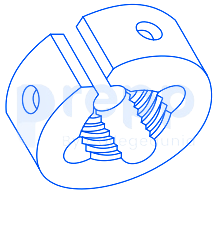
Identify the type of Die in the above Fig.
- The distance from a point on a thread to the corresponding point on the next thread of a screw is called ______.
- The head shape of a thumb screw is:
Important Questions from Screw Threads
What is the blank size (diameter) for preparing a bolt of M12 × 1.5?
What is the relation between the lead (L) and pitch (P) of a two-start thread screw?
Taps are re-sharpened by grinding:
The form of thread in a saw tooth thread is
The angle between the flanks in an Acme thread is



