
Lead is equal to double the pitch value then this type of thread is called as _____.
Double start thread
Understanding Screw Thread Terminology: Lead, Pitch, and Starts
This question asks about the type of screw thread based on the relationship between its lead and pitch values. To answer this, we need to understand what lead and pitch mean for screw threads and how they relate to the number of starts a thread has.
What are Lead and Pitch in Screw Threads?
- Pitch: The pitch of a screw thread is the distance measured parallel to the thread axis between corresponding points on adjacent thread forms in the same axial plane. It's essentially how close together the threads are.
- Lead: The lead of a screw thread is the axial distance the screw advances in one complete revolution (360 degrees).
For a single start thread, the lead is equal to the pitch. This means that in one full turn, the screw advances by a distance equal to the spacing between adjacent threads.
Relationship Between Lead, Pitch, and Number of Starts
Many screws have more than one thread running parallel along the body. These are called multi-start threads. The number of starts refers to the number of independent thread helices on the screw.
The relationship between lead, pitch, and the number of starts is given by the formula:
\(\text{Lead} = \text{Pitch} \times \text{Number of Starts}\)
Analyzing the Given Condition
The question states that the lead of the thread is equal to double the pitch value. We can write this as:
\(\text{Lead} = 2 \times \text{Pitch}\)
Calculating the Number of Starts
Now, we can substitute the given condition into the formula relating lead, pitch, and the number of starts:
\(2 \times \text{Pitch} = \text{Pitch} \times \text{Number of Starts}\)
To find the number of starts, we can divide both sides of the equation by the Pitch (assuming Pitch is not zero, which it wouldn't be for a screw thread):
\(\text{Number of Starts} = \frac{2 \times \text{Pitch}}{\text{Pitch}}\)
\(\text{Number of Starts} = 2\)
So, the thread has 2 starts.
Identifying the Thread Type
Based on the number of starts:
- A thread with 1 start is a single start thread.
- A thread with 2 starts is a double start thread.
- A thread with 3 starts is a triple start thread.
- Threads with more than one start are generally referred to as multi-start threads.
Since our calculation shows the thread has 2 starts, it is called a double start thread.
Conclusion
When the lead of a thread is double its pitch, the thread has two starts. Therefore, this type of thread is known as a double start thread.
Revision Table: Screw Thread Properties
| Property | Definition | Relation to Lead and Pitch |
|---|---|---|
| Pitch | Axial distance between adjacent threads | Base measurement for thread spacing |
| Lead | Axial distance advanced in one revolution | Lead = Pitch × Number of Starts |
| Number of Starts | Number of independent thread helices | Calculated from Lead and Pitch |
| Single Start Thread | 1 helix | Lead = Pitch |
| Double Start Thread | 2 helices | Lead = 2 × Pitch |
| Triple Start Thread | 3 helices | Lead = 3 × Pitch |
| Multi-start Thread | >1 helix | Lead > Pitch |
Additional Information: Why Use Multi-start Threads?
Multi-start threads, like double start threads, are used for specific purposes:
- Faster Axial Movement: For a given rotational speed, a multi-start thread advances axially much faster than a single start thread with the same pitch diameter. This is because the lead is greater than the pitch. This is useful in applications requiring rapid movement, such as quick-release mechanisms or bottle caps.
- Reduced Thread Depth: For a given lead (and thus speed), a multi-start thread has a larger pitch (distance between threads). This means the threads are coarser and typically have a shallower depth compared to a single-start thread designed for the same axial load capacity. This can make them easier to manufacture and potentially stronger against shear, though they might be less resistant to stripping depending on the design.
- Even Load Distribution: In some cases, multiple starts can help distribute the load more evenly among the engaged threads.
Understanding the difference between lead and pitch is crucial for selecting or designing the appropriate screw thread for a particular application based on speed, strength, and manufacturing considerations.
Similar Questions
When cutting an ISO Metric thread for a coarse pitch, by how many degrees should the compound rest be swiveled to?
Taps are re-sharpened by grinding:
The type of thread used in lead screw of a lathe is ______
The surface connecting crest and root of a thread is termed as
Angle of Knuckle thread is ______
Which one of the following is used to rectify damaged or rusted threads?
The resistance of fine thread unscrewing is ______
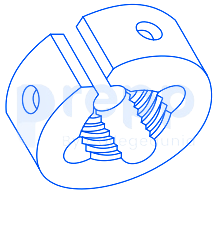
Identify the type of Die in the above Fig.
- The distance from a point on a thread to the corresponding point on the next thread of a screw is called ______.
- The head shape of a thumb screw is:
Important Questions from Screw Threads
When cutting an ISO Metric thread for a coarse pitch, by how many degrees should the compound rest be swiveled to?
What is the blank size (diameter) for preparing a bolt of M12 × 1.5?
What is the relation between the lead (L) and pitch (P) of a two-start thread screw?
Taps are re-sharpened by grinding:
The form of thread in a saw tooth thread is



