
The resistance of fine thread unscrewing is ______
high
Understanding Fine Thread Resistance to Unscrewing
The question asks about the resistance offered when a fine thread is being unscrewed. This relates to how easily a threaded fastener, like a screw or bolt, becomes loose or unscrews on its own or under vibration.
Fine threads have more threads per unit length compared to coarse threads. This fundamental difference significantly impacts their resistance to unscrewing.
Why Fine Threads Offer High Resistance to Unscrewing
Here are the key reasons why the resistance of fine thread unscrewing is considered high:
- Larger Contact Area: For a given length of engagement, fine threads have a larger total surface area in contact between the male and female threads. This increased contact area leads to higher friction, which opposes unscrewing.
- Smaller Helix Angle: Fine threads have a smaller helix angle than coarse threads of the same diameter. The helix angle is the angle of the thread relative to the fastener's axis. A smaller helix angle means it takes more rotations to advance the fastener a certain distance, and conversely, it's harder for axial forces or vibrations to cause rotation and unscrewing.
- Better Vibration Resistance: Due to the smaller helix angle and increased friction, fine threads are generally more resistant to loosening under vibration compared to coarse threads. This is a crucial factor in applications where dynamic loads or vibrations are present.
- Greater Thread Engagement: Often, fine threads allow for deeper or longer thread engagement in thin materials due to the higher number of threads available over a short length, further increasing resistance.
Comparing fine threads to coarse threads helps clarify the difference in unscrewing resistance.
| Feature | Fine Thread | Coarse Thread |
|---|---|---|
| Threads per unit length | More | Fewer |
| Pitch (distance between threads) | Smaller | Larger |
| Helix Angle | Smaller | Larger |
| Thread Contact Area (for same engagement length) | Larger | Smaller |
| Friction during unscrewing | Higher | Lower |
| Resistance to Unscrewing / Vibration | High | Lower |
Based on these characteristics, the resistance of fine thread unscrewing is significantly higher than that of coarse threads.
Revision Table: Fine Thread Characteristics
Let's quickly review the key properties of fine threads that contribute to their performance, including unscrewing resistance.
- Higher thread count per unit length.
- Smaller thread pitch.
- Smaller helix angle.
- Larger contact surface area for a given engagement.
- Greater resistance to vibration and loosening.
- Often used where precise adjustments are needed.
- Less susceptible to stripping in hard materials due to larger contact area distributing load.
Additional Information: Applications and Considerations
Understanding the resistance of fine thread unscrewing is important for selecting the right fastener for an application.
- Applications: Fine threads are often used in applications requiring high precision, strong clamping force, and resistance to vibration, such as in aerospace, automotive engines, precision machinery, and adjustment mechanisms.
- Strength: While fine threads offer high unscrewing resistance and strength against shear forces (per thread), coarse threads are generally stronger against tensile loads in the bolt itself if the threads are rolled, and are less prone to cross-threading or damage during assembly.
- Assembly: Fine threads require more rotations to assemble and disassemble compared to coarse threads, and they are more susceptible to damage from nicks or dirt due to the smaller pitch.
In summary, the physical geometry of fine threads results in a high resistance to unscrewing forces, making them suitable for critical applications where self-loosening must be prevented.
Similar Questions
When cutting an ISO Metric thread for a coarse pitch, by how many degrees should the compound rest be swiveled to?
Taps are re-sharpened by grinding:
The type of thread used in lead screw of a lathe is ______
The surface connecting crest and root of a thread is termed as
Angle of Knuckle thread is ______
Which one of the following is used to rectify damaged or rusted threads?
Lead is equal to double the pitch value then this type of thread is called as _____.
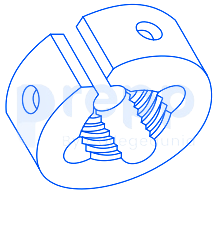
Identify the type of Die in the above Fig.
- The distance from a point on a thread to the corresponding point on the next thread of a screw is called ______.
- The head shape of a thumb screw is:
Important Questions from Screw Threads
When cutting an ISO Metric thread for a coarse pitch, by how many degrees should the compound rest be swiveled to?
What is the blank size (diameter) for preparing a bolt of M12 × 1.5?
What is the relation between the lead (L) and pitch (P) of a two-start thread screw?
Taps are re-sharpened by grinding:
The form of thread in a saw tooth thread is



