
Which practice is essential for producing accurate external threads using a die?
Ensuring the die is aligned squarely with the workpiece axis
Cutting an external thread with a die requires the thread to be concentric with the bar and of uniform pitch all the way round, which depends on how the die is presented to the work.
The key practice is to keep the die face square, that is exactly perpendicular, to the workpiece axis as it is started and rotated.
When the die enters square, every tooth engages the bar evenly, so the thread is cut straight, of even depth, and true to the axis.
Tilting the die away from the axis (option 1) makes it cut deeper on one side, producing a crooked, tapered or drunken thread.
Applying uneven pressure while turning (option 3) causes the die to wander and gives an irregular, poorly formed thread.
Skipping lubrication (option 4) lets the teeth tear rather than shear the metal, giving a rough, torn thread and rapid die wear, so all three are bad practice.
Hence, the answer is Ensuring the die is aligned squarely with the workpiece axis.
Similar Questions
When cutting an ISO Metric thread for a coarse pitch, by how many degrees should the compound rest be swiveled to?
Taps are re-sharpened by grinding:
The type of thread used in lead screw of a lathe is ______
The surface connecting crest and root of a thread is termed as
Angle of Knuckle thread is ______
Which one of the following is used to rectify damaged or rusted threads?
The resistance of fine thread unscrewing is ______
Lead is equal to double the pitch value then this type of thread is called as _____.
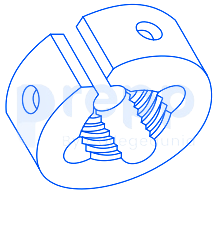
Identify the type of Die in the above Fig.
- The distance from a point on a thread to the corresponding point on the next thread of a screw is called ______.
Important Questions from Screw Threads
When cutting an ISO Metric thread for a coarse pitch, by how many degrees should the compound rest be swiveled to?
What is the blank size (diameter) for preparing a bolt of M12 × 1.5?
What is the relation between the lead (L) and pitch (P) of a two-start thread screw?
Taps are re-sharpened by grinding:
The form of thread in a saw tooth thread is



