
Which of the following is NOT a type of common threaded fastener?
Nail
Identifying Common Threaded Fasteners
Fasteners are essential components used to join two or more objects together. They come in many forms, categorized based on how they create a joint. One common category is threaded fasteners, which rely on helical ridges, called threads, to engage with other threads or materials to create a secure connection.
Let's examine the options provided to determine which one is NOT a type of common threaded fastener:
- Bolt: A bolt is a type of threaded fastener. It typically has a head at one end and a threaded shaft. Bolts are commonly used with a nut to clamp materials together. The threads on the bolt shaft engage with the internal threads of the nut.
- Screw: A screw is also a type of threaded fastener. It has a head and a threaded shaft designed to be driven into a material or a pre-tapped hole, often forming its own thread or engaging with an existing internal thread. Screws can hold materials together directly or be used with nuts or inserts.
- Nut: A nut is a type of threaded fastener that has an internally threaded hole. Nuts are almost always used in conjunction with a bolt of the same thread size and type. The internal threads of the nut engage with the external threads of the bolt to create a clamping force.
- Nail: A nail is a fastener, but it is typically NOT a threaded fastener. Nails usually have a smooth shank (the main body) with a pointed tip and a head. They are designed to be driven into materials using a hammer or nail gun. A nail holds materials together primarily through friction along its shank and by the deformation of the material around it. While some specialized nails might have ridges or even threads for increased holding power (like screw nails or ring-shank nails), the common definition and form of a standard nail do not involve threads in the same way as bolts, screws, and nuts.
Based on the characteristics of each item, bolts, screws, and nuts are all common types of threaded fasteners because they utilize threads for their fastening mechanism. A nail, on the other hand, relies on friction and material deformation and is not a threaded fastener in its common form.
Understanding Fastener Types
Fasteners can be broadly classified into different categories based on their principle of operation:
- Threaded Fasteners: Use threads to create a mechanical advantage and clamping force (e.g., bolts, screws, nuts, studs).
- Non-Threaded Fasteners: Do not use threads for their primary fastening action (e.g., nails, rivets, pins, cotter pins, staples).
- Adhesives: Use chemical bonding to join materials (e.g., glue, epoxy).
- Welding/Soldering: Join materials by melting and fusing them together, often with a filler material.
This question focuses specifically on identifying the item that does not belong to the threaded fastener category among the given options.
Comparing Threaded vs. Non-Threaded Fasteners
Here is a simple comparison of the common fasteners mentioned:
| Fastener Type | Primary Mechanism | Common Use | Threaded? |
|---|---|---|---|
| Bolt | Thread engagement (with nut) | Joining materials through holes | Yes |
| Screw | Thread engagement (into material or nut) | Joining materials, often into a solid piece | Yes |
| Nut | Thread engagement (with bolt) | Used with bolts to create a joint | Yes |
| Nail | Friction & Material Deformation | Fastening wood or other soft materials | No |
Therefore, the nail is the only option listed that is not a type of common threaded fastener.
Revision Table: Threaded Fasteners
| Concept | Key takeaway |
|---|---|
| Threaded Fastener | Uses threads for holding. |
| Non-Threaded Fastener | Holds without threads, often by friction or deformation. |
| Bolt, Screw, Nut | Examples of common threaded fasteners. |
| Nail | Example of a common non-threaded fastener. |
Additional Information: Types of Fasteners
Understanding different types of fasteners is crucial in construction, manufacturing, and everyday repairs. Beyond the common threaded fasteners like bolts, screws, and nuts, and the non-threaded nail, other fasteners include:
- Rivets: Permanent mechanical fasteners.
- Pins: Used for alignment or shear loads.
- Washers: Used under heads of bolts/screws or nuts to distribute load or prevent loosening.
- Anchors: Used to fasten items to concrete or masonry.
Each type of fastener has specific applications based on the materials being joined, the required strength, and whether the joint needs to be easily disassembled.
Similar Questions
When cutting an ISO Metric thread for a coarse pitch, by how many degrees should the compound rest be swiveled to?
Taps are re-sharpened by grinding:
The type of thread used in lead screw of a lathe is ______
The surface connecting crest and root of a thread is termed as
Angle of Knuckle thread is ______
Which one of the following is used to rectify damaged or rusted threads?
The resistance of fine thread unscrewing is ______
Lead is equal to double the pitch value then this type of thread is called as _____.
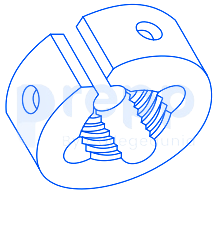
Identify the type of Die in the above Fig.
- The distance from a point on a thread to the corresponding point on the next thread of a screw is called ______.
Important Questions from Screw Threads
When cutting an ISO Metric thread for a coarse pitch, by how many degrees should the compound rest be swiveled to?
What is the blank size (diameter) for preparing a bolt of M12 × 1.5?
What is the relation between the lead (L) and pitch (P) of a two-start thread screw?
Taps are re-sharpened by grinding:
The form of thread in a saw tooth thread is



