
SCATSAT-1 Satellite's Primary Mission
SCATSAT-1 is an important satellite developed by the Indian Space Research Organisation (ISRO). Its primary purpose is related to understanding and monitoring Earth's weather patterns, specifically focusing on the ocean surface.
Understanding SCATSAT-1's Functionality
SCATSAT-1 is equipped with a scatterometer instrument. A scatterometer is a type of radiometer used to measure the strength of signals scattered by a surface. In the case of SCATSAT-1, this instrument measures:
- Sea surface wind speed
- Sea surface wind direction
This data is crucial for meteorological applications. By measuring the roughness of the sea surface caused by winds, the scatterometer can accurately determine wind conditions over the oceans.
Main Objective: Weather Forecasting and Cyclone Prediction
The data collected by SCATSAT-1, particularly the sea surface wind information, directly supports:
- Weather forecasting: Accurate wind data helps in creating more precise weather models and predictions.
- Cyclone prediction: Understanding wind patterns is vital for tracking the formation, intensity, and path of cyclones and other severe weather systems over the ocean. This helps in issuing timely warnings.
Therefore, the main objective of SCATSAT-1 is closely linked to improving weather forecasting and enhancing our ability to predict cyclones.
Analyzing SCATSAT-1 Objectives Against Options
Let's look at why the other options are not the main objective of SCATSAT-1:
- Monitoring earthquake zones: This typically involves geological surveys and seismic monitoring, not satellite-based wind measurements.
- Measuring atmospheric ozone depletion: While studying the atmosphere is a broad category, SCATSAT-1's specific payload (scatterometer) is designed for ocean surface wind measurements, not ozone concentration. Satellites like those from NASA's Aura mission focus on ozone.
- Mapping forest cover across India: Forest cover mapping usually requires optical or radar imaging satellites that can differentiate vegetation types and land features. SCATSAT-1's scatterometer is not optimized for this task.
Based on its design and the data it provides, SCATSAT-1's contribution to weather forecasting and cyclone prediction is its most significant and primary objective.
Similar Questions
- India's support for which of the following missions aligns most closely with IMEC's purpose?
- What advanced technology is being tested in ISRO's new "Next Generation Launch Vehicle" (NGLV) project to replace PSLV and GSLV?
- Which solar phenomenon is responsible for disturbances in Earth's magnetic field?
Consider the following statements:
1. The Aditya-L1 mission was launched to replace the INSAT series of weather satellites.
2. Aditya-L1 successfully entered a Halo Orbit around the Lagrange Point 1 (L1) to observe solar activity.
Which of the statements given above is/are correct?- Earth remote sensing satellites (EOS) are primarily designed to:
- What is the name of the satellite launched by ISRO's GSLV-F09 that was a gift to SAARC nations?
Who gave the expanding universe hypothesis?
Which of the following ISRO initiatives, launched with the vision of "Catch them young", aims to introduce school students to space science and technology?
- Who was announced on 26 June 2025 as first Indian astronaut for Titans Space mission?
Important Questions from Space and Nuclear Program
With reference to `Astrosat', the astronomical observatory launched by India, which of the following statements is/are correct?
1. Other than USA and Russia, India is the only country to have launched a similar observatory into space.
2. Astrosat is a 2000 kg satellite placed in an orbit at 1650 km above the surface of the Earth.
Select the correct answer using the code given below.
Consider the following statements: The Mangalyaan launched by ISRO
1. is also called the Mars Orbiter Mission
2. made India the second country to have a spacecraft orbit the Mars after USA
3. made India the only country to be successful in making its spacecraft orbit the Mars in its very first attempt
Which of the statements given above is/are correct?
Which of the following pair is/are correctly matched?
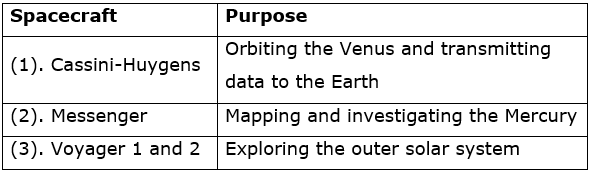
Select the correct answer using the code given below.
Satellites used for telecommunication relay are kept in a geostationary orbit. A satellite is said to be in such an orbit when:
1) The orbit is geosynchronous.
2) The orbit is circular.
3) The orbit lies in the plane of the Earth's equator.
4) The orbit is at an altitude of 22,236 km
Select the correct answer using the codes given below:
An artificial satellite orbiting around the Earth does not fall down. This is so because the attraction of Earth



