
Consider the following statements: The Mangalyaan launched by ISRO 1. is also called the Mars Orbiter Mission 2. made India the second country to have a spacecraft orbit the Mars after USA 3. made India the only country to be successful in making its spacecraft orbit the Mars in its very first attempt Which of the statements given above is/are correct?
1 and 3 only
Understanding the Mangalyaan Mission Statements
The question asks us to evaluate three statements about ISRO's Mangalyaan mission. Mangalyaan is India's first interplanetary mission. Let's analyze each statement carefully to determine its accuracy regarding the Mangalyaan mission.
We need to consider the following statements:
- Statement 1: The Mangalyaan launched by ISRO is also called the Mars Orbiter Mission.
- Statement 2: It made India the second country to have a spacecraft orbit the Mars after USA.
- Statement 3: It made India the only country to be successful in making its spacecraft orbit the Mars in its very first attempt.
Analyzing Each Statement about Mangalyaan
Let's break down each statement:
Statement 1: The Mangalyaan launched by ISRO is also called the Mars Orbiter Mission.
This statement is correct. The official name of the mission is the Mars Orbiter Mission (MOM), and "Mangalyaan" is the popular and informal name given to the spacecraft and the mission. The two terms are widely used interchangeably.
Statement 2: It made India the second country to have a spacecraft orbit the Mars after USA.
This statement is incorrect. Before India, several other entities had successfully sent spacecraft to orbit Mars. These include:
- The Soviet Union (USSR/Russia)
- The United States (USA)
- The European Space Agency (ESA)
India became the fourth space agency (and third country, considering ESA is a multi-national agency) to successfully achieve Mars orbit. Therefore, it was not the second country after the USA.
Statement 3: It made India the only country to be successful in making its spacecraft orbit the Mars in its very first attempt.
This statement is correct. ISRO's Mars Orbiter Mission (Mangalyaan) successfully entered Mars orbit on September 24, 2014, on its maiden attempt. This was a historic achievement, making India the first country globally to succeed in a Mars mission on its first try. Many previous Mars missions by other countries had failed on their initial attempts.
Conclusion on Correct Statements
Based on the analysis:
- Statement 1 is correct.
- Statement 2 is incorrect.
- Statement 3 is correct.
Therefore, the correct statements are 1 and 3.
Choosing the Correct Option
We are looking for the option that includes only statements 1 and 3.
- Option 1: 1 only (Incorrect, Statement 3 is also correct)
- Option 2: 2 and 3 only (Incorrect, Statement 2 is incorrect)
- Option 3: 1 and 3 only (Correct, Statements 1 and 3 are correct)
- Option 4: 1, 2 and 3 (Incorrect, Statement 2 is incorrect)
The option that correctly identifies statements 1 and 3 as correct is Option 3.
Revision Table: Mangalyaan Key Facts
| Feature | Detail |
|---|---|
| Mission Name | Mars Orbiter Mission (MOM) / Mangalyaan |
| Launched by | ISRO (Indian Space Research Organisation) |
| Launch Vehicle | PSLV-XL C25 |
| Launch Date | November 5, 2013 |
| Mars Orbit Insertion | September 24, 2014 |
| Key Achievement 1 | First country to succeed in Mars mission on first attempt |
| Key Achievement 2 | Fourth space agency globally to reach Mars orbit |
| Primary Goal | Technology demonstration, Mars surface features study, atmosphere composition study |
Additional Information on Mars Missions
Exploring Mars has been a significant goal for various space agencies since the dawn of the space age. Many missions have been sent, including orbiters, landers, and rovers. Achieving a stable orbit around Mars requires precise calculations and execution due to gravitational forces and the specific velocity needed.
Here's a brief look at some successful Mars orbiters before Mangalyaan:
- USSR/Russia: Successfully orbited Mars with missions like Mars 2 and Mars 3 (though landers failed) in the early 1970s. Subsequent orbiters like Phobos 2 were also successful.
- USA (NASA): NASA has had numerous successful Mars orbiters, starting with Mariner 9 in 1971. Subsequent missions like Mars Global Surveyor, Mars Odyssey, Mars Reconnaissance Orbiter, and MAVEN were also successful orbiters operating before or during Mangalyaan's mission.
- European Space Agency (ESA): ESA successfully placed the Mars Express spacecraft into orbit around Mars in 2003.
Mangalyaan's success on its first try was a testament to ISRO's growing capabilities and cost-effective approach to space exploration. It was a major milestone for India's space program.
Important Questions from Space and Nuclear Program
With reference to `Astrosat', the astronomical observatory launched by India, which of the following statements is/are correct?
1. Other than USA and Russia, India is the only country to have launched a similar observatory into space.
2. Astrosat is a 2000 kg satellite placed in an orbit at 1650 km above the surface of the Earth.
Select the correct answer using the code given below.
Which of the following pair is/are correctly matched?
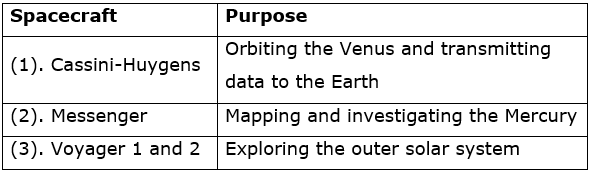
Select the correct answer using the code given below.
Satellites used for telecommunication relay are kept in a geostationary orbit. A satellite is said to be in such an orbit when:
1) The orbit is geosynchronous.
2) The orbit is circular.
3) The orbit lies in the plane of the Earth's equator.
4) The orbit is at an altitude of 22,236 km
Select the correct answer using the codes given below:
An artificial satellite orbiting around the Earth does not fall down. This is so because the attraction of Earth
Electrically charged particles from space travelling at speeds of several hundred km/sec can severely harm living beings if they reach the surface of the Earth What prevents them from reaching the surface of the Earth?


