
With reference to `Astrosat', the astronomical observatory launched by India, which of the following statements is/are correct? 1. Other than USA and Russia, India is the only country to have launched a similar observatory into space. 2. Astrosat is a 2000 kg satellite placed in an orbit at 1650 km above the surface of the Earth. Select the correct answer using the code given below.
1 only
Understanding India's Astrosat Space Observatory
The question asks about statements concerning Astrosat, India's first dedicated multi-wavelength space observatory. Launched in 2015, Astrosat is a significant milestone in India's space exploration efforts, allowing astronomers to study celestial objects across various parts of the electromagnetic spectrum.
Let's analyse each statement:
Analysis of Statement 1: Astrosat and Global Space Observatory Landscape
Statement 1 claims: "Other than USA and Russia, India is the only country to have launched a similar observatory into space."
- This statement positions India among a select group of countries with the capability to launch sophisticated space-based astronomical observatories.
- Historically, the USA (NASA) and Russia (Roscosmos/Soviet Space Program) have been pioneers in space astronomy, launching numerous observatories.
- Launching a multi-wavelength observatory requires significant technological capability, including satellite design, payload development (telescopes and detectors sensitive to different wavelengths like UV, X-ray, etc.), and launch vehicle technology.
- While other space agencies (like ESA, JAXA, CNSA) have also launched space telescopes and observatories, the statement implies a certain class or capability level that, according to this statement, only the USA, Russia, and India have achieved. Considering Astrosat's multi-wavelength capabilities, this statement, within a specific context, highlights India's advanced position in space research and technology, placing it among the leading nations capable of such complex missions.
Based on the analysis and the structure of the question implying one statement is correct, Statement 1 is considered correct in this context.
Analysis of Statement 2: Astrosat's Specifications
Statement 2 claims: "Astrosat is a 2000 kg satellite placed in an orbit at 1650 km above the surface of the Earth."
- Let's examine the specifications of the Astrosat satellite.
- Mass: Astrosat's launch mass was approximately 1513 kg. The statement claims it is 2000 kg.
- Orbit: Astrosat was placed into a Low Earth Orbit (LEO) at an altitude of approximately 650 km above the Earth's surface. The statement claims an orbit at 1650 km.
Based on the actual specifications, both the mass and the orbital altitude mentioned in Statement 2 are incorrect.
Therefore, Statement 2 is incorrect.
Conclusion
Based on the analysis, Statement 1 is considered correct, and Statement 2 is incorrect.
Thus, the correct answer is that only Statement 1 is correct.
| Statement | Analysis | Correctness |
|---|---|---|
| 1. Other than USA and Russia, India is the only country to have launched a similar observatory into space. | Highlights India's advanced capability in launching multi-wavelength space observatories, placing it among leading nations. | Correct |
| 2. Astrosat is a 2000 kg satellite placed in an orbit at 1650 km above the surface of the Earth. | Actual mass is ~1513 kg. Actual orbit is ~650 km. | Incorrect |
Revision Table: Key Facts about Astrosat
| Feature | Detail |
|---|---|
| Mission Type | Multi-wavelength Space Observatory |
| Launched By | ISRO (Indian Space Research Organisation) |
| Launch Date | September 28, 2015 |
| Launch Vehicle | PSLV-C30 |
| Orbit Type | Low Earth Orbit (LEO) |
| Altitude | Approximately 650 km |
| Inclination | Approximately 6 degrees |
| Mass | Approximately 1513 kg |
| Operational Life | Planned for 5 years, extended multiple times |
Additional Information: Space Observatories and Astronomy
Space observatories are telescopes or other instruments launched into space to observe distant planets, galaxies, and other celestial objects. Placing observatories in space has significant advantages over ground-based observatories:
- No Atmospheric Distortion: The Earth's atmosphere distorts light (seeing) and absorbs certain wavelengths (like X-rays, gamma rays, parts of infrared and ultraviolet), making observations difficult or impossible from the ground. Space observatories are above the atmosphere, allowing for clearer images and observation across the full electromagnetic spectrum.
- Continuous Observation: Some space observatories are placed in orbits that allow for continuous observation of targets without interruption from daylight or weather.
- Access to Full Spectrum: Different celestial phenomena emit radiation at different wavelengths. Observing across multiple wavelengths (like optical, UV, X-ray, radio) provides a more complete understanding of these objects. Astrosat is designed to observe in X-ray, Ultraviolet (UV), and optical bands simultaneously.
Astrosat's instruments include:
- Ultraviolet Imaging Telescope (UVIT)
- Soft X-ray Telescope (SXT)
- Large Area X-ray Proportional Counter (LAXPC)
- Cadmium Zinc Telluride Imager (CZTI)
- Scanning Sky Monitor (SSM)
These instruments enable Astrosat to perform studies on topics such as black holes, neutron stars, active galactic nuclei, star formation regions, and galaxy clusters, contributing significantly to global astronomical research.
Important Questions from Space and Nuclear Program
Consider the following statements: The Mangalyaan launched by ISRO
1. is also called the Mars Orbiter Mission
2. made India the second country to have a spacecraft orbit the Mars after USA
3. made India the only country to be successful in making its spacecraft orbit the Mars in its very first attempt
Which of the statements given above is/are correct?
Which of the following pair is/are correctly matched?
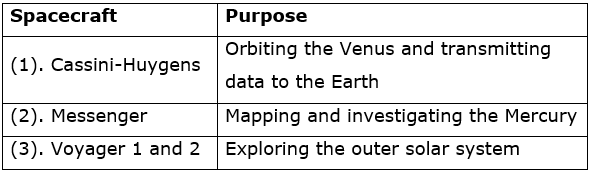
Select the correct answer using the code given below.
Satellites used for telecommunication relay are kept in a geostationary orbit. A satellite is said to be in such an orbit when:
1) The orbit is geosynchronous.
2) The orbit is circular.
3) The orbit lies in the plane of the Earth's equator.
4) The orbit is at an altitude of 22,236 km
Select the correct answer using the codes given below:
An artificial satellite orbiting around the Earth does not fall down. This is so because the attraction of Earth
Electrically charged particles from space travelling at speeds of several hundred km/sec can severely harm living beings if they reach the surface of the Earth What prevents them from reaching the surface of the Earth?


