
An artificial satellite orbiting around the Earth does not fall down. This is so because the attraction of Earth
provides the necessary acceleration for its motion
Understanding Why Artificial Satellites Orbit Earth
The question asks why an artificial satellite remains in orbit around the Earth instead of falling down. This is a fundamental concept in orbital mechanics and relates to the interaction between Earth's gravity and the satellite's motion.
The Role of Earth's Gravity
Earth exerts a gravitational force on everything around it, including artificial satellites. This force pulls objects towards the center of the Earth. For an object on the surface, this force causes it to fall if not supported. For an object in orbit, this force plays a crucial role in keeping it in its path.
Gravity as Centripetal Force
An artificial satellite moves at a very high speed tangential to the Earth. If there were no force acting on it, it would move in a straight line (Newton's first law). However, Earth's gravitational pull constantly acts on the satellite, pulling it towards the Earth's center.
This constant pull is what provides the necessary centripetal force. A centripetal force is a force that acts towards the center of a circular or curved path. It is this force that causes the object to change direction continuously, keeping it moving in a curve rather than a straight line.
Mathematically, the gravitational force $F_g$ provides the centripetal force $F_c$ needed for the circular motion (assuming a circular orbit for simplicity):
$\qquad F_g = F_c$
$\qquad \frac{G M m}{r^2} = \frac{m v^2}{r}$
Where:
- $G$ is the gravitational constant
- $M$ is the mass of the Earth
- $m$ is the mass of the satellite
- $r$ is the orbital radius
- $v$ is the orbital speed
From this equation, we can see that for a given orbital radius $r$, there is a specific speed $v$ required to maintain the orbit.
Gravity Provides Necessary Acceleration
According to Newton's second law of motion ($F = ma$), a force causes acceleration. In the case of a satellite in orbit, the gravitational force provides the centripetal acceleration ($a_c$) needed to keep it moving in a circle:
$\qquad F_g = m a_c$
$\qquad a_c = \frac{F_g}{m} = \frac{v^2}{r}$
This acceleration is always directed towards the center of the Earth. It doesn't change the *magnitude* of the satellite's velocity (its speed) in a perfect circular orbit, but it continuously changes its *direction*, pulling it away from the straight line path it would otherwise follow.
So, the satellite isn't "falling down" in the sense of decreasing its altitude and hitting the Earth because its high tangential velocity combined with the continuous centripetal acceleration provided by gravity causes it to follow the curvature of the Earth, staying in orbit.
Analyzing the Options
Let's examine the given options in light of this understanding:
- Option 1: "does not exist at such distance" - Incorrect. Earth's gravity exists and is significant at satellite altitudes. Without it, the satellite would fly off into space.
- Option 2: "is neutralized by the attraction of the moon" - Incorrect. While the Moon does exert a gravitational pull, it does not neutralize Earth's much stronger attraction at orbital distances. The Moon's gravity causes minor perturbations in the orbit, but is not the primary factor in preventing the satellite from falling.
- Option 3: "provides the necessary speed for its steady motion" - Incorrect. Gravity is the force that causes acceleration (change in velocity). While orbital speed is determined by the balance between gravity and inertia, gravity directly provides the acceleration needed to curve the path, not the speed itself. The initial speed is provided by the launch vehicle.
- Option 4: "provides the necessary acceleration for its motion" - Correct. Earth's gravitational force provides the centripetal acceleration that continuously changes the direction of the satellite's velocity, keeping it in its curved orbital path around the Earth. This acceleration prevents the satellite from flying off into space or falling towards Earth.
Therefore, the reason an artificial satellite orbiting around the Earth does not fall down is because the attraction of Earth provides the necessary acceleration for its motion, specifically the centripetal acceleration that keeps it in orbit.
| Concept | Explanation |
|---|---|
| Earth's Gravity | Attractive force pulling the satellite towards Earth's center. |
| Satellite's Velocity | High speed tangential to the orbit. |
| Centripetal Force | Provided by Earth's gravity; acts towards the center. |
| Centripetal Acceleration | Caused by the centripetal force; changes velocity direction, not speed (in circular orbit). |
| Result | Satellite follows a curved path (orbit) around the Earth, not falling towards it. |
Revision Table: Artificial Satellite Orbit Concepts
| Key Term | Brief Description | ||
|---|---|---|---|
| Orbit | The curved path of a celestial object or spacecraft around a star, planet, or moon. | ||
| Gravity | The force of attraction between objects with mass. Earth's gravity pulls the satellite. | Centripetal Force | A force directed towards the center of rotation for an object moving in a curved path. Earth's gravity provides this for the satellite. |
| Acceleration | The rate of change of velocity. Centripetal acceleration changes the direction of velocity. | ||
| Inertia | The tendency of an object to resist changes in its state of motion. Without gravity, the satellite's inertia would carry it in a straight line. |
Additional Information: Orbital Motion & Satellites
Understanding satellite orbits involves several key concepts:
- Orbital Velocity: The specific speed required for a satellite to maintain a stable orbit at a given altitude. If the speed is too low, it will fall back to Earth; if too high, it may escape Earth's gravity.
- Types of Orbits: Orbits are not always perfectly circular. They can be elliptical. In an elliptical orbit, the speed changes (faster when closer to Earth, slower when farther away), but gravity still provides the necessary acceleration to keep it on the curved path.
- Falling Analogy: A common way to think about orbiting is that the satellite is constantly "falling" towards the Earth, but it is moving sideways so fast that the Earth's surface curves away beneath it at the same rate it falls.
- Why Satellites Don't Need Fuel (to stay in orbit): Once in a stable orbit, a satellite ideally doesn't need continuous thrust from engines to stay there because gravity provides the required centripetal force. Fuel is used for initial launch, orbital maneuvers, or station-keeping against minor perturbations (like atmospheric drag at lower altitudes or gravitational pulls from the Moon/Sun).
In summary, Earth's gravity is essential for keeping satellites in orbit by providing the centripetal acceleration that dictates their path.
Important Questions from Space and Nuclear Program
With reference to `Astrosat', the astronomical observatory launched by India, which of the following statements is/are correct?
1. Other than USA and Russia, India is the only country to have launched a similar observatory into space.
2. Astrosat is a 2000 kg satellite placed in an orbit at 1650 km above the surface of the Earth.
Select the correct answer using the code given below.
Consider the following statements: The Mangalyaan launched by ISRO
1. is also called the Mars Orbiter Mission
2. made India the second country to have a spacecraft orbit the Mars after USA
3. made India the only country to be successful in making its spacecraft orbit the Mars in its very first attempt
Which of the statements given above is/are correct?
Which of the following pair is/are correctly matched?
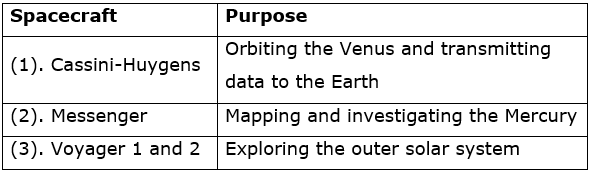
Select the correct answer using the code given below.
Satellites used for telecommunication relay are kept in a geostationary orbit. A satellite is said to be in such an orbit when:
1) The orbit is geosynchronous.
2) The orbit is circular.
3) The orbit lies in the plane of the Earth's equator.
4) The orbit is at an altitude of 22,236 km
Select the correct answer using the codes given below:
Electrically charged particles from space travelling at speeds of several hundred km/sec can severely harm living beings if they reach the surface of the Earth What prevents them from reaching the surface of the Earth?


