
Satellites used for telecommunication relay are kept in a geostationary orbit. A satellite is said to be in such an orbit when: 1) The orbit is geosynchronous. 2) The orbit is circular. 3) The orbit lies in the plane of the Earth's equator. 4) The orbit is at an altitude of 22,236 km Select the correct answer using the codes given below:
1, 2 and 3 only
Understanding Geostationary Orbits for Telecommunication Satellites
The question asks about the conditions under which a satellite is considered to be in a geostationary orbit, particularly those used for telecommunication relay. A geostationary orbit is a specific type of orbit that allows a satellite to appear fixed in the sky relative to an observer on Earth. This is crucial for telecommunications as ground antennas can remain pointed in a single direction without tracking the satellite's movement.
Analyzing the Conditions for a Geostationary Orbit
Let's examine each condition provided:
-
The orbit is geosynchronous: A geosynchronous orbit is one where the satellite's orbital period is equal to the Earth's sidereal rotation period (approximately 23 hours, 56 minutes, 4 seconds). This means the satellite completes one orbit around the Earth in the same time it takes the Earth to rotate once on its axis. This is a necessary condition for the satellite to appear stationary relative to Earth over time.
-
The orbit is circular: If the orbit were elliptical, the satellite's speed and distance from Earth would vary throughout its orbit. Even with a geosynchronous period, an elliptical orbit would cause the satellite to drift east and west in the sky from a ground observer's perspective. A circular orbit ensures the satellite maintains a constant speed and altitude, which is necessary for it to appear fixed.
-
The orbit lies in the plane of the Earth's equator: If the orbit were inclined relative to the equator, the satellite would appear to move north and south of the equator during its orbit, even if the period is geosynchronous and the orbit is circular. To appear truly stationary above a single point on the equator, the orbit must lie exactly in the equatorial plane.
-
The orbit is at an altitude of 22,236 km: The altitude of a geostationary orbit is a consequence of the conditions above (geosynchronous period, circular, equatorial plane) and Earth's gravitational pull. The standard altitude for a geostationary orbit above the Earth's surface is approximately 35,786 km (about 22,236 miles). The figure given (22,236 km) is significantly lower than the required altitude for a geosynchronous period in Earth's gravity. Therefore, this statement as written with "km" is factually incorrect for a standard geostationary orbit. Even if the altitude were correct, it is a result of the orbital mechanics given the required period, not one of the primary defining geometric or temporal conditions itself.
Identifying the Defining Conditions
For a satellite to be in a geostationary orbit, it must meet three key criteria:
- It must have a period equal to Earth's sidereal rotation period (Geosynchronous).
- Its orbit must be circular.
- Its orbit must be in the plane of the Earth's equator.
These three conditions together ensure that the satellite appears motionless relative to a fixed point on the Earth's surface, making it ideal for continuous telecommunication links.
Statement 4 provides an altitude which is a result of these conditions, but as given (22,236 km), it is incorrect for a standard geostationary orbit. Even if the altitude were correct, it is typically considered a consequence rather than a fundamental defining characteristic like the period, shape, and inclination.
Therefore, the conditions that define a geostationary orbit are statements 1, 2, and 3.
Conclusion
Based on the analysis of the conditions, a satellite is said to be in a geostationary orbit when the orbit is geosynchronous, circular, and lies in the plane of the Earth's equator. The altitude is a result of these conditions and Earth's gravity.
Thus, the correct combination of statements is 1, 2 and 3 only.
Revision Table: Geostationary Orbit Properties
| Property | Description for Geostationary Orbit | Relevance |
|---|---|---|
| Orbital Period | Equals Earth's sidereal rotation period (~23h 56m) - Geosynchronous | Ensures satellite completes one orbit as Earth rotates once. |
| Orbit Shape | Circular | Ensures constant speed and altitude, preventing drift. |
| Orbital Plane | In the plane of the Earth's equator | Ensures satellite remains above the equator, preventing north/south drift. |
| Altitude (above surface) | Approximately 35,786 km (22,236 miles) | Result of geosynchronous period, circular orbit, and Earth's gravity. |
| Appearance from Ground | Appears stationary in the sky. | Primary benefit for telecommunications. |
Additional Information: Satellites and Orbits
Geostationary orbits are a type of Geosynchronous Earth Orbit (GEO). While all geostationary orbits are geosynchronous, not all geosynchronous orbits are geostationary.
- Geosynchronous Orbit (GSO): Any orbit with a period equal to Earth's sidereal rotation period. If the orbit is inclined or elliptical, the satellite will appear to oscillate in the sky (following a figure-eight pattern if circular and inclined).
- Geostationary Orbit (GEO): A specific type of GSO that is circular and lies exactly in the equatorial plane. Only a GEO appears truly stationary from the ground.
Satellites in geostationary orbit are vital for various applications:
- Telecommunications: Provides continuous coverage to large areas for TV broadcasting, phone services, and internet.
- Meteorology: Provides constant views of weather systems over a region.
- Navigation Augmentation: Systems like WAAS (Wide Area Augmentation System) use geostationary satellites to improve GPS accuracy.
Placing a satellite into geostationary orbit is a complex process involving multiple orbital maneuvers, typically starting from a lower orbit and transferring to a geosynchronous transfer orbit (GTO) before reaching the final geostationary slot.
Important Questions from Space and Nuclear Program
With reference to `Astrosat', the astronomical observatory launched by India, which of the following statements is/are correct?
1. Other than USA and Russia, India is the only country to have launched a similar observatory into space.
2. Astrosat is a 2000 kg satellite placed in an orbit at 1650 km above the surface of the Earth.
Select the correct answer using the code given below.
Consider the following statements: The Mangalyaan launched by ISRO
1. is also called the Mars Orbiter Mission
2. made India the second country to have a spacecraft orbit the Mars after USA
3. made India the only country to be successful in making its spacecraft orbit the Mars in its very first attempt
Which of the statements given above is/are correct?
Which of the following pair is/are correctly matched?
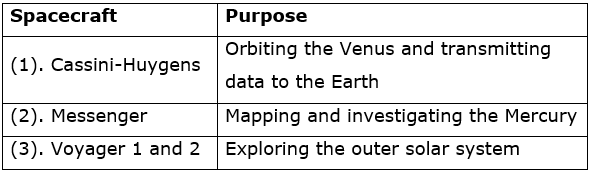
Select the correct answer using the code given below.
An artificial satellite orbiting around the Earth does not fall down. This is so because the attraction of Earth
Electrically charged particles from space travelling at speeds of several hundred km/sec can severely harm living beings if they reach the surface of the Earth What prevents them from reaching the surface of the Earth?


