
Electrically charged particles from space travelling at speeds of several hundred km/sec can severely harm living beings if they reach the surface of the Earth What prevents them from reaching the surface of the Earth?
Moisture in the upper layers of atmosphere prevents them from reaching the surface of the Earth
Understanding Charged Particles from Space
Electrically charged particles, such as protons and electrons, travel through space at very high speeds. These particles originate from sources like the Sun (solar wind) and distant cosmic events (cosmic rays). If these energetic particles reached the Earth's surface in large numbers, they could pose a significant health risk to living organisms due to their ability to ionize matter and cause radiation damage.
The Earth has natural defenses that protect the surface from most of these harmful particles. The question asks what specific mechanism prevents these particles from reaching the Earth's surface.
Analysing the Role of Atmospheric Moisture
Let's consider the statement that moisture in the upper layers of the atmosphere prevents these particles from reaching the surface.
The Earth's atmosphere is composed of various gases, including water vapor (moisture), especially in the lower layers, but significant amounts can also exist in the upper troposphere and lower stratosphere. When high-speed charged particles enter the atmosphere, they collide with the atoms and molecules present. These collisions can cause the particles to lose energy, scatter, and eventually be absorbed or stopped before they reach the ground.
Moisture, being polar molecules, could potentially interact with charged particles through electrostatic forces. Collisions with water molecules would contribute to the total number of interactions experienced by the incoming particles. Each interaction can cause the particle to lose a small amount of energy and deviate from its path. Over multiple collisions in the upper layers of the atmosphere where moisture is present, the cumulative effect could be significant energy loss and scattering, effectively preventing many particles from penetrating further down to the surface.
In this context, moisture is considered one of the atmospheric components that interacts with the incoming charged particles, contributing to their deceleration and scattering.
Evaluating the Options
Let's look at the given options:
- The Earth's magnetic field diverts them towards its poles.
- Ozone layer around the Earth reflects them back to outer space.
- Moisture in the upper layers of atmosphere prevents them from reaching the surface of the Earth.
- None of the statements (a), (b) and (c) given above is correct.
Based on the provided answer text, the mechanism highlighted is the interaction with moisture in the upper atmosphere. This suggests that among the given options, the presence of moisture is considered the factor preventing the particles from reaching the surface.
While the Earth's magnetic field is a primary shield diverting many charged particles (especially solar wind) towards the poles (causing phenomena like the aurora), the question asks what prevents them from reaching the surface. Particles not completely diverted by the magnetic field still encounter the atmosphere.
The ozone layer primarily absorbs ultraviolet radiation from the Sun and does not reflect charged particles back to space.
The provided statement focuses on moisture in the upper atmosphere as the preventing mechanism.
Conclusion
Considering the provided options and the mechanism described wherein interactions with atmospheric constituents cause energy loss and scattering, the presence of moisture in the upper layers of the atmosphere is presented as the factor that prevents high-speed electrically charged particles from space from reaching the surface of the Earth.
Revision Table: Atmospheric Protection
| Protective Mechanism | Primary Interaction | Effect on Charged Particles |
|---|---|---|
| Earth's Magnetic Field | Lorentz Force | Diverts particles, channels towards poles |
| Earth's Atmosphere | Collisions with gas molecules (including moisture) | Energy loss, scattering, absorption |
| Ozone Layer | Absorption of UV radiation | Minimal direct effect on charged particles |
Additional Information: Particle Interaction with Atmosphere
When high-energy charged particles enter the Earth's atmosphere, they undergo a cascade of interactions. These interactions involve:
- Ionization: The particle transfers energy to atmospheric atoms or molecules, knocking out electrons and creating ions.
- Excitation: The particle raises atmospheric atoms or molecules to higher energy levels.
- Scattering: Collisions with atmospheric particles change the direction of the incoming particle.
These processes cause the incoming particle to rapidly lose energy. The higher the density of the atmosphere, the more frequent these interactions become. The upper layers of the atmosphere, while less dense than lower layers, are still substantial enough to interact with and stop many high-energy particles before they reach the ground. Different atmospheric components, including nitrogen, oxygen, and water vapor (moisture), contribute to this stopping power through these interactions.
Important Questions from Space and Nuclear Program
With reference to `Astrosat', the astronomical observatory launched by India, which of the following statements is/are correct?
1. Other than USA and Russia, India is the only country to have launched a similar observatory into space.
2. Astrosat is a 2000 kg satellite placed in an orbit at 1650 km above the surface of the Earth.
Select the correct answer using the code given below.
Consider the following statements: The Mangalyaan launched by ISRO
1. is also called the Mars Orbiter Mission
2. made India the second country to have a spacecraft orbit the Mars after USA
3. made India the only country to be successful in making its spacecraft orbit the Mars in its very first attempt
Which of the statements given above is/are correct?
Which of the following pair is/are correctly matched?
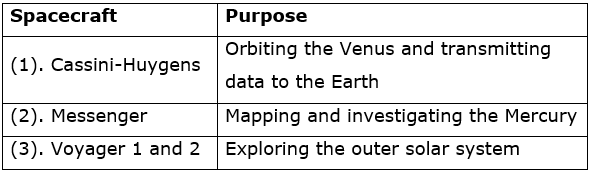
Select the correct answer using the code given below.
Satellites used for telecommunication relay are kept in a geostationary orbit. A satellite is said to be in such an orbit when:
1) The orbit is geosynchronous.
2) The orbit is circular.
3) The orbit lies in the plane of the Earth's equator.
4) The orbit is at an altitude of 22,236 km
Select the correct answer using the codes given below:
An artificial satellite orbiting around the Earth does not fall down. This is so because the attraction of Earth


