
Consider the following statements:
1. The Aditya-L1 mission was launched to replace the INSAT series of weather satellites.
2. Aditya-L1 successfully entered a Halo Orbit around the Lagrange Point 1 (L1) to observe solar activity.
Which of the statements given above is/are correct?
Aditya-L1 Mission Objectives and Orbit
This section analyzes the two statements provided regarding the Aditya-L1 mission to determine their accuracy.
Statement 1 Analysis: Aditya-L1 vs. INSAT Series
Statement 1 claims that the Aditya-L1 mission was launched to replace the INSAT series of weather satellites. Let's examine this:
- The INSAT series (Indian National Satellite system) is a multipurpose satellite constellation used for telecommunications, broadcasting, weather forecasting, and disaster warning services.
- The Aditya-L1 mission, launched by ISRO, is specifically designed for solar observation. Its primary goal is to study the Sun's corona, solar winds, flares, and CMEs (Coronal Mass Ejections), and other solar phenomena.
- Aditya-L1's objective is solar research, not the replacement of the functionalities provided by the INSAT satellites, which cover a much broader range of applications including meteorology.
Therefore, Statement 1 is incorrect.
Statement 2 Analysis: Aditya-L1 Orbit and Purpose
Statement 2 states that Aditya-L1 successfully entered a Halo Orbit around the Lagrange Point 1 (L1) to observe solar activity. Let's verify this:
- The Aditya-L1 spacecraft was indeed placed into a specific orbit around the Sun-Earth Lagrange Point 1 (L1).
- This L1 point is located about 1.5 million kilometers from Earth, situated between the Sun and Earth.
- Orbiting the L1 point allows Aditya-L1 to maintain a relatively stable position and continuously observe the Sun without any obstruction or eclipse from the Earth or Moon. This vantage point is crucial for its scientific objective of studying solar activities.
- The mission successfully achieved this halo orbit in January 2024.
Thus, Statement 2 is correct.
Conclusion on Correct Statements
Based on the analysis of both statements:
- Statement 1 is incorrect because Aditya-L1 is not a replacement for the INSAT series.
- Statement 2 is correct as Aditya-L1 is in a Halo Orbit around L1 for solar observation.
Therefore, only Statement 2 is correct.
Similar Questions
Which of the following ISRO initiatives, launched with the vision of "Catch them young", aims to introduce school students to space science and technology?
- What is the main objective of ISRO'S SCATSAT-1 satellite?
- Who was announced on 26 June 2025 as first Indian astronaut for Titans Space mission?
- India's support for which of the following missions aligns most closely with IMEC's purpose?
- What advanced technology is being tested in ISRO's new "Next Generation Launch Vehicle" (NGLV) project to replace PSLV and GSLV?
- Which solar phenomenon is responsible for disturbances in Earth's magnetic field?
- Earth remote sensing satellites (EOS) are primarily designed to:
- What is the name of the satellite launched by ISRO's GSLV-F09 that was a gift to SAARC nations?
Who gave the expanding universe hypothesis?
Important Questions from Space and Nuclear Program
With reference to `Astrosat', the astronomical observatory launched by India, which of the following statements is/are correct?
1. Other than USA and Russia, India is the only country to have launched a similar observatory into space.
2. Astrosat is a 2000 kg satellite placed in an orbit at 1650 km above the surface of the Earth.
Select the correct answer using the code given below.
Consider the following statements: The Mangalyaan launched by ISRO
1. is also called the Mars Orbiter Mission
2. made India the second country to have a spacecraft orbit the Mars after USA
3. made India the only country to be successful in making its spacecraft orbit the Mars in its very first attempt
Which of the statements given above is/are correct?
Which of the following pair is/are correctly matched?
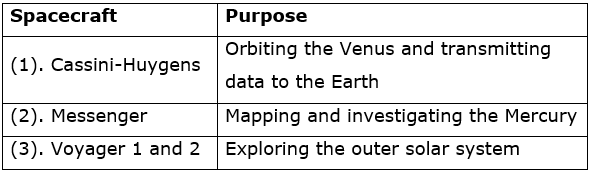
Select the correct answer using the code given below.
Satellites used for telecommunication relay are kept in a geostationary orbit. A satellite is said to be in such an orbit when:
1) The orbit is geosynchronous.
2) The orbit is circular.
3) The orbit lies in the plane of the Earth's equator.
4) The orbit is at an altitude of 22,236 km
Select the correct answer using the codes given below:
An artificial satellite orbiting around the Earth does not fall down. This is so because the attraction of Earth



