
ISRO NGLV Project: Future Launch Vehicle Technology
The Indian Space Research Organisation (ISRO) is developing a new heavy-lift rocket called the Next Generation Launch Vehicle (NGLV). This ambitious project aims to create a more powerful and versatile launch system that will eventually replace the current Polar Satellite Launch Vehicle (PSLV) and Geosynchronous Satellite Launch Vehicle (GSLV) families.
Advanced Technology in NGLV
The NGLV project is focused on incorporating cutting-edge technologies to enhance performance, reduce costs, and increase launch frequency. The core advanced technology being tested and developed for the NGLV includes:
- Reusable Booster Stage: This involves designing the first stage (booster) of the rocket so that it can return to Earth safely after launch and be refurbished for future missions. Reusability significantly cuts down the cost of space launches as the expensive hardware is not discarded after a single use.
- Semi-Cryogenic Engine: This advanced engine technology uses a mixture of a refined petroleum product (like kerosene or methane) as fuel and liquid oxygen (LOX) as the oxidizer. Compared to traditional cryogenic engines (which use liquid hydrogen and liquid oxygen), semi-cryogenic engines offer higher thrust and are generally more cost-effective to operate, making them ideal for the first stage of a heavy-lift vehicle.
By integrating a reusable booster stage with a powerful semi-cryogenic engine, ISRO aims to make its future launch capabilities more efficient and economical, competing effectively in the global commercial launch market.
Analysis of Other Options
While other technologies exist in rocketry, they are not the primary focus for ISRO's NGLV as described:
- Quantum entanglement-based control: This is a theoretical concept for communication or computing and is not applicable to current rocket propulsion or control systems.
- Ramjet propulsion: Ramjets are air-breathing engines used for high-speed atmospheric flight (like missiles or experimental aircraft) and are unsuitable for the vacuum of space.
- Multiple orbital drop pods: This sounds like a concept for payload deployment rather than core launch vehicle propulsion technology.
Therefore, the combination of a reusable booster stage and a semi-cryogenic engine represents the key advanced technology driving ISRO's NGLV development.
Similar Questions
- India's support for which of the following missions aligns most closely with IMEC's purpose?
- Which solar phenomenon is responsible for disturbances in Earth's magnetic field?
Consider the following statements:
1. The Aditya-L1 mission was launched to replace the INSAT series of weather satellites.
2. Aditya-L1 successfully entered a Halo Orbit around the Lagrange Point 1 (L1) to observe solar activity.
Which of the statements given above is/are correct?- Earth remote sensing satellites (EOS) are primarily designed to:
- What is the name of the satellite launched by ISRO's GSLV-F09 that was a gift to SAARC nations?
Who gave the expanding universe hypothesis?
Which of the following ISRO initiatives, launched with the vision of "Catch them young", aims to introduce school students to space science and technology?
- What is the main objective of ISRO'S SCATSAT-1 satellite?
- Who was announced on 26 June 2025 as first Indian astronaut for Titans Space mission?
Important Questions from Space and Nuclear Program
With reference to `Astrosat', the astronomical observatory launched by India, which of the following statements is/are correct?
1. Other than USA and Russia, India is the only country to have launched a similar observatory into space.
2. Astrosat is a 2000 kg satellite placed in an orbit at 1650 km above the surface of the Earth.
Select the correct answer using the code given below.
Consider the following statements: The Mangalyaan launched by ISRO
1. is also called the Mars Orbiter Mission
2. made India the second country to have a spacecraft orbit the Mars after USA
3. made India the only country to be successful in making its spacecraft orbit the Mars in its very first attempt
Which of the statements given above is/are correct?
Which of the following pair is/are correctly matched?
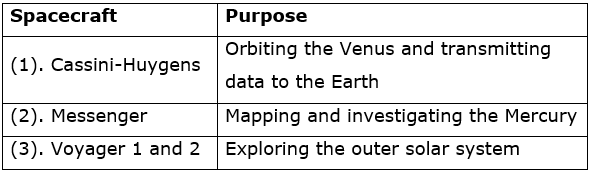
Select the correct answer using the code given below.
Satellites used for telecommunication relay are kept in a geostationary orbit. A satellite is said to be in such an orbit when:
1) The orbit is geosynchronous.
2) The orbit is circular.
3) The orbit lies in the plane of the Earth's equator.
4) The orbit is at an altitude of 22,236 km
Select the correct answer using the codes given below:
An artificial satellite orbiting around the Earth does not fall down. This is so because the attraction of Earth



