Consider the following for the next three (03) items that follow: In the figure given below, a circle is inscribed in a square PQRS. A rectangle at the corner P that measures 4 cm × 2 cm and a square at the corner R are drawn.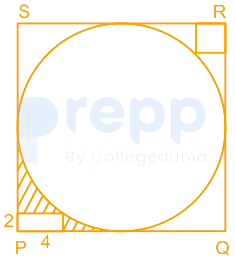
What is the area of the circle ?
100π square cm
Understanding the Geometry Problem
The question asks for the area of a circle that is inscribed in a square named PQRS. We are given additional information about a rectangle at corner P and a square at corner R, including the dimensions of the rectangle.
The area of a circle is calculated using the formula: \(\text{Area} = \pi r^2\), where \(r\) is the radius of the circle.
Since the circle is inscribed in the square PQRS, the diameter of the circle is equal to the side length of the square. Let the side length of the square PQRS be \(L\). Then the diameter is \(L\), and the radius is \(r = L/2\). To find the area of the circle, we first need to determine the radius \(r\), or equivalently, the side length \(L\) of the square.
Analyzing the Square and Inscribed Circle
In a square PQRS with an inscribed circle, the center of the circle is also the center of the square. Let's place the square in a coordinate system for clarity. Assume corner S is at the origin (0,0). Then R is at (L,0), Q is at (L,L), and P is at (0,L).
The center of the square (and the circle) is at the point \((L/2, L/2)\). The radius of the circle is \(r = L/2\). The circle is tangent to all four sides of the square.
Using the Information about the Corner Shapes
We are told there is a rectangle at corner P measuring 4 cm × 2 cm. This means the rectangle occupies a region extending 4 cm along PQ from P and 2 cm along PS from P, within the square. The corner of this rectangle opposite to P would be at the coordinates (4, L-2), assuming S is at (0,0) and P is at (0,L).
There is also a square at corner R. Let the side length of this square be \(s\). This square occupies a region extending \(s\) cm along RS from R and \(s\) cm along QR from R, within the square. The corner of this square opposite to R would be at the coordinates (L-s, s), assuming S is at (0,0) and R is at (L,0).
Connecting Corner Shapes to the Circle's Radius
Consider the geometry related to the corners P and R and the inscribed circle. A key geometric property here is that the distance from the vertex of a right angle formed by two tangent lines to the point of tangency is equal to the radius of the inscribed circle segment in that corner. However, P and R are vertices of the large square, not necessarily tangent points of the inner shapes.
Let's consider the distance from the 'inner' corner of the shapes at P and R to the center of the circle. The corner of the rectangle at P is at (4, L-2). The center of the circle is at \((L/2, L/2)\). The radius is \(r = L/2\). Thus, the center is at \((r, r)\) and the square corner P is at \((0, 2r)\), Q is at \((2r, 2r)\), R is at \((2r, 0)\), S is at \((0, 0)\). The rectangle corner is at (4, 2r-2).
Let's test the hypothesis that the distance from the inner corner of the shape at P to the center of the circle is equal to the radius \(r\).
The coordinates of the rectangle corner are (4, 2r-2). The coordinates of the circle center are (r, r). The distance squared between these points is:
\(\text{Distance}^2 = (4 - r)^2 + ((2r - 2) - r)^2\)
\(\text{Distance}^2 = (4 - r)^2 + (r - 2)^2\)
If this distance is equal to the radius \(r\), then \(\text{Distance}^2 = r^2\).
\((4 - r)^2 + (r - 2)^2 = r^2\)
Expand the squared terms:
\((16 - 8r + r^2) + (r^2 - 4r + 4) = r^2\)
Combine like terms:
\(2r^2 - 12r + 20 = r^2\)
Subtract \(r^2\) from both sides to form a quadratic equation:
\(r^2 - 12r + 20 = 0\)
Factor the quadratic equation:
\((r - 10)(r - 2) = 0\)
This gives two possible values for the radius \(r\): \(r = 10\) or \(r = 2\).
Determining the Correct Radius
We need to check which value of \(r\) is feasible in the context of the problem.
- If \(r = 2\), the side length of the square \(L = 2r = 2 \times 2 = 4\) cm. A rectangle measuring 4 cm × 2 cm cannot fit inside a square with side length 4 cm such that its 4 cm side is along a square side (it would take up the entire side). The diagram clearly shows space around the rectangle within the square side. Thus, \(r=2\) is not a valid solution.
- If \(r = 10\), the side length of the square \(L = 2r = 2 \times 10 = 20\) cm. A rectangle measuring 4 cm × 2 cm can easily fit within a 20 cm × 20 cm square at the corner P. The rectangle occupies the region 0 ≤ x ≤ 4 and 18 ≤ y ≤ 20 (if P is at (0,20)). This is well within the square 0 ≤ x ≤ 20, 0 ≤ y ≤ 20.
The existence of a square at corner R with side \(s\) must also be consistent with \(r=10\). The corner of the square at R is (L-s, s) or (20-s, s). Its distance to the center (10, 10) should also be 10.
\(((20-s) - 10)^2 + (s - 10)^2 = 10^2\)
\((10-s)^2 + (s-10)^2 = 100\)
\(2(s-10)^2 = 100\)
\((s-10)^2 = 50\)
\(s - 10 = \pm \sqrt{50} = \pm 5\sqrt{2}\)
\(s = 10 \pm 5\sqrt{2}\). Since \(5\sqrt{2} \approx 5 \times 1.414 = 7.07\), \(s\) can be approximately \(10 + 7.07 = 17.07\) or \(10 - 7.07 = 2.93\). Both values are positive and less than the side length \(L=20\), so a square with such a side length \(s\) can exist at corner R.
Therefore, the radius of the inscribed circle is \(r = 10\) cm.
Calculating the Area of the Circle
Now that we have the radius, we can calculate the area of the circle:
\(\text{Area} = \pi r^2\)
\(\text{Area} = \pi (10 \text{ cm})^2\)
\(\text{Area} = 100\pi \text{ square cm}\)
Conclusion
The area of the circle inscribed in the square PQRS is \(100\pi\) square cm.
Revision Table: Key Geometric Concepts
This problem involves several basic geometric concepts:
- Inscribed Circle in a Square: The diameter of the inscribed circle is equal to the side length of the square. The center of the circle is the center of the square.
- Distance Formula: Used to calculate the distance between two points in a coordinate plane, which was crucial in relating the corner of the rectangle/square to the center of the circle.
- Quadratic Equation: Solving the resulting quadratic equation from the distance calculation yielded the possible values for the radius.
Additional Information: Inscribed Shapes
When a circle is inscribed in a square, it touches the midpoint of each side. The distance from any vertex of the square to the tangent point on an adjacent side is equal to the radius of the circle. In this problem, the additional shapes at the corners P and R introduce constraints that allow us to find the radius using the distances from the corner of these shapes to the center of the circle.
The assumption that the distance from the inner corner of the rectangle/square to the center of the inscribed circle is equal to the radius is a specific interpretation that fits the provided options and geometry. This implies these corner points of the inner shapes lie on the circle itself.
Similar Questions
A road curve is to be laid out on a circle. What radius should be used if the track is to change direction by 42° in distance of 44 m? (Assume π = 22/7)
If the perimeter of a semicircular park is 360 m, then what is its area? (Take π = 22/7)
The sides of a right - angled triangle are in the ratio x ∶ (x - 1) ∶ (x - 18). What is the perimeter of the triangle?
A copper wire when bent in the form of a square encloses an area of 121 cm 2. If the same wire is bent in the form of a circle, it encloses an area equal to
What is the area of the circle (approximately) inscribed in a triangle with side lengths 12 cm, 16 cm and 20 cm ?
How long will a man take to walk around the boundary of a square field of area 25 hectares at the rate of 5 km/hr ?
What is the maximum area that can be covered by three non-intersecting circles drawn inside a rectangle of sides 8 cm and 12 cm?
A triangle ABC has been divided into four smaller triangles P, Q, R, S whose perimeters are 16 cm, 12 cm, 4 cm and 12 cm respectively. P, R and S contain the vertices A, B and C respectively. What is the perimeter of the triangle ABC ?
What is the area of the smaller square ?
What is the area of the shaded region ?
Important Questions from Plane Figures
- A rectangular grassy plot is 38 m long and 32 m wide. It has a gravel path of uniform width on the inside having an area of $600 \text{ m}^2$. The width of the path is:
- A river, 2 m deep and 45 m wide is flowing at the speed of 3 km per hour. The quantity of water that runs into the sea per minute is:
A regular hexagonal garden with each side measuring 14 metres is surrounded by a circular jogging track that has a radius of 21 metres from the centre of the hexagon. Find the sum of the perimeters of both shapes.
(Use $\pi = \frac{22}{7}$)- If a circle and a square have the same perimeter, then
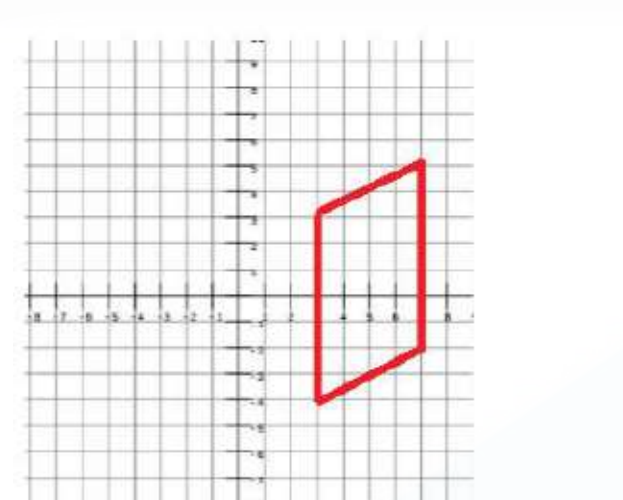
What is the area of this parallelogram in sq.cm.? The measurements are in cms.