
Consider the following for the next three (03) items that follow: In the figure given below, a circle is inscribed in a square PQRS. A rectangle at the corner P that measures 4 cm × 2 cm and a square at the corner R are drawn.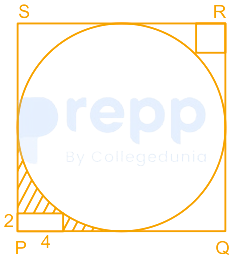
What is the area of the smaller square ?
50(3 - 2√2) square cm
Solving the Geometry Problem: Area of the Smaller Square
This problem involves a geometric figure consisting of a large square, an inscribed circle, a rectangle, and a smaller square. We are asked to find the area of the smaller square located at corner R of the large square PQRS.
Understanding the Geometric Setup
We have a square PQRS. A circle is inscribed within this square, meaning it touches all four sides. A rectangle with dimensions 4 cm \(\times\) 2 cm is placed at corner P, and a smaller square is placed at corner R. The image shows that a vertex of the rectangle (opposite to P) lies on the circle, and a vertex of the smaller square (opposite to R) also lies on the circle.
Finding the Side Length of the Large Square (PQRS)
Let the side length of the large square PQRS be \(s\). Since the circle is inscribed, its diameter is equal to the side length of the square, so the radius is \(s/2\).
Let's place the corner P at the origin \((0,0)\) of a coordinate system. Then the vertices of the square are P\((0,0)\), Q\((s,0)\), R\((s,s)\), and S\((0,s)\). The center of the square, and thus the center of the inscribed circle, is at \((s/2, s/2)\). The equation of the circle is given by:
\[ \left(x - \frac{s}{2}\right)^2 + \left(y - \frac{s}{2}\right)^2 = \left(\frac{s}{2}\right)^2 \]
The rectangle at corner P\((0,0)\) has dimensions 4 cm and 2 cm. The vertex of this rectangle opposite to P is at coordinates \((4,2)\). According to the problem description and the figure, this vertex lies on the inscribed circle.
Substitute the coordinates \((4,2)\) into the circle's equation:
\[ \left(4 - \frac{s}{2}\right)^2 + \left(2 - \frac{s}{2}\right)^2 = \left(\frac{s}{2}\right)^2 \]
Expand the terms:
\[ \left(16 - 2 \times 4 \times \frac{s}{2} + \frac{s^2}{4}\right) + \left(4 - 2 \times 2 \times \frac{s}{2} + \frac{s^2}{4}\right) = \frac{s^2}{4} \]
\[ \left(16 - 4s + \frac{s^2}{4}\right) + \left(4 - 2s + \frac{s^2}{4}\right) = \frac{s^2}{4} \]
Combine like terms:
\[ 20 - 6s + \frac{2s^2}{4} = \frac{s^2}{4} \]
\[ 20 - 6s + \frac{s^2}{2} = \frac{s^2}{4} \]
Multiply the entire equation by 4 to remove fractions:
\[ 4(20) - 4(6s) + 4\left(\frac{s^2}{2}\right) = 4\left(\frac{s^2}{4}\right) \]
\[ 80 - 24s + 2s^2 = s^2 \]
Rearrange into a quadratic equation:
\[ s^2 - 24s + 80 = 0 \]
We can solve this quadratic equation for \(s\) using the quadratic formula \(s = \frac{-b \pm \sqrt{b^2 - 4ac}}{2a}\):
\[ s = \frac{-(-24) \pm \sqrt{(-24)^2 - 4(1)(80)}}{2(1)} \]
\[ s = \frac{24 \pm \sqrt{576 - 320}}{2} \]
\[ s = \frac{24 \pm \sqrt{256}}{2} \]
\[ s = \frac{24 \pm 16}{2} \]
This gives two possible values for \(s\):
- \(s_1 = \frac{24 + 16}{2} = \frac{40}{2} = 20\) cm
- \(s_2 = \frac{24 - 16}{2} = \frac{8}{2} = 4\) cm
Looking at the figure, the side length of the large square \(s\) must be greater than the dimensions of the rectangle at corner P (which are 4 and 2). Therefore, \(s = 20\) cm is the correct side length for the large square PQRS.
Finding the Side Length of the Smaller Square
The smaller square is located at corner R. Let its side length be \(a\). With P at \((0,0)\), the coordinates of R are \((s,s)\), which is \((20,20)\). The smaller square at R has vertices \((20,20)\), \((20-a, 20)\), \((20, 20-a)\), and \((20-a, 20-a)\). The vertex of this smaller square opposite to R is at \((20-a, 20-a)\). This vertex lies on the inscribed circle.
Substitute the coordinates \((20-a, 20-a)\) into the circle's equation with \(s=20\) (so \(s/2 = 10\)):
\[ \left((20-a) - 10\right)^2 + \left((20-a) - 10\right)^2 = 10^2 \]
\[ \left(10 - a\right)^2 + \left(10 - a\right)^2 = 100 \]
\[ 2(10 - a)^2 = 100 \]
Divide by 2:
\[ (10 - a)^2 = 50 \]
Take the square root of both sides:
\[ 10 - a = \pm \sqrt{50} \]
\[ 10 - a = \pm \sqrt{25 \times 2} \]
\[ 10 - a = \pm 5\sqrt{2} \]
Now, solve for \(a\):
\[ a = 10 \mp 5\sqrt{2} \]
This gives two possible values for \(a\):
- \(a_1 = 10 + 5\sqrt{2}\)
- \(a_2 = 10 - 5\sqrt{2}\)
The smaller square is at corner R. Its side length \(a\) must be less than the radius of the circle \(s/2 = 10\) because the circle curves away from the corner. \(10 + 5\sqrt{2} \approx 10 + 5(1.414) = 10 + 7.07 = 17.07\), which is greater than 10. \(10 - 5\sqrt{2} \approx 10 - 7.07 = 2.93\), which is less than 10.
Therefore, the side length of the smaller square is \(a = 10 - 5\sqrt{2}\) cm.
Calculating the Area of the Smaller Square
The area of the smaller square is \(a^2\).
\[ \text{Area} = (10 - 5\sqrt{2})^2 \]
Expand the square using the formula \((p-q)^2 = p^2 - 2pq + q^2\):
\[ \text{Area} = 10^2 - 2(10)(5\sqrt{2}) + (5\sqrt{2})^2 \]
\[ \text{Area} = 100 - 100\sqrt{2} + (25 \times 2) \]
\[ \text{Area} = 100 - 100\sqrt{2} + 50 \]
\[ \text{Area} = 150 - 100\sqrt{2} \]
Factor out 50:
\[ \text{Area} = 50(3 - 2\sqrt{2}) \text{ square cm} \]
Conclusion
The area of the smaller square is \(50(3 - 2\sqrt{2})\) square cm.
Revision Table: Key Geometric Concepts
| Concept | Description | Relevance to Problem |
|---|---|---|
| Inscribed Circle | A circle inside a polygon that touches all sides of the polygon. | Used to relate the circle's radius to the square's side length. |
| Equation of a Circle | \((x-h)^2 + (y-k)^2 = r^2\), where \((h,k)\) is the center and \(r\) is the radius. | Used with coordinate geometry to find the unknown side lengths. |
| Quadratic Equation | An equation of the form \(ax^2 + bx + c = 0\). | Used to solve for the side lengths of the squares. |
| Coordinate Geometry | Using coordinates to represent geometric figures and solve problems. | Essential for setting up and solving the equations based on points lying on the circle. |
Additional Information: Solving Geometry Problems
When tackling geometry problems involving coordinates and curves, it's often helpful to:
- Draw or carefully examine the figure.
- Set up a coordinate system at a convenient point (like a corner or center).
- Write down the equations of the shapes involved (lines, circles, etc.).
- Use the given information (like points on a curve) to create equations.
- Solve the system of equations to find unknown values.
- Always check if the obtained solutions make sense in the context of the geometry (e.g., lengths must be positive, side lengths must fit within the figure).
- Be proficient with algebraic manipulations, including solving quadratic equations and simplifying radicals.
Similar Questions
Let x be the area of a square inscribed in a circle of radius r and y be the area of an equilateral triangle inscribed in the same circle. Which one of the following is correct ?
What is the area of the circle (approximately) inscribed in a triangle with side lengths 12 cm, 16 cm and 20 cm ?
A triangle ABC has been divided into four smaller triangles P, Q, R, S whose perimeters are 16 cm, 12 cm, 4 cm and 12 cm respectively. P, R and S contain the vertices A, B and C respectively. What is the perimeter of the triangle ABC ?
If the length of a rectangle is increased by \(66 \frac{2}{3} \%\), then by what percent should the width of the rectangle be decreased in order to maintain the same area ?
The perimeter of a sector of a circle of radius 5.2 cm is 16.4 cm. What is the area of the sector ?
What is the ratio of the area of the circle to the area of the rectangle ?
An equilateral triangle, a square and a circle have equal perimeter. If T, S and C denote the area of the triangle, area of the square and area of the circle respectively, then which one of the following is correct?
If the perimeter of a rectangle is 10 cm and the area is 4 cm 2, then its length is
Which of the following triplets does not represent the sides of a triangle?
Three circles each of radius 3.5 cm touch one another. The area subtended between them is
Important Questions from Plane Figures
A wheel makes 4000 revolution is covering a distance of 60 km. The radius of the wheel is:
A person bought a rectangular piece of land whose length and breadth are in the ratio 7 : 5. If the cost of fencing the land is ₹2,880 at the rate of ₹15/m, then what is the length of the land?
If the diameter of a circle increases by 15%, then what will be the percentage increase in its area?
The areas of two squares are 16 : 9. The ratio of their perimeter is:
A square with maximum possible side is drawn in a circle of radius 12 cm. What is the area of square?



