
Consider the following for the next two (02) items that follow : In the following figure, a rectangle ABCD is inscribed in a circle of radius r. Given ∠DAE = 30° and ∠ACD = 30°. 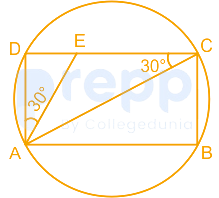
What is the ratio of the area of the circle to the area of the rectangle ?
Understanding the Problem: Ratio of Circle Area to Inscribed Rectangle Area
The problem asks for the ratio of the area of a circle to the area of a rectangle inscribed within it. We are given the radius of the circle, and two angles related to the figure: \(\angle DAE = 30^\circ\) and \(\angle ACD = 30^\circ\). The rectangle is ABCD.
Analyzing the Geometry
When a rectangle is inscribed in a circle, its diagonals are diameters of the circle. In rectangle ABCD, the diagonal AC is a diameter of the circle. We are given that the radius of the circle is \(r\). Therefore, the diameter AC is \(2r\).
In a rectangle, all angles are \(90^\circ\). So, \(\angle ADC = 90^\circ\). Triangle ADC is a right-angled triangle with the hypotenuse AC.
We are given that \(\angle ACD = 30^\circ\). In the right-angled triangle ADC, we can use trigonometry to find the lengths of the sides AD and CD (which are the width and length of the rectangle).
Calculating the Dimensions of the Rectangle
In right-angled triangle ADC:
- The side AD is opposite to angle \(\angle ACD\).
- The side CD is adjacent to angle \(\angle ACD\).
- The hypotenuse is AC.
Using trigonometric ratios:
- Sine of \(\angle ACD\): \( \sin(\angle ACD) = \frac{AD}{AC} \)
- Cosine of \(\angle ACD\): \( \cos(\angle ACD) = \frac{CD}{AC} \)
We have \(\angle ACD = 30^\circ\) and \(AC = 2r\).
Let's calculate the length of AD:
\[ AD = AC \times \sin(30^\circ) \]We know that \(\sin(30^\circ) = \frac{1}{2}\).
\[ AD = 2r \times \frac{1}{2} = r \]So, the width of the rectangle AD is \(r\).
Now, let's calculate the length of CD:
\[ CD = AC \times \cos(30^\circ) \]We know that \(\cos(30^\circ) = \frac{\sqrt{3}}{2}\).
\[ CD = 2r \times \frac{\sqrt{3}}{2} = r\sqrt{3} \]So, the length of the rectangle CD is \(r\sqrt{3}\).
The sides of the rectangle are \(r\) and \(r\sqrt{3}\).
Note: The angle \(\angle DAE = 30^\circ\) is not needed to determine the dimensions of the rectangle from the given information about the inscribed rectangle and \(\angle ACD\).
Calculating the Area of the Rectangle and the Circle
The area of the rectangle ABCD is given by:
\[ \text{Area of Rectangle} = \text{Length} \times \text{Width} = CD \times AD \] \[ \text{Area of Rectangle} = (r\sqrt{3}) \times r = r^2\sqrt{3} \]The area of the circle with radius \(r\) is given by:
\[ \text{Area of Circle} = \pi r^2 \]Calculating the Ratio of Areas
We need to find the ratio of the area of the circle to the area of the rectangle:
\[ \text{Ratio} = \frac{\text{Area of Circle}}{\text{Area of Rectangle}} \] \[ \text{Ratio} = \frac{\pi r^2}{r^2\sqrt{3}} \]We can cancel out the \(r^2\) terms:
\[ \text{Ratio} = \frac{\pi}{\sqrt{3}} \]Summary of Calculations
| Item | Formula/Value | Calculated Value |
|---|---|---|
| Circle Radius | \(r\) | \(r\) |
| Circle Diameter (AC) | \(2 \times \text{Radius}\) | \(2r\) |
| Angle \(\angle ACD\) | Given | \(30^\circ\) |
| Rectangle Width (AD) | \(AC \sin(30^\circ)\) | \(2r \times \frac{1}{2} = r\) |
| Rectangle Length (CD) | \(AC \cos(30^\circ)\) | \(2r \times \frac{\sqrt{3}}{2} = r\sqrt{3}\) |
| Area of Rectangle | \(AD \times CD\) | \(r \times r\sqrt{3} = r^2\sqrt{3}\) |
| Area of Circle | \(\pi r^2\) | \(\pi r^2\) |
| Ratio (Circle Area / Rectangle Area) | \(\frac{\pi r^2}{r^2\sqrt{3}}\) | \(\frac{\pi}{\sqrt{3}}\) |
The ratio of the area of the circle to the area of the rectangle is \(\frac{\pi}{\sqrt{3}}\).
Revision Table: Key Concepts
| Concept | Description | Relevance to Problem |
|---|---|---|
| Inscribed Rectangle | A rectangle drawn inside a circle such that all its vertices lie on the circle's circumference. | Its diagonal is the circle's diameter. |
| Circle Area | The space occupied by a circle, calculated as \(\pi r^2\). | Required for the numerator of the ratio. |
| Rectangle Area | The space occupied by a rectangle, calculated as Length \(\times\) Width. | Required for the denominator of the ratio. |
| Trigonometry (Sine and Cosine) | Used to relate angles and side lengths in right-angled triangles. | Used to find rectangle dimensions from diagonal and angle. |
Additional Information: Inscribed Shapes
Inscribed shapes are common in geometry problems. Knowing the properties of how certain shapes relate to the circle when inscribed is crucial.
- For an inscribed rectangle, the diagonal is always the diameter.
- For an inscribed right-angled triangle, the hypotenuse is always the diameter.
- For an inscribed equilateral triangle, there are specific relationships between its side length and the circle's radius.
- For an inscribed square, its diagonal is the circle's diameter, and its side length is \(r\sqrt{2}\) (where \(r\) is the radius).
These properties help in finding the dimensions of the inscribed shape based on the circle's properties, or vice versa, which is often the first step in solving such problems.
Similar Questions
ABCD is a trapezium in which AB is parallel to DC. Let E and F be the midpoints on AD and BC respectively. If EF = 10 cm and AB - DC = 4 cm, then what is the value of AB × DC?
The lengths of the sides of a right-angled triangle are consecutive even integers (in cm). What is the product of these integers?
Let x be the area of a square inscribed in a circle of radius r and y be the area of an equilateral triangle inscribed in the same circle. Which one of the following is correct ?
If the length of a rectangle is increased by \(66 \frac{2}{3} \%\), then by what percent should the width of the rectangle be decreased in order to maintain the same area ?
The perimeter and the area of a right-angled triangle are 36 cm and 54 square cm respectively. What is the length of the hypotenuse?
What is the area of Δ AEC ?
What is the area of a triangle with sides of length 12 cm, 13 cm and 5 cm?
A road curve is to be laid out on a circle. What radius should be used if the track is to change direction by 42° in distance of 44 m? (Assume π = 22/7)
If the perimeter of a semicircular park is 360 m, then what is its area? (Take π = 22/7)
The sides of a right - angled triangle are in the ratio x ∶ (x - 1) ∶ (x - 18). What is the perimeter of the triangle?
Important Questions from Plane Figures
If the area of a square is 625 cm 2, then what is the perimeter of the square?
The area and the perimeter of a sheet of paper are 240 cm 2and 68 cm, respectively. What would be its length and breadth?
One side of rectangular field is 15 meters and one of its diagonals is 17 meters. Then find the area of the field.
The perimeter and the length of one of the diagonals of a rhombus is 26 cm and 5 cm respectively. Find the length of its other diagonal (in cm).
ABCD is a trapezium in which AB is parallel to DC. Let E and F be the midpoints on AD and BC respectively. If EF = 10 cm and AB - DC = 4 cm, then what is the value of AB × DC?



