
Two equal resistors R are connected in parallel, and a battery of 12 V is connected across this combination A dc current of 100 mA flows through the circuit as shown below: The value of R is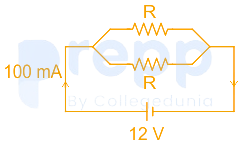
240 Ω
CONCEPT:
Resistance:
- The measurement of the opposition of the flow of electric current through a conductor is called resistance of that conductor. It is denoted by R.
Resistances in parallel:

- When the terminals of two or more resistances are connected at the same two points and the potential difference across them is equal is called resistances in parallel.
- The net resistance/equivalent resistance(R) of resistances in parallel is given by:
\(\frac{1}{R} = \frac{1}{{{R_1}}} + \frac{1}{{{R_2}}}\)
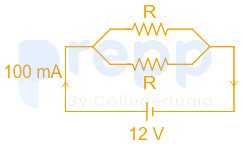
- Here both resistors R are in parallel combination, therefore the resultant resistance is
\(⇒ \frac{1}{R_{net}} = \frac{1}{{{R_1}}} + \frac{1}{{{R_2}}}\)
\(⇒ \frac{1}{R_{net}} = \frac{1}{{{R}}} + \frac{1}{{{R}}}=\frac{2}{R}\)
\(⇒ R_{net}=\frac{R}{2}\)
As we know, in parallel combination the potential difference across the resistors remains the same. Therefore, according to ohm's law
⇒ V = IRnet
\(⇒ R_{net}=\frac{R}{2}=\frac{V}{I}=\frac{12\times10^3}{100}=120 V\)
⇒ R = 240 Ω
NOTE :
- Resistances in series:

- When two or more resistances are connected one after another such that the same current flows through them are called as resistances in series .
- The net resistance/equivalent resistance (R) of resistances in series is given by:
- Equivalent resistance, R = R 1 + R 2
Similar Questions
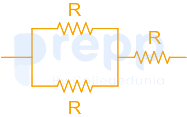
What is the total resistance in the following circuit element?
Three wires each of length \(L\), cross-sectional area \(A\) and resistivity \(\rho\) are connected as shown in the figure.
These are to be replaced by another wire of same resistivity such that the resistance between points \(X\) and \(Z\) does not change. If \(L_1\) is the length and \(A_1\) is the cross-sectional area of the new wire, then which one among the following is correct?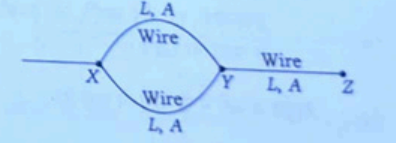
Consider the following electric circuit:
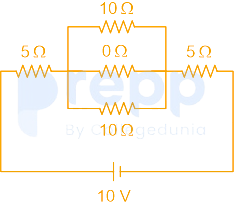
The current in the above electric circuit is:A metallic wire having a resistance of 20Ω is cut into two equal parts in length. These parts are then connected in parallel. The resistance of this parallel combination is equal to
- Two resistors R 1 and R 2 arranged in parallel combination in an electrical closed circuit are made of the same material and of the same thickness. If the length of R 2 is twice the length of R 1, then the total resistance R satisfies
Consider the following part of an electric circuit:
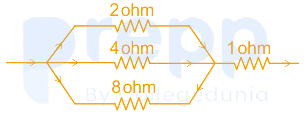
The total electrical resistance in the given part of the electric circuit is
- An electric wire of resistance 50 ohm is cut into five equal wires. These wires are then connected in parallel. What is the equivalent resistance of this combination?
Three resistors with magnitudes 2, 4, and 8 ohms are connected in parallel. The equivalent resistance of the system would be
Consider the following circuit:
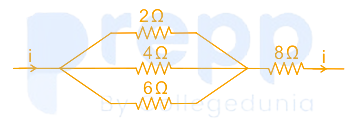
The equivalent resistance of the circuit will be
When three resistors, each having resistance r, are connected in parallel, their resultant resistance is x. If these three resistances are connected in series, the total resistance will be
Important Questions from Combination of Resistors — Series and Parallel
A cell of negligible resistance and e.m.f 2 volt is connected to series combination of 2 ohm, 3 ohm and 5 ohm. The potential difference across the 3 ohm resistance is:
3 resistors of 3 ohm each connected in series. What is the mean values of resistors?
Ten cells, each of 2 volts emf and 1 ohm internal resistance are connected in series. What is the current flowing through a resistance of 10 ohms connected across this combination of cells?
- Two resistors, one of \(20\ \Omega\) and the other of \(30\ \Omega\), are connected in parallel. This combination is connected in series with an \(8\ \Omega\) resistor and a 12-V battery. The current through the \(20\ \Omega\) resistor is:
- Two resistors, each of \(20\ \Omega\), are connected in parallel, and this combination is connected across a 40-V supply. Find the voltage across each resistor.



