
A metallic wire having a resistance of 20Ω is cut into two equal parts in length. These parts are then connected in parallel. The resistance of this parallel combination is equal to
5 Ω
Calculating Equivalent Resistance of Parallel Wire Parts
Let's break down this problem about the resistance of a metallic wire when cut and connected in parallel. We are given a metallic wire with an initial resistance of 20 Ω.
Resistance of a wire is directly proportional to its length. This means if you cut a wire into equal parts, the resistance of each part will be a fraction of the original resistance, corresponding to the fraction of the length.
In this case, the wire is cut into two equal parts in length. So, the length of each new part is half the original length. Consequently, the resistance of each part will be half of the original resistance.
Original Resistance (\(R_{original}\)) = 20 Ω
Number of equal parts = 2
Resistance of each part (\(R_{part}\)) = \(\frac{R_{original}}{2} = \frac{20\, \Omega}{2} = 10\, \Omega\)
Now, these two parts, each having a resistance of 10 Ω, are connected in parallel. When resistors are connected in parallel, the equivalent resistance (\(R_{eq}\)) is calculated differently than when they are in series.
For two resistors (\(R_1\) and \(R_2\)) in parallel, the equivalent resistance is given by the formula:
\(\frac{1}{R_{eq}} = \frac{1}{R_1} + \frac{1}{R_2}\)
Alternatively, for exactly two resistors, you can use the product-over-sum formula:
\(R_{eq} = \frac{R_1 \times R_2}{R_1 + R_2}\)
In this problem, both parts have a resistance of 10 Ω. So, \(R_1 = 10\, \Omega\) and \(R_2 = 10\, \Omega\).
Using the product-over-sum formula:
\(R_{eq} = \frac{10\, \Omega \times 10\, \Omega}{10\, \Omega + 10\, \Omega}\)
\(R_{eq} = \frac{100\, \Omega^2}{20\, \Omega}\)
\(R_{eq} = 5\, \Omega\)
Using the reciprocal formula:
\(\frac{1}{R_{eq}} = \frac{1}{10\, \Omega} + \frac{1}{10\, \Omega}\)
\(\frac{1}{R_{eq}} = \frac{2}{10\, \Omega}\)
\(\frac{1}{R_{eq}} = \frac{1}{5\, \Omega}\)
Taking the reciprocal of both sides:
\(R_{eq} = 5\, \Omega\)
Thus, the resistance of the parallel combination of the two parts is 5 Ω.
Revision Table: Wire Resistance Calculation
| Original Wire | Properties |
|---|---|
| Initial Resistance | 20 Ω |
| How it's cut | Into two equal lengths |
| Resistance of each part | 10 Ω (half of original) |
| Connection | Parallel |
| Formula for Parallel Resistance | \(\frac{1}{R_{eq}} = \frac{1}{R_1} + \frac{1}{R_2}\) or \(R_{eq} = \frac{R_1 R_2}{R_1 + R_2}\) |
| Calculated Equivalent Resistance | 5 Ω |
Additional Information on Electrical Resistance
Electrical resistance is a measure of how much a material opposes the flow of electric current. It is measured in Ohms (Ω).
- Factors Affecting Resistance: The resistance of a uniform metallic wire depends on its length (L), cross-sectional area (A), and the resistivity (\(\rho\)) of the material. The relationship is given by \(R = \rho \frac{L}{A}\).
- Series Combination: When resistors are connected end-to-end in series, the total equivalent resistance is the sum of individual resistances: \(R_{series} = R_1 + R_2 + R_3 + ...\) The current is the same through each resistor.
- Parallel Combination: When resistors are connected across the same two points in parallel, the reciprocal of the equivalent resistance is the sum of the reciprocals of individual resistances: \(\frac{1}{R_{parallel}} = \frac{1}{R_1} + \frac{1}{R_2} + \frac{1}{R_3} + ...\) The voltage is the same across each resistor. The equivalent resistance in a parallel combination is always less than the smallest individual resistance.
Understanding how resistance changes with length and how resistors combine in series and parallel circuits is fundamental in electrical circuit analysis.
Similar Questions
What is the total resistance in the following circuit element?
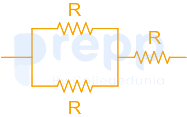
Three wires each of length \(L\), cross-sectional area \(A\) and resistivity \(\rho\) are connected as shown in the figure.
These are to be replaced by another wire of same resistivity such that the resistance between points \(X\) and \(Z\) does not change. If \(L_1\) is the length and \(A_1\) is the cross-sectional area of the new wire, then which one among the following is correct?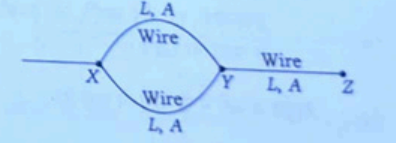
Consider the following electric circuit:
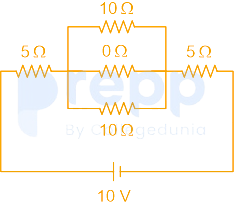
The current in the above electric circuit is:Two equal resistors R are connected in parallel, and a battery of 12 V is connected across this combination A dc current of 100 mA flows through the circuit as shown below:
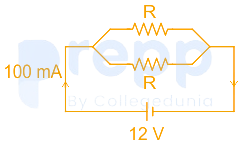
The value of R is
- Two resistors R 1 and R 2 arranged in parallel combination in an electrical closed circuit are made of the same material and of the same thickness. If the length of R 2 is twice the length of R 1, then the total resistance R satisfies
Consider the following part of an electric circuit:
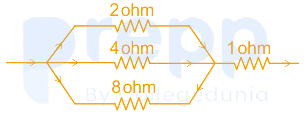
The total electrical resistance in the given part of the electric circuit is
- An electric wire of resistance 50 ohm is cut into five equal wires. These wires are then connected in parallel. What is the equivalent resistance of this combination?
Three resistors with magnitudes 2, 4, and 8 ohms are connected in parallel. The equivalent resistance of the system would be
Consider the following circuit:
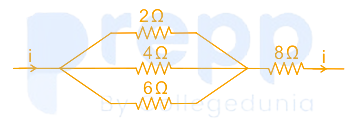
The equivalent resistance of the circuit will be
When three resistors, each having resistance r, are connected in parallel, their resultant resistance is x. If these three resistances are connected in series, the total resistance will be
Important Questions from Combination of Resistors — Series and Parallel
A cell of negligible resistance and e.m.f 2 volt is connected to series combination of 2 ohm, 3 ohm and 5 ohm. The potential difference across the 3 ohm resistance is:
3 resistors of 3 ohm each connected in series. What is the mean values of resistors?
Ten cells, each of 2 volts emf and 1 ohm internal resistance are connected in series. What is the current flowing through a resistance of 10 ohms connected across this combination of cells?
- Two resistors, one of \(20\ \Omega\) and the other of \(30\ \Omega\), are connected in parallel. This combination is connected in series with an \(8\ \Omega\) resistor and a 12-V battery. The current through the \(20\ \Omega\) resistor is:
- Two resistors, each of \(20\ \Omega\), are connected in parallel, and this combination is connected across a 40-V supply. Find the voltage across each resistor.



