
When three resistors, each having resistance r, are connected in parallel, their resultant resistance is x. If these three resistances are connected in series, the total resistance will be
9x
Understanding Resistors in Series and Parallel
This problem involves understanding how to calculate the equivalent resistance when resistors are connected in two different ways: parallel and series. We are given a situation where three identical resistors, each with resistance \(r\), are first connected in parallel, resulting in a total resistance \(x\). We then need to find the total resistance when these same three resistors are connected in series.
Resistors in Parallel Connection
When resistors are connected in parallel, the reciprocal of the total equivalent resistance is the sum of the reciprocals of the individual resistances. The formula for parallel connection is:
\[ \frac{1}{R_{parallel}} = \frac{1}{R_1} + \frac{1}{R_2} + \frac{1}{R_3} + \dots \]
In this problem, we have three identical resistors, each with resistance \(r\), connected in parallel. The given resultant resistance is \(x\). So, we can write:
\[ \frac{1}{x} = \frac{1}{r} + \frac{1}{r} + \frac{1}{r} \]
Combining the terms on the right side:
\[ \frac{1}{x} = \frac{1+1+1}{r} \]
\[ \frac{1}{x} = \frac{3}{r} \]
From this equation, we can find the value of \(r\) in terms of \(x\). By cross-multiplying, we get:
\[ r = 3x \]
This tells us the resistance of a single resistor (\(r\)) is three times the total resistance (\(x\)) when they are connected in parallel.
Resistors in Series Connection
When resistors are connected in series, the total equivalent resistance is simply the sum of the individual resistances. The formula for series connection is:
\[ R_{series} = R_1 + R_2 + R_3 + \dots \]
Now, we consider the same three identical resistors, each with resistance \(r\), connected in series. The total resistance in series (\(R_{series}\)) will be:
\[ R_{series} = r + r + r \]
\[ R_{series} = 3r \]
Calculating Total Resistance in Series in terms of x
We have found that the total resistance in series is \(3r\). From the parallel connection analysis, we found that \(r = 3x\). Now, we substitute this value of \(r\) into the series resistance equation:
\[ R_{series} = 3 \times (3x) \]
\[ R_{series} = 9x \]
Therefore, if the three resistors are connected in series, the total resistance will be \(9x\).
Summary of Calculations
| Connection Type | Individual Resistances | Formula | Resultant Resistance Given | Relationship Derived |
|---|---|---|---|---|
| Parallel | \(r, r, r\) | \(\frac{1}{R_{parallel}} = \frac{1}{R_1} + \frac{1}{R_2} + \frac{1}{R_3}\) | \(R_{parallel} = x\) | \(\frac{1}{x} = \frac{3}{r} \Rightarrow r = 3x\) |
| Series | \(r, r, r\) | \(R_{series} = R_1 + R_2 + R_3\) | \(R_{series} = ?\) | \(R_{series} = 3r\) |
Using the relationship \(r = 3x\) in the series resistance formula \(R_{series} = 3r\):
\[ R_{series} = 3 \times (3x) = 9x \]
The total resistance when the three resistors are connected in series is \(9x\).
Revision Table: Key Concepts for Resistor Networks
| Concept | Description | Formula (for 3 resistors R1, R2, R3) | Special Case (n identical resistors R) |
|---|---|---|---|
| Series Connection | Resistors are connected end-to-end, forming a single path for current. Total resistance increases. | \(R_{total} = R_1 + R_2 + R_3\) | \(R_{total} = nR\) |
| Parallel Connection | Resistors are connected across the same two points, providing multiple paths for current. Total resistance decreases. | \(\frac{1}{R_{total}} = \frac{1}{R_1} + \frac{1}{R_2} + \frac{1}{R_3}\) | \(\frac{1}{R_{total}} = \frac{n}{R} \Rightarrow R_{total} = \frac{R}{n}\) |
| Equivalent Resistance | A single resistor that can replace a combination of resistors (series or parallel) and have the same effect on the rest of the circuit. | Varies based on connection type. | Varies based on connection type. |
Additional Information: Resistors and Circuits
Resistors are fundamental components in electrical circuits used to oppose the flow of electric current. Their resistance is measured in Ohms (\(\Omega\)).
- Ohm's Law: This law relates voltage (\(V\)), current (\(I\)), and resistance (\(R\)): \(V = IR\). Understanding Ohm's law is crucial for analyzing circuits with resistors.
- Voltage Division (Series): In a series circuit, the total voltage is divided among the resistors in proportion to their resistances.
- Current Division (Parallel): In a parallel circuit, the total current is divided among the branches, with current flowing more easily through paths of lower resistance.
- Applications: Resistors are used for various purposes, such as controlling current flow, creating voltage drops, and terminating transmission lines.
Problems involving series and parallel combinations of resistors are common in physics and electrical engineering. Being able to convert between different configurations and calculate equivalent resistance is a key skill.
Similar Questions
What is the total resistance in the following circuit element?
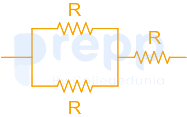
Three wires each of length \(L\), cross-sectional area \(A\) and resistivity \(\rho\) are connected as shown in the figure.
These are to be replaced by another wire of same resistivity such that the resistance between points \(X\) and \(Z\) does not change. If \(L_1\) is the length and \(A_1\) is the cross-sectional area of the new wire, then which one among the following is correct?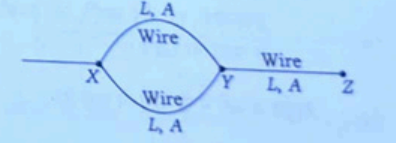
Consider the following electric circuit:
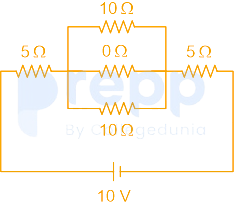
The current in the above electric circuit is:Two equal resistors R are connected in parallel, and a battery of 12 V is connected across this combination A dc current of 100 mA flows through the circuit as shown below:
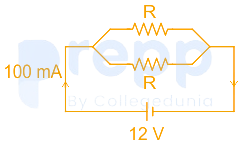
The value of R is
A metallic wire having a resistance of 20Ω is cut into two equal parts in length. These parts are then connected in parallel. The resistance of this parallel combination is equal to
- Two resistors R 1 and R 2 arranged in parallel combination in an electrical closed circuit are made of the same material and of the same thickness. If the length of R 2 is twice the length of R 1, then the total resistance R satisfies
Consider the following part of an electric circuit:
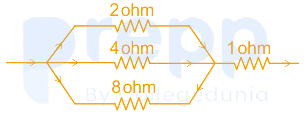
The total electrical resistance in the given part of the electric circuit is
- An electric wire of resistance 50 ohm is cut into five equal wires. These wires are then connected in parallel. What is the equivalent resistance of this combination?
Three resistors with magnitudes 2, 4, and 8 ohms are connected in parallel. The equivalent resistance of the system would be
Consider the following circuit:
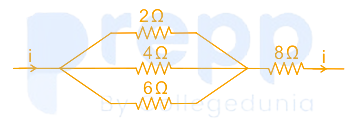
The equivalent resistance of the circuit will be
Important Questions from Combination of Resistors — Series and Parallel
A cell of negligible resistance and e.m.f 2 volt is connected to series combination of 2 ohm, 3 ohm and 5 ohm. The potential difference across the 3 ohm resistance is:
3 resistors of 3 ohm each connected in series. What is the mean values of resistors?
Ten cells, each of 2 volts emf and 1 ohm internal resistance are connected in series. What is the current flowing through a resistance of 10 ohms connected across this combination of cells?
- Two resistors, one of \(20\ \Omega\) and the other of \(30\ \Omega\), are connected in parallel. This combination is connected in series with an \(8\ \Omega\) resistor and a 12-V battery. The current through the \(20\ \Omega\) resistor is:
- Two resistors, each of \(20\ \Omega\), are connected in parallel, and this combination is connected across a 40-V supply. Find the voltage across each resistor.



