
The value of sin 264° + cos 64° sin 26° + 2 cos 43° cosec 47° is:
3
The expression is \(\sin^2 64^\circ + \cos 64^\circ \sin 26^\circ + 2\cos 43^\circ \csc 47^\circ\).
Step 1 — Simplify the second term using complementary angles:
Since \(\sin 26^\circ = \cos 64^\circ\), we get \(\cos 64^\circ \sin 26^\circ = \cos^2 64^\circ\). So the first two terms become \(\sin^2 64^\circ + \cos^2 64^\circ = 1\).
Step 2 — Simplify the third term:
\(\csc 47^\circ = \sec 43^\circ = \dfrac{1}{\cos 43^\circ}\), so \(2\cos 43^\circ \csc 47^\circ = \dfrac{2\cos 43^\circ}{\cos 43^\circ} = 2\).
Therefore the value is \(1 + 2 = \mathbf{3}\).
Similar Questions
If sin t + cos t = \(\frac{4}{5}\), then find sin t. cos t.
If sec A + tan A = 5,then sin A is equal to:
Simplify the given expression.
\(\frac{1+sin^4 \theta+cos^4\theta}{cos^2 \theta+sin^4\theta}\)
Which of the following will satisfy a2 = b2 + (ab)2 for the values a and b?
If sec x – cos x = 4, then what will be the value of \({{(1 \ + \ cos^2 x)} \over cos x}\)?
If cos θ + cos2θ =1, find the value of \(\sqrt{\sin^4θ + \cos^2θ}\).
If Sin θ = \(\frac{4}{5}\), find the value of tan θ - Cot θ.
- \(\rm \frac{\sin^4 \theta+\cos ^4\theta}{1-2\sin^2\theta.\cos^2\theta}=\) ________.
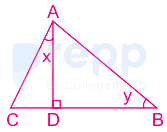
In the given figure if AD ⊥ BC, AC = 26 units, CD = 10 units, BC = 42 units, ∠DAC = x and ∠B = y then the value of \(\rm \frac{6}{\cos x}-\frac{5}{\cos y}+8\tan y\) is:
If a cot θ + b cosec θ = p and b cot θ + a cosec θ = q then p2 - q2 is equal to ______.
Important Questions from Trigonometric Ratios and Identities
What is the ratio of the greatest to the smallest value of 2 – 2 sin x – sin 2x, 0 ≤ x ≤ (π/2)?
If sinθ = \(\frac{4}{5}\) , Find the value of sin3θ
If x, y are acute angles, where 0 < x + y < 90° and sin(3x - 40°) = cos (3y + 40°), then the value of tan (x + y) is equal to
What is (1 + cot θ - cosec θ)(1 + tan θ + sec θ) equal to?
If \(\sin \theta =\frac{3}{5}\) and \(\cos \theta =\frac{4}{5}\) , then the value of \(\frac{1+\tan \theta}{1-\cot \theta}\) is:



