
Simplify the given expression. \(\frac{1+sin^4 \theta+cos^4\theta}{cos^2 \theta+sin^4\theta}\)
2
Simplifying Trigonometric Expressions: A Step-by-Step Guide
Let's simplify the given trigonometric expression:
\[\frac{1+\sin^4 \theta+\cos^4\theta}{\cos^2 \theta+\sin^4\theta}\]
We will simplify the numerator and the denominator separately using fundamental trigonometric identities.
Simplifying the Numerator: \(1+\sin^4 \theta+\cos^4\theta\)
Recall the basic identity: \(\sin^2 \theta + \cos^2 \theta = 1\).
We can rewrite \(\sin^4 \theta + \cos^4 \theta\) using this identity:
\[\sin^4 \theta + \cos^4 \theta = (\sin^2 \theta)^2 + (\cos^2 \theta)^2\]
This looks like the form \(a^2 + b^2\). We know \(a^2 + b^2 = (a+b)^2 - 2ab\).
So, let \(a = \sin^2 \theta\) and \(b = \cos^2 \theta\):
\[\sin^4 \theta + \cos^4 \theta = (\sin^2 \theta + \cos^2 \theta)^2 - 2 (\sin^2 \theta)(\cos^2 \theta)\]
Since \(\sin^2 \theta + \cos^2 \theta = 1\), we have:
\[\sin^4 \theta + \cos^4 \theta = (1)^2 - 2 \sin^2 \theta \cos^2 \theta = 1 - 2 \sin^2 \theta \cos^2 \theta\]
Now substitute this back into the numerator:
Numerator = \(1 + (\sin^4 \theta + \cos^4 \theta)\)
Numerator = \(1 + (1 - 2 \sin^2 \theta \cos^2 \theta)\)
Numerator = \(1 + 1 - 2 \sin^2 \theta \cos^2 \theta\)
Numerator = \(2 - 2 \sin^2 \theta \cos^2 \theta\)
Numerator = \(2(1 - \sin^2 \theta \cos^2 \theta)\)
Analyzing the Denominator: \(\cos^2 \theta+\sin^4\theta\)
The denominator is \(\cos^2 \theta+\sin^4\theta\).
Let's examine the simplified numerator: \(2(1 - \sin^2 \theta \cos^2 \theta)\). Can we relate the expression \(1 - \sin^2 \theta \cos^2 \theta\) to the denominator?
Recall \(1 = \sin^2 \theta + \cos^2 \theta\).
So, \(1 - \sin^2 \theta \cos^2 \theta = (\sin^2 \theta + \cos^2 \theta) - \sin^2 \theta \cos^2 \theta\). This doesn't immediately look like the denominator.
Let's try to show that \(1 - \sin^2 \theta \cos^2 \theta\) can be written in a form related to the denominator \(cos^2 \theta + sin^4 \theta\). Consider the identity we need to establish:
\(1 - \sin^2 \theta \cos^2 \theta = \cos^2 \theta + \sin^4 \theta\)
Let's work from the right side and try to reach the left side using the identity \(\cos^2 \theta = 1 - \sin^2 \theta\):
RHS = \(\cos^2 \theta + \sin^4 \theta\)
RHS = \((1 - \sin^2 \theta) + \sin^4 \theta\)
RHS = \(1 - \sin^2 \theta + \sin^4 \theta\)
This still doesn't look like \(1 - \sin^2 \theta \cos^2 \theta\).
Let's re-examine the relationship derived from the correct answer option being 2. If the expression simplifies to 2, it means:
\[\frac{1+\sin^4 \theta+\cos^4\theta}{\cos^2 \theta+\sin^4\theta} = 2\]
This implies that the numerator is equal to 2 times the denominator:
\[1+\sin^4 \theta+\cos^4\theta = 2(\cos^2 \theta+\sin^4\theta)\]
We know the numerator simplifies to \(2 - 2 \sin^2 \theta \cos^2 \theta\). So we need to check if:
\[2 - 2 \sin^2 \theta \cos^2 \theta = 2(\cos^2 \theta+\sin^4\theta)\]
Divide both sides by 2:
\[1 - \sin^2 \theta \cos^2 \theta = \cos^2 \theta+\sin^4\theta\]
We need to verify if this identity is true for all \(\theta\) where the expression is defined.
Let's rearrange the terms to check:
\[1 - \cos^2 \theta = \sin^2 \theta \cos^2 \theta + \sin^4 \theta\]
We know \(1 - \cos^2 \theta = \sin^2 \theta\). So we need to check if:
\[\sin^2 \theta = \sin^2 \theta \cos^2 \theta + \sin^4 \theta\]
Factor out \(\sin^2 \theta\) from the right side:
\[\sin^2 \theta = \sin^2 \theta (\cos^2 \theta + \sin^2 \theta)\]
Using the identity \(\cos^2 \theta + \sin^2 \theta = 1\):
\[\sin^2 \theta = \sin^2 \theta (1)\]
\[\sin^2 \theta = \sin^2 \theta\]
This is true for all \(\theta\)! Therefore, the identity \(1 - \sin^2 \theta \cos^2 \theta = \cos^2 \theta+\sin^4\theta\) is correct.
Final Simplification
We found that:
- Numerator = \(1+\sin^4 \theta+\cos^4\theta = 2(1 - \sin^2 \theta \cos^2 \theta)\)
- Denominator = \(\cos^2 \theta+\sin^4\theta\)
- And we verified that \(1 - \sin^2 \theta \cos^2 \theta = \cos^2 \theta+\sin^4\theta\)
Substitute the equivalent expression for \(1 - \sin^2 \theta \cos^2 \theta\) into the numerator:
Numerator = \(2(\cos^2 \theta+\sin^4\theta)\)
Now, substitute this back into the original expression:
\[\frac{2(\cos^2 \theta+\sin^4\theta)}{\cos^2 \theta+\sin^4\theta}\]
Assuming the denominator \(\cos^2 \theta+\sin^4\theta\) is not equal to zero, we can cancel the common term:
\[\frac{2\cancel{(\cos^2 \theta+\sin^4\theta)}}{\cancel{(\cos^2 \theta+\sin^4\theta)}} = 2\]
Thus, the simplified expression is 2.
Summary of Steps
To simplify the expression, we followed these steps:
- Simplified the numerator \(1+\sin^4 \theta+\cos^4\theta\) using the identity \(\sin^2 \theta+\cos^2\theta=1\) to get \(2(1 - \sin^2 \theta \cos^2 \theta)\).
- Examined the denominator \(\cos^2 \theta+\sin^4\theta\).
- Proved the identity \(1 - \sin^2 \theta \cos^2 \theta = \cos^2 \theta+\sin^4\theta\) by substituting \(\cos^2 \theta = 1 - \sin^2 \theta\) and simplifying to \(\sin^2 \theta = \sin^2 \theta\).
- Substituted the equivalent expression into the numerator, resulting in \(2(\cos^2 \theta+\sin^4\theta)\).
- Divided the numerator by the denominator, cancelling the common term to get 2.
The final answer is 2.
| Revision Table: Simplifying Trigonometric Expressions |
|---|
| Key Identity Used: |
| \(\sin^2 \theta + \cos^2 \theta = 1\) |
| Intermediate Identity: |
| \(\sin^4 \theta + \cos^4 \theta = 1 - 2 \sin^2 \theta \cos^2 \theta\) |
| Proven Relationship: |
| \(1 - \sin^2 \theta \cos^2 \theta = \cos^2 \theta + \sin^4 \theta\) |
| Numerator Simplification: |
| \(1+\sin^4 \theta+\cos^4\theta = 2(1 - \sin^2 \theta \cos^2 \theta)\) |
| Expression After Substitution: |
| \(\frac{2(\cos^2 \theta+\sin^4\theta)}{\cos^2 \theta+\sin^4\theta}\) |
| Final Simplified Value: |
| 2 |
Additional Information: Trigonometric Identities for Simplification
Simplifying trigonometric expressions often relies on recognizing and applying fundamental identities. Here are some important ones:
- Pythagorean Identities:
- \(\sin^2 \theta + \cos^2 \theta = 1\)
- \(1 + \tan^2 \theta = \sec^2 \theta\)
- \(1 + \cot^2 \theta = \csc^2 \theta\)
- Reciprocal Identities:
- \(\csc \theta = \frac{1}{\sin \theta}\)
- \(\sec \theta = \frac{1}{\cos \theta}\)
- \(\cot \theta = \frac{1}{\tan \theta}\)
- Quotient Identities:
- \(\tan \theta = \frac{\sin \theta}{\cos \theta}\)
- \(\cot \theta = \frac{\cos \theta}{\sin \theta}\)
Manipulating expressions involving higher powers like \(\sin^4 \theta\) or \(\cos^4 \theta\) often involves using the square identities repeatedly or techniques like the one used in this problem where \(a^4+b^4 = (a^2+b^2)^2 - 2a^2b^2\). Recognizing patterns and equivalent forms of expressions is key to successful simplification.
Similar Questions
If sin t + cos t = \(\frac{4}{5}\), then find sin t. cos t.
If sec A + tan A = 5,then sin A is equal to:
Which of the following will satisfy a2 = b2 + (ab)2 for the values a and b?
If sec x – cos x = 4, then what will be the value of \({{(1 \ + \ cos^2 x)} \over cos x}\)?
If cos θ + cos2θ =1, find the value of \(\sqrt{\sin^4θ + \cos^2θ}\).
If Sin θ = \(\frac{4}{5}\), find the value of tan θ - Cot θ.
- \(\rm \frac{\sin^4 \theta+\cos ^4\theta}{1-2\sin^2\theta.\cos^2\theta}=\) ________.
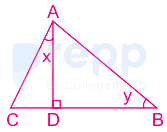
In the given figure if AD ⊥ BC, AC = 26 units, CD = 10 units, BC = 42 units, ∠DAC = x and ∠B = y then the value of \(\rm \frac{6}{\cos x}-\frac{5}{\cos y}+8\tan y\) is:
If a cot θ + b cosec θ = p and b cot θ + a cosec θ = q then p2 - q2 is equal to ______.
If \(\rm \cot A=\frac{12}{5}\), then the value of (sin A + cos A) × cosec A is _______.
Important Questions from Trigonometric Ratios and Identities
What is the ratio of the greatest to the smallest value of 2 – 2 sin x – sin 2x, 0 ≤ x ≤ (π/2)?
If sinθ = \(\frac{4}{5}\) , Find the value of sin3θ
If x, y are acute angles, where 0 < x + y < 90° and sin(3x - 40°) = cos (3y + 40°), then the value of tan (x + y) is equal to
What is (1 + cot θ - cosec θ)(1 + tan θ + sec θ) equal to?
If \(\sin \theta =\frac{3}{5}\) and \(\cos \theta =\frac{4}{5}\) , then the value of \(\frac{1+\tan \theta}{1-\cot \theta}\) is:



