
If a cot θ + b cosec θ = p and b cot θ + a cosec θ = q then p2 - q2 is equal to ______.
b2 - a2
Trigonometry Problem: Solving for p² - q²
This problem involves manipulating given trigonometric equations to find the value of an expression. We are given two equations relating variables \(p\) and \(q\) with trigonometric functions \(\cot \theta\) and \(\operatorname{cosec} \theta\), and constants \(a\) and \(b\).
Understanding the Given Trigonometric Equations
The two equations provided are:
- \(a \cot \theta + b \operatorname{cosec} \theta = p\)
- \(b \cot \theta + a \operatorname{cosec} \theta = q\)
We need to find the value of \(p^2 - q^2\).
Calculating p² and q²
First, let's square both equations to find \(p^2\) and \(q^2\).
Calculating p²:
Squaring the first equation \((a \cot \theta + b \operatorname{cosec} \theta = p)\):
\(p^2 = (a \cot \theta + b \operatorname{cosec} \theta)^2\)
Using the \((x+y)^2 = x^2 + y^2 + 2xy\) formula:
\(p^2 = (a \cot \theta)^2 + (b \operatorname{cosec} \theta)^2 + 2(a \cot \theta)(b \operatorname{cosec} \theta)\)
\(p^2 = a^2 \cot^2 \theta + b^2 \operatorname{cosec}^2 \theta + 2ab \cot \theta \operatorname{cosec} \theta \quad \text{(Equation 3)}\)
Calculating q²:
Squaring the second equation \((b \cot \theta + a \operatorname{cosec} \theta = q)\):
\(q^2 = (b \cot \theta + a \operatorname{cosec} \theta)^2\)
Using the \((x+y)^2 = x^2 + y^2 + 2xy\) formula:
\(q^2 = (b \cot \theta)^2 + (a \operatorname{cosec} \theta)^2 + 2(b \cot \theta)(a \operatorname{cosec} \theta)\)
\(q^2 = b^2 \cot^2 \theta + a^2 \operatorname{cosec}^2 \theta + 2ab \cot \theta \operatorname{cosec} \theta \quad \text{(Equation 4)}\)
Finding p² - q²
Now, we subtract Equation 4 from Equation 3:
\(p^2 - q^2 = (a^2 \cot^2 \theta + b^2 \operatorname{cosec}^2 \theta + 2ab \cot \theta \operatorname{cosec} \theta) - (b^2 \cot^2 \theta + a^2 \operatorname{cosec}^2 \theta + 2ab \cot \theta \operatorname{cosec} \theta)\)
Distribute the negative sign:
\(p^2 - q^2 = a^2 \cot^2 \theta + b^2 \operatorname{cosec}^2 \theta + 2ab \cot \theta \operatorname{cosec} \theta - b^2 \cot^2 \theta - a^2 \operatorname{cosec}^2 \theta - 2ab \cot \theta \operatorname{cosec} \theta\)
Notice that the terms \(+ 2ab \cot \theta \operatorname{cosec} \theta\) and \(- 2ab \cot \theta \operatorname{cosec} \theta\) cancel each other out.
\(p^2 - q^2 = a^2 \cot^2 \theta + b^2 \operatorname{cosec}^2 \theta - b^2 \cot^2 \theta - a^2 \operatorname{cosec}^2 \theta\)
Simplifying the Expression using Trigonometric Identity
Rearrange the terms to group those with \(a^2\) and \(b^2\):
\(p^2 - q^2 = (b^2 \operatorname{cosec}^2 \theta - a^2 \operatorname{cosec}^2 \theta) + (a^2 \cot^2 \theta - b^2 \cot^2 \theta)\)
Factor out common terms:
\(p^2 - q^2 = \operatorname{cosec}^2 \theta (b^2 - a^2) + \cot^2 \theta (a^2 - b^2)\)
To use the identity \(\operatorname{cosec}^2 \theta - \cot^2 \theta = 1\), we need the terms inside the parentheses to be the same. We can rewrite \((a^2 - b^2)\) as \(-(b^2 - a^2)\):
\(p^2 - q^2 = \operatorname{cosec}^2 \theta (b^2 - a^2) + \cot^2 \theta (-(b^2 - a^2))\)
\(p^2 - q^2 = \operatorname{cosec}^2 \theta (b^2 - a^2) - \cot^2 \theta (b^2 - a^2)\)
Now, factor out the common term \((b^2 - a^2)\):
\(p^2 - q^2 = (b^2 - a^2) (\operatorname{cosec}^2 \theta - \cot^2 \theta)\)
Recall the fundamental trigonometric identity: \(\operatorname{cosec}^2 \theta - \cot^2 \theta = 1\).
Substitute this into the expression:
\(p^2 - q^2 = (b^2 - a^2)(1)\)
\(p^2 - q^2 = b^2 - a^2\)
Final Answer
The value of \(p^2 - q^2\) is \(b^2 - a^2\).
Revision Table: Key Trigonometric Identities and Concepts
| Concept/Identity | Description/Formula | Relevance to Problem |
|---|---|---|
| Squaring a binomial | \((x+y)^2 = x^2 + y^2 + 2xy\) | Used to expand \(p^2\) and \(q^2\). |
| Difference of Squares | \(x^2 - y^2\) | The expression we needed to evaluate. |
| Fundamental Identity | \(\operatorname{cosec}^2 \theta - \cot^2 \theta = 1\) | Crucial for simplifying the expression. |
Additional Information: Understanding Reciprocal Identities
The functions \(\cot \theta\) and \(\operatorname{cosec} \theta\) are related to the basic trigonometric functions \(\sin \theta\) and \(\cos \theta\) through reciprocal identities:
- \(\cot \theta = \frac{1}{\tan \theta} = \frac{\cos \theta}{\sin \theta}\)
- \(\operatorname{cosec} \theta = \frac{1}{\sin \theta}\)
The identity \(\operatorname{cosec}^2 \theta - \cot^2 \theta = 1\) can be derived from the identity \(\sin^2 \theta + \cos^2 \theta = 1\) by dividing all terms by \(\sin^2 \theta\) (assuming \(\sin \theta \ne 0\)):
\(\frac{\sin^2 \theta}{\sin^2 \theta} + \frac{\cos^2 \theta}{\sin^2 \theta} = \frac{1}{\sin^2 \theta}\)
\(1 + \cot^2 \theta = \operatorname{cosec}^2 \theta\)
Rearranging this gives: \(\operatorname{cosec}^2 \theta - \cot^2 \theta = 1\). This identity is fundamental in solving trigonometric problems involving \(\cot\) and \(\operatorname{cosec}\).
Similar Questions
If sin t + cos t = \(\frac{4}{5}\), then find sin t. cos t.
If sec A + tan A = 5,then sin A is equal to:
Simplify the given expression.
\(\frac{1+sin^4 \theta+cos^4\theta}{cos^2 \theta+sin^4\theta}\)
Which of the following will satisfy a2 = b2 + (ab)2 for the values a and b?
If sec x – cos x = 4, then what will be the value of \({{(1 \ + \ cos^2 x)} \over cos x}\)?
If cos θ + cos2θ =1, find the value of \(\sqrt{\sin^4θ + \cos^2θ}\).
If Sin θ = \(\frac{4}{5}\), find the value of tan θ - Cot θ.
- \(\rm \frac{\sin^4 \theta+\cos ^4\theta}{1-2\sin^2\theta.\cos^2\theta}=\) ________.
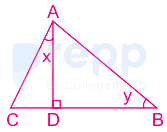
In the given figure if AD ⊥ BC, AC = 26 units, CD = 10 units, BC = 42 units, ∠DAC = x and ∠B = y then the value of \(\rm \frac{6}{\cos x}-\frac{5}{\cos y}+8\tan y\) is:
If \(\rm \cot A=\frac{12}{5}\), then the value of (sin A + cos A) × cosec A is _______.
Important Questions from Trigonometric Ratios and Identities
What is the ratio of the greatest to the smallest value of 2 – 2 sin x – sin 2x, 0 ≤ x ≤ (π/2)?
If sinθ = \(\frac{4}{5}\) , Find the value of sin3θ
If x, y are acute angles, where 0 < x + y < 90° and sin(3x - 40°) = cos (3y + 40°), then the value of tan (x + y) is equal to
What is (1 + cot θ - cosec θ)(1 + tan θ + sec θ) equal to?
If \(\sin \theta =\frac{3}{5}\) and \(\cos \theta =\frac{4}{5}\) , then the value of \(\frac{1+\tan \theta}{1-\cot \theta}\) is:



