
If \(\rm \cot A=\frac{12}{5}\), then the value of (sin A + cos A) × cosec A is _______.
Evaluating Trigonometric Expressions with cot A
The problem asks us to find the value of the expression \((\sin A + \cos A) \times \text{cosec } A\) given that \(\cot A = \frac{12}{5}\). We can solve this problem using trigonometric identities, which is often the most efficient way.
Using Trigonometric Identities to Simplify
We are given the expression \((\sin A + \cos A) \times \text{cosec } A\).
We know that \(\text{cosec } A\) is the reciprocal of \(\sin A\), i.e., \(\text{cosec } A = \frac{1}{\sin A}\).
Let's distribute \(\text{cosec } A\) across the terms inside the parenthesis:
- \((\sin A + \cos A) \times \text{cosec } A = \sin A \times \text{cosec } A + \cos A \times \text{cosec } A\)
Substitute \(\text{cosec } A = \frac{1}{\sin A}\) into the expression:
- \(= \sin A \times \frac{1}{\sin A} + \cos A \times \frac{1}{\sin A}\)
The first term simplifies:
- \(= 1 + \frac{\cos A}{\sin A}\)
We also know that \(\cot A\) is defined as the ratio of \(\cos A\) to \(\sin A\), i.e., \(\cot A = \frac{\cos A}{\sin A}\).
So, the expression simplifies to:
- \(= 1 + \cot A\)
We are given that \(\cot A = \frac{12}{5}\). Substituting this value into the simplified expression:
- \(= 1 + \frac{12}{5}\)
To add these values, find a common denominator:
- \(= \frac{5}{5} + \frac{12}{5}\)
- \(= \frac{5+12}{5}\)
- \(= \frac{17}{5}\)
Thus, the value of \((\sin A + \cos A) \times \text{cosec } A\) is \(\frac{17}{5}\).
Alternative Method: Using a Right-Angled Triangle
We can also solve this by constructing a right-angled triangle. Given \(\cot A = \frac{12}{5}\). In a right-angled triangle, \(\cot A = \frac{\text{Adjacent side}}{\text{Opposite side}}\).
Assume the adjacent side is \(12k\) and the opposite side is \(5k\) for some positive constant \(k\).
Using the Pythagorean theorem, the hypotenuse (\(h\)) is:
\(h^2 = (12k)^2 + (5k)^2\) \(h^2 = 144k^2 + 25k^2\) \(h^2 = 169k^2\) \(h = \sqrt{169k^2} = 13k\)
Now we can find \(\sin A\), \(\cos A\), and \(\text{cosec } A\) using the triangle's sides:
- \(\sin A = \frac{\text{Opposite side}}{\text{Hypotenuse}} = \frac{5k}{13k} = \frac{5}{13}\)
- \(\cos A = \frac{\text{Adjacent side}}{\text{Hypotenuse}} = \frac{12k}{13k} = \frac{12}{13}\)
- \(\text{cosec } A = \frac{1}{\sin A} = \frac{1}{\frac{5}{13}} = \frac{13}{5}\)
Now substitute these values into the expression \((\sin A + \cos A) \times \text{cosec } A\):
- \((\frac{5}{13} + \frac{12}{13}) \times \frac{13}{5}\)
- \((\frac{5+12}{13}) \times \frac{13}{5}\)
- \((\frac{17}{13}) \times \frac{13}{5}\)
- \(= \frac{17}{5}\)
Both methods yield the same result.
Summary of Calculations
Here is a summary of the steps using the identity method:
| Step | Calculation/Identity | Result |
|---|---|---|
| Start Expression | \((\sin A + \cos A) \times \text{cosec } A\) | \((\sin A + \cos A) \times \text{cosec } A\) |
| Distribute \(\text{cosec } A\) | \(\sin A \times \text{cosec } A + \cos A \times \text{cosec } A\) | \(\sin A \times \text{cosec } A + \cos A \times \text{cosec } A\) |
| Use \(\text{cosec } A = \frac{1}{\sin A}\) | \(\sin A \times \frac{1}{\sin A} + \cos A \times \frac{1}{\sin A}\) | \(1 + \frac{\cos A}{\sin A}\) |
| Use \(\cot A = \frac{\cos A}{\sin A}\) | \(1 + \cot A\) | \(1 + \cot A\) |
| Substitute \(\cot A = \frac{12}{5}\) | \(1 + \frac{12}{5}\) | \(\frac{17}{5}\) |
The final value of the expression \((\sin A + \cos A) \times \text{cosec } A\) is \(\frac{17}{5}\).
Revision Table: Key Trigonometric Ratios & Identities
| Trigonometric Ratio | Definition (Right Triangle) | Identity |
|---|---|---|
| \(\sin A\) | Opposite / Hypotenuse | \(1/\text{cosec } A\) |
| \(\cos A\) | Adjacent / Hypotenuse | |
| \(\tan A\) | Opposite / Adjacent | \(\sin A / \cos A\) |
| \(\cot A\) | Adjacent / Opposite | \(\cos A / \sin A\) or \(1/\tan A\) |
| \(\text{sec } A\) | Hypotenuse / Adjacent | \(1/\cos A\) |
| \(\text{cosec } A\) | Hypotenuse / Opposite | \(1/\sin A\) |
Additional Information: Understanding Reciprocal Identities
The problem heavily relied on the reciprocal identities in trigonometry. These identities relate pairs of trigonometric functions that are reciprocals of each other.
- \(\sin \theta\) and \(\text{cosec } \theta\): \(\text{cosec } \theta = \frac{1}{\sin \theta}\) or \(\sin \theta \times \text{cosec } \theta = 1\).
- \(\cos \theta\) and \(\text{sec } \theta\): \(\text{sec } \theta = \frac{1}{\cos \theta}\) or \(\cos \theta \times \text{sec } \theta = 1\).
- \(\tan \theta\) and \(\cot \theta\): \(\cot \theta = \frac{1}{\tan \theta}\) or \(\tan \theta \times \cot \theta = 1\).
Understanding these fundamental identities allows for simplification of complex trigonometric expressions, making calculations much easier, as demonstrated in this problem. The quotient identity \(\cot A = \frac{\cos A}{\sin A}\) was also crucial for the identity-based solution.
Similar Questions
If sin t + cos t = \(\frac{4}{5}\), then find sin t. cos t.
If sec A + tan A = 5,then sin A is equal to:
Simplify the given expression.
\(\frac{1+sin^4 \theta+cos^4\theta}{cos^2 \theta+sin^4\theta}\)
Which of the following will satisfy a2 = b2 + (ab)2 for the values a and b?
If sec x – cos x = 4, then what will be the value of \({{(1 \ + \ cos^2 x)} \over cos x}\)?
If cos θ + cos2θ =1, find the value of \(\sqrt{\sin^4θ + \cos^2θ}\).
If Sin θ = \(\frac{4}{5}\), find the value of tan θ - Cot θ.
- \(\rm \frac{\sin^4 \theta+\cos ^4\theta}{1-2\sin^2\theta.\cos^2\theta}=\) ________.
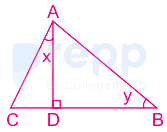
In the given figure if AD ⊥ BC, AC = 26 units, CD = 10 units, BC = 42 units, ∠DAC = x and ∠B = y then the value of \(\rm \frac{6}{\cos x}-\frac{5}{\cos y}+8\tan y\) is:
If a cot θ + b cosec θ = p and b cot θ + a cosec θ = q then p2 - q2 is equal to ______.
Important Questions from Trigonometric Ratios and Identities
What is the ratio of the greatest to the smallest value of 2 – 2 sin x – sin 2x, 0 ≤ x ≤ (π/2)?
If sinθ = \(\frac{4}{5}\) , Find the value of sin3θ
If x, y are acute angles, where 0 < x + y < 90° and sin(3x - 40°) = cos (3y + 40°), then the value of tan (x + y) is equal to
What is (1 + cot θ - cosec θ)(1 + tan θ + sec θ) equal to?
If \(\sin \theta =\frac{3}{5}\) and \(\cos \theta =\frac{4}{5}\) , then the value of \(\frac{1+\tan \theta}{1-\cot \theta}\) is:



