
If Sin θ = \(\frac{4}{5}\), find the value of tan θ - Cot θ.
Understanding the Trigonometry Problem
The question asks us to find the value of $\text{tan } \theta - \text{Cot } \theta$ given that $\text{Sin } \theta = \(\frac{4}{5}\)$. This is a common trigonometry problem that involves using the definitions of trigonometric ratios and the Pythagorean theorem.
Using the Given Sine Value
We are given that $\text{Sin } \theta = \(\frac{4}{5}\)$. Recall the definition of Sine in a right-angled triangle:
$\text{Sin } \theta = \frac{\text{Opposite side}}{\text{Hypotenuse}}$
So, if we consider a right-angled triangle with angle $\theta$, the ratio of the opposite side to the hypotenuse is 4:5. We can assume the opposite side is 4 units and the hypotenuse is 5 units for simplicity in calculation.
Finding the Adjacent Side using Pythagorean Theorem
To find the values of $\text{tan } \theta$ and $\text{Cot } \theta$, we need to know the length of the adjacent side. We can use the Pythagorean theorem, which states that in a right-angled triangle, the square of the hypotenuse is equal to the sum of the squares of the other two sides (opposite and adjacent sides).
$\text{Adjacent}^2 + \text{Opposite}^2 = \text{Hypotenuse}^2$
Substituting the known values:
$\text{Adjacent}^2 + (4)^2 = (5)^2$
$\text{Adjacent}^2 + 16 = 25$}
Now, subtract 16 from both sides to find $\text{Adjacent}^2$:
$\text{Adjacent}^2 = 25 - 16$
$\text{Adjacent}^2 = 9$}
Taking the square root of both sides to find the length of the adjacent side:
$\text{Adjacent} = \sqrt{9}$
$\text{Adjacent} = 3$ units
So, the three sides of the right-angled triangle are: Opposite = 4, Adjacent = 3, Hypotenuse = 5.
Calculating Tan and Cot Values
Now we can find the values of $\text{tan } \theta$ and $\text{Cot } \theta$ using their definitions:
$\text{tan } \theta = \frac{\text{Opposite side}}{\text{Adjacent side}}$
$\text{tan } \theta = \frac{4}{3}$
$\text{Cot } \theta = \frac{\text{Adjacent side}}{\text{Opposite side}}$
$\text{Cot } \theta = \frac{3}{4}$}
Finding the Value of tan θ - Cot θ
Finally, we need to calculate $\text{tan } \theta - \text{Cot } \theta$:
$\text{tan } \theta - \text{Cot } \theta = \frac{4}{3} - \frac{3}{4}$}
To subtract these fractions, we need a common denominator. The least common multiple of 3 and 4 is 12.
Convert $\frac{4}{3}$ to a fraction with a denominator of 12:
$\frac{4}{3} = \frac{4 \times 4}{3 \times 4} = \frac{16}{12}$
Convert $\frac{3}{4}$ to a fraction with a denominator of 12:
$\frac{3}{4} = \frac{3 \times 3}{4 \times 3} = \frac{9}{12}$
Now perform the subtraction:
$\text{tan } \theta - \text{Cot } \theta = \frac{16}{12} - \frac{9}{12} = \frac{16 - 9}{12}$}
$\text{tan } \theta - \text{Cot } \theta = \frac{7}{12}$}
The value of $\text{tan } \theta - \text{Cot } \theta$ is $\(\frac{7}{12}\)$.
Summary of Steps
- Identify the given trigonometric ratio ($\text{Sin } \theta$).
- Use the definition of $\text{Sin } \theta$ to identify the ratio of the opposite side to the hypotenuse in a right-angled triangle.
- Use the Pythagorean theorem ($\text{Adjacent}^2 + \text{Opposite}^2 = \text{Hypotenuse}^2$) to find the length of the adjacent side.
- Use the definitions of $\text{tan } \theta$ ($\frac{\text{Opposite}}{\text{Adjacent}}$) and $\text{Cot } \theta$ ($\frac{\text{Adjacent}}{\text{Opposite}}$) to find their values.
- Subtract $\text{Cot } \theta$ from $\text{tan } \theta$ by finding a common denominator for the fractions.
- Simplify the result to get the final answer.
| Trigonometric Ratio | Definition | Calculated Value |
|---|---|---|
| $\text{Sin } \theta$ | $\frac{\text{Opposite}}{\text{Hypotenuse}}$ | $\frac{4}{5}$ (Given) |
| $\text{Cos } \theta$ | $\frac{\text{Adjacent}}{\text{Hypotenuse}}$ | $\frac{3}{5}$ |
| $\text{Tan } \theta$ | $\frac{\text{Opposite}}{\text{Adjacent}}$ | $\frac{4}{3}$ |
| $\text{Cot } \theta$ | $\frac{\text{Adjacent}}{\text{Opposite}}$ | $\frac{3}{4}$ |
| $\text{Sec } \theta$ | $\frac{\text{Hypotenuse}}{\text{Adjacent}}$ | $\frac{5}{3}$ |
| $\text{Cosec } \theta$ | $\frac{\text{Hypotenuse}}{\text{Opposite}}$ | $\frac{5}{4}$ |
Revision Table: Key Trigonometric Ratios
Understanding the basic trigonometric ratios is crucial for solving such problems. Here's a quick reference:
- $\text{Sin } \theta = \frac{\text{Opposite}}{\text{Hypotenuse}}$
- $\text{Cos } \theta = \frac{\text{Adjacent}}{\text{Hypotenuse}}$
- $\text{Tan } \theta = \frac{\text{Opposite}}{\text{Adjacent}} = \frac{\text{Sin } \theta}{\text{Cos } \theta}$
- $\text{Cot } \theta = \frac{\text{Adjacent}}{\text{Opposite}} = \frac{1}{\text{Tan } \theta}$
- $\text{Sec } \theta = \frac{\text{Hypotenuse}}{\text{Adjacent}} = \frac{1}{\text{Cos } \theta}$
- $\text{Cosec } \theta = \frac{\text{Hypotenuse}}{\text{Opposite}} = \frac{1}{\text{Sin } \theta}$
Additional Information: Pythagorean Identities
Beyond the basic ratios, there are fundamental identities derived from the Pythagorean theorem that are very useful in trigonometry:
- $\text{Sin}^2 \theta + \text{Cos}^2 \theta = 1$
- $\text{Tan}^2 \theta + 1 = \text{Sec}^2 \theta$
- $\text{Cot}^2 \theta + 1 = \text{Cosec}^2 \theta$
These identities can often be used to simplify expressions or find unknown trigonometric values if one value is given, sometimes providing an alternative path to the solution compared to directly using the sides of a right-angled triangle.
Similar Questions
If sin t + cos t = \(\frac{4}{5}\), then find sin t. cos t.
If sec A + tan A = 5,then sin A is equal to:
Simplify the given expression.
\(\frac{1+sin^4 \theta+cos^4\theta}{cos^2 \theta+sin^4\theta}\)
Which of the following will satisfy a2 = b2 + (ab)2 for the values a and b?
If sec x – cos x = 4, then what will be the value of \({{(1 \ + \ cos^2 x)} \over cos x}\)?
If cos θ + cos2θ =1, find the value of \(\sqrt{\sin^4θ + \cos^2θ}\).
- \(\rm \frac{\sin^4 \theta+\cos ^4\theta}{1-2\sin^2\theta.\cos^2\theta}=\) ________.
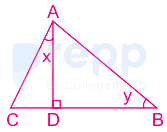
In the given figure if AD ⊥ BC, AC = 26 units, CD = 10 units, BC = 42 units, ∠DAC = x and ∠B = y then the value of \(\rm \frac{6}{\cos x}-\frac{5}{\cos y}+8\tan y\) is:
If a cot θ + b cosec θ = p and b cot θ + a cosec θ = q then p2 - q2 is equal to ______.
If \(\rm \cot A=\frac{12}{5}\), then the value of (sin A + cos A) × cosec A is _______.
Important Questions from Trigonometric Ratios and Identities
What is the ratio of the greatest to the smallest value of 2 – 2 sin x – sin 2x, 0 ≤ x ≤ (π/2)?
If sinθ = \(\frac{4}{5}\) , Find the value of sin3θ
If x, y are acute angles, where 0 < x + y < 90° and sin(3x - 40°) = cos (3y + 40°), then the value of tan (x + y) is equal to
What is (1 + cot θ - cosec θ)(1 + tan θ + sec θ) equal to?
If \(\sin \theta =\frac{3}{5}\) and \(\cos \theta =\frac{4}{5}\) , then the value of \(\frac{1+\tan \theta}{1-\cot \theta}\) is:



