
If sec A + tan A = 5,then sin A is equal to:
Finding sin A when sec A + tan A is Given
This question asks us to find the value of \( \sin A \) given the relationship \( \sec A + \tan A = 5 \). We can solve this trigonometric problem by using fundamental trigonometric identities and solving a system of equations.
Using Fundamental Trigonometric Identities
A key trigonometric identity relates secant and tangent: \( \sec^2 A - \tan^2 A = 1 \). This identity is derived from the Pythagorean identity \( 1 + \tan^2 A = \sec^2 A \).
The identity \( \sec^2 A - \tan^2 A = 1 \) can be factored as a difference of squares:
\( (\sec A - \tan A)(\sec A + \tan A) = 1 \)
We are given that \( \sec A + \tan A = 5 \). Substituting this into the factored identity:
\( (\sec A - \tan A)(5) = 1 \)
Dividing both sides by 5, we get a second relationship between \( \sec A \) and \( \tan A \):
\( \sec A - \tan A = \frac{1}{5} \)
Solving for sec A and tan A
Now we have a system of two linear equations involving \( \sec A \) and \( \tan A \):
- \( \sec A + \tan A = 5 \)
- \( \sec A - \tan A = \frac{1}{5} \)
We can solve this system by adding or subtracting the equations.
Adding the two equations:
\( (\sec A + \tan A) + (\sec A - \tan A) = 5 + \frac{1}{5} \)
\( 2 \sec A = \frac{25}{5} + \frac{1}{5} \)
\( 2 \sec A = \frac{26}{5} \)
Divide by 2 to find \( \sec A \):
\( \sec A = \frac{26}{5} \times \frac{1}{2} = \frac{13}{5} \)
Subtracting the second equation from the first:
\( (\sec A + \tan A) - (\sec A - \tan A) = 5 - \frac{1}{5} \)
\( \sec A + \tan A - \sec A + \tan A = \frac{25}{5} - \frac{1}{5} \)
\( 2 \tan A = \frac{24}{5} \)
Divide by 2 to find \( \tan A \):
\( \tan A = \frac{24}{5} \times \frac{1}{2} = \frac{12}{5} \)
Finding sin A
We have found \( \sec A = \frac{13}{5} \) and \( \tan A = \frac{12}{5} \). We need to find \( \sin A \).
We know that \( \tan A = \frac{\sin A}{\cos A} \). Also, \( \sec A = \frac{1}{\cos A} \). From \( \sec A = \frac{13}{5} \), we can find \( \cos A \):
\( \cos A = \frac{1}{\sec A} = \frac{1}{13/5} = \frac{5}{13} \)
Now we can use the relationship \( \tan A = \frac{\sin A}{\cos A} \) to find \( \sin A \):
\( \sin A = \tan A \times \cos A \)
Substitute the values of \( \tan A \) and \( \cos A \):
\( \sin A = \frac{12}{5} \times \frac{5}{13} \)
\( \sin A = \frac{12 \times 5}{5 \times 13} \)
\( \sin A = \frac{12}{13} \)
Alternatively, since we have \( \tan A = \frac{12}{5} \), which is the ratio of the opposite side to the adjacent side in a right-angled triangle, we can construct a right triangle. If the opposite side is 12k and the adjacent side is 5k for some constant k (we can assume k=1 for simplicity in ratios), the hypotenuse would be calculated using the Pythagorean theorem:
\( \text{Hypotenuse} = \sqrt{(\text{Opposite})^2 + (\text{Adjacent})^2} = \sqrt{12^2 + 5^2} = \sqrt{144 + 25} = \sqrt{169} = 13 \)
So, in this right triangle, the sides are 12, 5, and 13. Now we can find \( \sin A \), which is the ratio of the opposite side to the hypotenuse:
\( \sin A = \frac{\text{Opposite}}{\text{Hypotenuse}} = \frac{12}{13} \)
We can also check if \( \sec A + \tan A = 5 \) holds with these values:
\( \cos A = \frac{5}{13} \implies \sec A = \frac{13}{5} \)
\( \sec A + \tan A = \frac{13}{5} + \frac{12}{5} = \frac{13+12}{5} = \frac{25}{5} = 5 \)
This confirms our values for \( \sec A \), \( \tan A \), and \( \sin A \) are consistent with the given information.
Therefore, \( \sin A \) is equal to \( \frac{12}{13} \).
Revision Table: Trigonometric Ratios and Identities
| Trigonometric Ratio | Definition (Right Triangle) | Relationship |
|---|---|---|
| \( \sin A \) | Opposite / Hypotenuse | \( \frac{1}{\csc A} \) |
| \( \cos A \) | Adjacent / Hypotenuse | \( \frac{1}{\sec A} \) |
| \( \tan A \) | Opposite / Adjacent | \( \frac{1}{\cot A}, \frac{\sin A}{\cos A} \) |
| \( \sec A \) | Hypotenuse / Adjacent | \( \frac{1}{\cos A} \) |
Additional Information: Important Trigonometric Identities
Beyond \( \sec^2 A - \tan^2 A = 1 \), several other identities are crucial for solving trigonometry problems:
- Pythagorean Identities:
- \( \sin^2 A + \cos^2 A = 1 \)
- \( 1 + \tan^2 A = \sec^2 A \)
- \( 1 + \cot^2 A = \csc^2 A \)
- Reciprocal Identities:
- \( \sec A = \frac{1}{\cos A} \)
- \( \csc A = \frac{1}{\sin A} \)
- \( \cot A = \frac{1}{\tan A} \)
- Quotient Identities:
- \( \tan A = \frac{\sin A}{\cos A} \)
- \( \cot A = \frac{\cos A}{\sin A} \)
Understanding and applying these identities is key to simplifying expressions and solving equations in trigonometry. The identity \( \sec^2 A - \tan^2 A = 1 \) is particularly useful when dealing with sums or differences of secant and tangent, as shown in this problem.
Similar Questions
If sin t + cos t = \(\frac{4}{5}\), then find sin t. cos t.
Simplify the given expression.
\(\frac{1+sin^4 \theta+cos^4\theta}{cos^2 \theta+sin^4\theta}\)
Which of the following will satisfy a2 = b2 + (ab)2 for the values a and b?
If sec x – cos x = 4, then what will be the value of \({{(1 \ + \ cos^2 x)} \over cos x}\)?
If cos θ + cos2θ =1, find the value of \(\sqrt{\sin^4θ + \cos^2θ}\).
If Sin θ = \(\frac{4}{5}\), find the value of tan θ - Cot θ.
- \(\rm \frac{\sin^4 \theta+\cos ^4\theta}{1-2\sin^2\theta.\cos^2\theta}=\) ________.
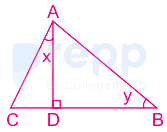
In the given figure if AD ⊥ BC, AC = 26 units, CD = 10 units, BC = 42 units, ∠DAC = x and ∠B = y then the value of \(\rm \frac{6}{\cos x}-\frac{5}{\cos y}+8\tan y\) is:
If a cot θ + b cosec θ = p and b cot θ + a cosec θ = q then p2 - q2 is equal to ______.
If \(\rm \cot A=\frac{12}{5}\), then the value of (sin A + cos A) × cosec A is _______.
Important Questions from Trigonometric Ratios and Identities
What is the ratio of the greatest to the smallest value of 2 – 2 sin x – sin 2x, 0 ≤ x ≤ (π/2)?
If sinθ = \(\frac{4}{5}\) , Find the value of sin3θ
If x, y are acute angles, where 0 < x + y < 90° and sin(3x - 40°) = cos (3y + 40°), then the value of tan (x + y) is equal to
What is (1 + cot θ - cosec θ)(1 + tan θ + sec θ) equal to?
If \(\sin \theta =\frac{3}{5}\) and \(\cos \theta =\frac{4}{5}\) , then the value of \(\frac{1+\tan \theta}{1-\cot \theta}\) is:



