
If cos θ + cos2θ =1, find the value of \(\sqrt{\sin^4θ + \cos^2θ}\).
Solving a Trigonometric Equation: Finding \(\sqrt{\sin^4θ + \cos^2θ}\)
We are given a trigonometric equation, \(\cos θ + \cos^2θ =1\), and asked to find the value of the expression \(\sqrt{\sin^4θ + \cos^2θ}\).
Let's start by analyzing the given equation.
The given equation is:
\[ \cos θ + \cos^2θ =1 \]We can rearrange this equation to find a useful relationship:
\[ \cos θ = 1 - \cos^2θ \]Recall the fundamental trigonometric identity, the Pythagorean identity:
\[ \sin^2θ + \cos^2θ = 1 \]From this identity, we can express \(\sin^2θ\) as:
\[ \sin^2θ = 1 - \cos^2θ \]Comparing this with the rearranged given equation, we see a direct relationship:
\[ \cos θ = \sin^2θ \]This relationship is key to solving the problem. Now, let's consider the expression we need to evaluate: \(\sqrt{\sin^4θ + \cos^2θ}\).
We can substitute the relationship \(\sin^2θ = \cos θ\) into this expression. First, let's find \(\sin^4θ\):
\[ \sin^4θ = (\sin^2θ)^2 \]Substituting \(\sin^2θ = \cos θ\) into this, we get:
\[ \sin^4θ = (\cos θ)^2 = \cos^2θ \]Now, substitute \(\sin^4θ = \cos^2θ\) back into the expression \(\sqrt{\sin^4θ + \cos^2θ}\):
\[ \sqrt{\sin^4θ + \cos^2θ} = \sqrt{\cos^2θ + \cos^2θ} \]Combine the terms under the square root:
\[ \sqrt{\cos^2θ + \cos^2θ} = \sqrt{2 \cos^2θ} \]Now, we can simplify the square root. Using the property \(\sqrt{ab} = \sqrt{a}\sqrt{b}\) and \(\sqrt{x^2} = |x|\), we get:
\[ \sqrt{2 \cos^2θ} = \sqrt{2} \cdot \sqrt{\cos^2θ} \]While \(\sqrt{\cos^2θ}\) is strictly \(|\cos θ|\), the options provided suggest the answer is in terms of \(\cos θ\). Therefore, we assume \(\sqrt{\cos^2θ} = \cos θ\) in this context to match the structure of the answer options.
So, the value of the expression is:
\[ \sqrt{2} \cos θ \]Let's check this result against the given options.
- Option 1: \(\sqrt{2}\) Cos θ
- Option 2: 2 Cos θ
- Option 3: \(\sqrt{2}\) Sin θ
- Option 4: 2 Sin θ
Our derived value matches Option 1: \(\sqrt{2}\) Cos θ.
Step-by-Step Solution Summary
- Start with the given equation: \(\cos θ + \cos^2θ =1\).
- Rearrange the equation: \(\cos θ = 1 - \cos^2θ\).
- Use the Pythagorean identity \(\sin^2θ + \cos^2θ = 1\) to see that \(1 - \cos^2θ = \sin^2θ\).
- Establish the key relationship: \(\cos θ = \sin^2θ\).
- Consider the expression to evaluate: \(\sqrt{\sin^4θ + \cos^2θ}\).
- Substitute \(\sin^2θ = \cos θ\) into \(\sin^4θ\) to get \(\sin^4θ = (\sin^2θ)^2 = (\cos θ)^2 = \cos^2θ\).
- Substitute \(\sin^4θ = \cos^2θ\) into the expression: \(\sqrt{\cos^2θ + \cos^2θ}\).
- Simplify: \(\sqrt{2\cos^2θ}\).
- Take the square root: \(\sqrt{2}\sqrt{\cos^2θ}\).
- Assuming \(\sqrt{\cos^2θ} = \cos θ\) to match the answer options, the result is \(\sqrt{2} \cos θ\).
Revision Table: Key Trigonometric Concepts
| Concept | Description | Formula |
|---|---|---|
| Pythagorean Identity | Relates sine and cosine of an angle. | \(\sin^2θ + \cos^2θ = 1\) |
| Rearranging Equations | Manipulating equations to isolate variables or terms. | \(a+b=c \implies a = c-b\) |
| Square Root Property | Finding the value that, when multiplied by itself, equals the original number. | \(\sqrt{x^2} = |x|\) (In many trig problems, context simplifies this) |
Additional Information on Trigonometric Identities
Trigonometric identities are equations that are true for all values of the variable for which both sides of the equation are defined. They are crucial tools for simplifying expressions, solving trigonometric equations, and evaluating integrals in calculus.
The Pythagorean identity \(\sin^2θ + \cos^2θ = 1\) is one of the most fundamental identities. It comes directly from the definition of sine and cosine on the unit circle (\(x^2 + y^2 = r^2\), where \(x = r\cosθ\) and \(y = r\sinθ\)).
Other important identities include:
- Reciprocal Identities: \(\cscθ = \frac{1}{\sinθ}\), \(\secθ = \frac{1}{\cosθ}\), \(\cotθ = \frac{1}{\tanθ}\)
- Quotient Identities: \(\tanθ = \frac{\sinθ}{\cosθ}\), \(\cotθ = \frac{\cosθ}{\sinθ}\)
Mastering these identities is essential for success in trigonometry and related fields of mathematics.
Similar Questions
If sin t + cos t = \(\frac{4}{5}\), then find sin t. cos t.
If sec A + tan A = 5,then sin A is equal to:
Simplify the given expression.
\(\frac{1+sin^4 \theta+cos^4\theta}{cos^2 \theta+sin^4\theta}\)
Which of the following will satisfy a2 = b2 + (ab)2 for the values a and b?
If sec x – cos x = 4, then what will be the value of \({{(1 \ + \ cos^2 x)} \over cos x}\)?
If Sin θ = \(\frac{4}{5}\), find the value of tan θ - Cot θ.
- \(\rm \frac{\sin^4 \theta+\cos ^4\theta}{1-2\sin^2\theta.\cos^2\theta}=\) ________.
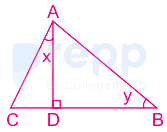
In the given figure if AD ⊥ BC, AC = 26 units, CD = 10 units, BC = 42 units, ∠DAC = x and ∠B = y then the value of \(\rm \frac{6}{\cos x}-\frac{5}{\cos y}+8\tan y\) is:
If a cot θ + b cosec θ = p and b cot θ + a cosec θ = q then p2 - q2 is equal to ______.
If \(\rm \cot A=\frac{12}{5}\), then the value of (sin A + cos A) × cosec A is _______.
Important Questions from Trigonometric Ratios and Identities
What is the ratio of the greatest to the smallest value of 2 – 2 sin x – sin 2x, 0 ≤ x ≤ (π/2)?
If sinθ = \(\frac{4}{5}\) , Find the value of sin3θ
If x, y are acute angles, where 0 < x + y < 90° and sin(3x - 40°) = cos (3y + 40°), then the value of tan (x + y) is equal to
What is (1 + cot θ - cosec θ)(1 + tan θ + sec θ) equal to?
If \(\sin \theta =\frac{3}{5}\) and \(\cos \theta =\frac{4}{5}\) , then the value of \(\frac{1+\tan \theta}{1-\cot \theta}\) is:



