A. The byte is placed in the instruction decoder of the microprocessor.
B. The byte from the memory location is placed on data bus.
C. The control unit sends the control signal $\overline{\text{RD}}$ to enable the memory chip.
D. The microprocessor places the 16-bit memory address from program counter on the address bus.
Choose the correct answer from the options given below :
Microprocessor Memory Fetch Sequence: D, C, B, A
To understand how a microprocessor fetches a data byte from memory, let's analyze the sequence of steps involved:
Step 1: Address Placement (D)
The process starts with identifying the target memory location. The microprocessor uses the program counter (PC) to get the 16-bit memory address. This address is then placed onto the address bus, specifying where the data resides.
Step 2: Control Signal Activation (C)
Following address placement, the microprocessor's control unit initiates the read operation. It sends a specific control signal, the read signal $\\overline{\text{RD}}$, to the memory system. This signal enables the target memory chip and indicates that data needs to be read.
Step 3: Data Transfer (B)
With the correct address on the address bus and the read signal active, the memory chip responds. It fetches the requested byte from the specified location and places it onto the data bus. The data bus acts as the pathway for transferring this byte back to the microprocessor.
Step 4: Data Processing (A)
Finally, the data byte travels from the data bus into the microprocessor. It is then directed to the appropriate internal component, such as the instruction decoder, for further processing or execution according to the program's instructions.
The correct sequence combining these essential steps is D, C, B, A.
Similar Questions
- Calculate the output voltage of an op-amp for input voltages of $V_{i1} = 150 \mu\text{V}$ and $V_{i2} = 140 \mu\text{V}$. The amplifier has a differential gain of $A_d = 4000$ and the value of CMRR is $100$ :
- For an op-amp having a slew rate of $4\text{ V}/\mu\text{s}$, what is the maximum closed-loop voltage gain that can be used when input signal varies by $0.1\text{V}$ in $10\mu\text{s}$ ?
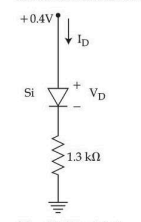
For the series diode configuration of the given figure, determine $V_D$ and $I_D$.
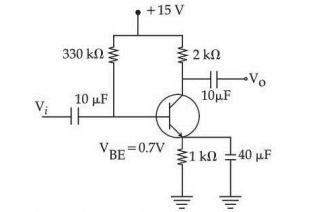
For the given emitter-bias network, determine the values of $I_C$ and $V_{CE}$. Assume $\beta = 100$.
- Given below are two statements : one is labelled as Assertion (A) and the other is labelled as Reason (R).
Assertion (A) : The gate of a MOSFET is insulated from body of FET by deposition of a very thin fragile layer of $\text{SiO}_2$ over the substrate.
Reason (R) : The device is therefore called an insulated gate field-effect transistor (IGFET).
In the light of the above statements, choose the most appropriate answer from the options given below : - If 8085 microprocessor adds 87H and 79H, then :
- The content of register (B) and register (C) of 8085 microprocessor are 0AH and 0BH. It is desired to multiply the content of register B and register C and store the results in accumulator. A part of 8085 program for this purpose is given as :
MVI A, 00H
LOOP ; _ _ _ _ _
_ _ _ _ _ _ _ _ _
_ _ _ _ _ _ _ _ _
HLT END
A sequence of instructions to complete the program would be : - Sequence of steps in 8085 microprocessor interrupt execution :
A. Interrupt acknowledged
B. Program counter content saved
C. Control transfered to ISR
D. Interrupt vector is read
Choose the correct answer from the options given below : - Consider the following statements regarding the 8085 microprocessor :
A. The 8085 is an 8-bit microprocessor.
B. It has a 16-bit address bus, allowing it to access 64 KB of memory.
C. It has 40 pins.
D. It uses a multiplexed address/data bus.
Choose the correct answer from the options given below : - In 8085 microprocessor, which of the following are 2-byte instructions ?
A. MOV C, A
B. MVI A, 32H
C. LDA 2050H
D. JMP 2085H
E. ADD B
Choose the correct answer from the options given below :
Important Questions from Miscellaneous
- Which of the following scheduler/schedulers is/are also called CPU scheduler ?
(A). Short Term Scheduler
(B). Long Term Scheduler
(C). Medium Term Scheduler
(D). Asymmetric Scheduler
Choose the correct answer from the options given below: - A situation where two or more processes are blocked, waiting for resources held by each other is called:
- External fragmentation occurs ________.
- Which disk scheduling algorithm looks for the track closest to the current head position?
- Which CPU scheduling algorithm prefers the process with the shortest burst time?