
The quienscent state of transistor is when
Biased but no signal is applied
To understand the quiescent state of a transistor, let's delve into some key concepts. Transistors are key components in electronic circuits, used primarily as amplifiers or switches. Their operation is dependent on the biasing and signal conditions. The quiescent state, also known as the "Q point" or "operating point," is crucial for the operation of a transistor.
Explanation:
- Quiescent State: This is the condition in which a transistor is correctly biased with no input signal applied. The term "quiescent" refers to a state of rest or inactivity, meaning the transistor is in a steady state but ready to respond to input signals.
- Option 1: It is unbiased. This is incorrect. For a transistor to function properly in any configuration (e.g., amplifier), it must be correctly biased. Unbiased transistors do not establish the necessary conditions for amplification or switching.
- Option 2: Biased but no signal is applied. This is the correct answer. The quiescent state requires the transistor to be properly biased (i.e., voltage or current applied to set the initial state), but with no dynamic signal at its input. This allows the transistor to quickly respond to input signals when they are applied.
- Option 3: No current flows. This is incorrect. In the quiescent state, although there is no signal, bias currents and voltages must be present to keep the transistor in its operating region.
- Option 4: Punch through occurs at the collector junction. This is incorrect. Punch through refers to a failure condition where the depletion region expands to the extent that it affects the device's operation. This is a fault condition, not a quiescent state.
Conclusion: The correct option is "Biased but no signal is applied," which defines the quiescent state where the transistor is ready for action with appropriate biasing but no active input signal changes. Proper biasing positions the transistor at an optimal operating point, ensuring efficient amplification or switching when a signal is introduced.
Similar Questions
Assertion (A) : A self-biased circuit has a better stability than a fixed bias circuit.
Reason (R) : It provides negative feed back by the use of an additional resistor between the base and ground.
The basic purpose of biasing a transistor with a network is
For an Emitter Bias BJT configuration arrange stability factor S(Iw) in descending order if β = 50. RB is base resistance and RE is emitter resistance.
(A) RE = 0.1 RB
(B) RB = 60 RE
(C) RB = 100 RE
(D) RE = 10 RB
(E) RB = 30 REChoose the most appropriate answer from the options given below :
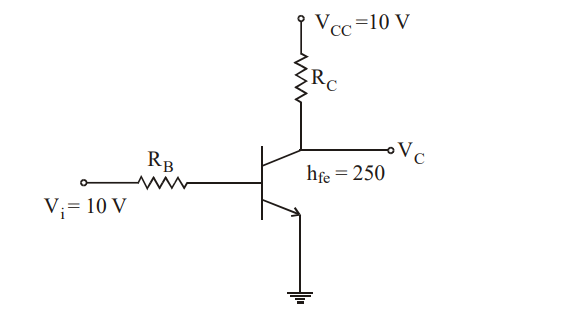
For a transistor inverter shown below, if IC sat is 10 mA, the value of RB and RC are
Assertion (A) : The bias instability occurs in transistors due to thermal variations.
Reason (R) : The reverse saturation current doubles for every 18 °C temperature rise. Due to this the reverse saturation current further heats the junction. As a result there is a thermal run-away.
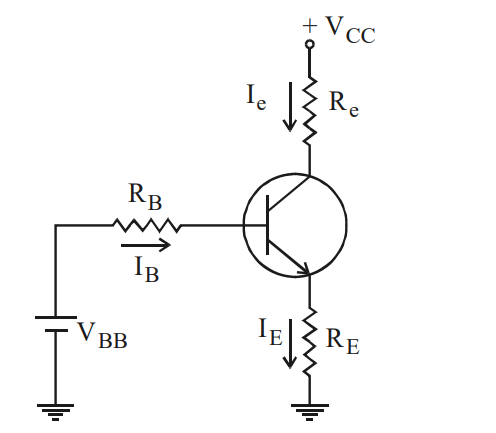
In a circuit given below the base current IB is
Assertion (A) : Completion of the design in a transistor requires the check of quiescent-point variations due to temperature changes and unit to unit parameter differences.
Reason (R) : As the principle of operation of the BJT & FET differ, so do the associated methods of Q-point stabilization.
Select your answer using the codes given below :
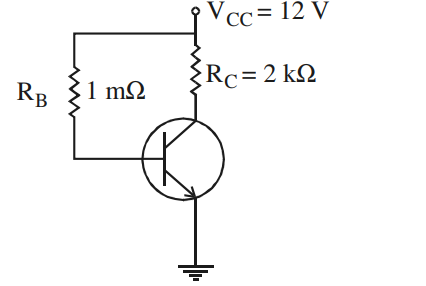
In a circuit shown below, the base current is
Important Questions from Biasing of Transistors
What is the operating point of a transistor as an amplifier known as?
When no ac input signals are connected to CE Transistor Load line can be plotted ______
In how many regions can the biased transistor work?
In a BJT, if the base-emitter junction is reverse-biased and the base-collector junction is reverse-biased, it is said to operate in
When transistors are used in digital circuits they usually operate in the:



