
Assertion (A) : Completion of the design in a transistor requires the check of quiescent-point variations due to temperature changes and unit to unit parameter differences. Reason (R) : As the principle of operation of the BJT & FET differ, so do the associated methods of Q-point stabilization. Select your answer using the codes given below :
Both (A) and (R) are true, but (R) is not the correct explanation of (A)
Both statements are true, but they answer different questions, so the code is 2.
Why (A) is true. A bias design that works on paper can still fail in practice, because the two things it depends on are not fixed:
Temperature. In a BJT, \(V_{BE}\) falls by about 2 mV per °C and the reverse leakage \(I_{CBO}\) roughly doubles every 10 °C. Both push IC upward, which raises the junction temperature further — the positive feedback known as thermal runaway.
Unit-to-unit spread. The current gain \(\beta\) of a single type number may vary by a factor of three between devices — a 2N2222 is specified from 100 to 300. A design whose operating point depends on \(\beta\) is therefore not a design at all.
Checking the Q point against both is the last step of any bias design, exactly as the assertion says. The standard measure is the stability factor
\(S=\dfrac{\partial I_{C}}{\partial I_{CO}}\)
which the voltage-divider bias reduces towards unity by making the base voltage independent of \(\beta\) and letting the emitter resistor supply negative feedback.
Why (R) is true but not the explanation. BJT and FET biasing do differ, and for good reason:
| BJT | FET | |
|---|---|---|
| Controlled by | Base current | Gate voltage |
| Spread in | \(\beta\) | IDSS, VP |
| Usual scheme | Voltage-divider with RE | Self-bias, or voltage-divider self-bias |
| Thermal runaway | A real risk | Self-limiting — mobility falls with temperature |
But that difference does not explain why the check is needed. The assertion says the Q point must be verified against temperature and device spread; the reason says the techniques for doing so differ between device families. The need exists whichever device is used — indeed it would exist even if only one type of transistor had ever been invented. So the two statements stand independently.
The answer is flagged for confirmation because a reader who takes (R) as "device parameters vary, hence stabilisation is needed" would call it explanatory; read literally, it is about the difference between the two families.
Hence, both (A) and (R) are true, but (R) is not the correct explanation of (A).
Similar Questions
Assertion (A) : A self-biased circuit has a better stability than a fixed bias circuit.
Reason (R) : It provides negative feed back by the use of an additional resistor between the base and ground.
The basic purpose of biasing a transistor with a network is
For an Emitter Bias BJT configuration arrange stability factor S(Iw) in descending order if β = 50. RB is base resistance and RE is emitter resistance.
(A) RE = 0.1 RB
(B) RB = 60 RE
(C) RB = 100 RE
(D) RE = 10 RB
(E) RB = 30 REChoose the most appropriate answer from the options given below :
The quienscent state of transistor is when
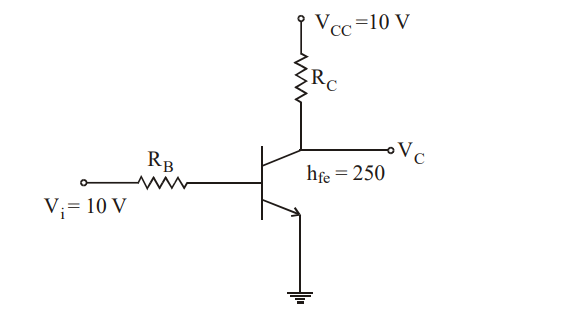
For a transistor inverter shown below, if IC sat is 10 mA, the value of RB and RC are
Assertion (A) : The bias instability occurs in transistors due to thermal variations.
Reason (R) : The reverse saturation current doubles for every 18 °C temperature rise. Due to this the reverse saturation current further heats the junction. As a result there is a thermal run-away.
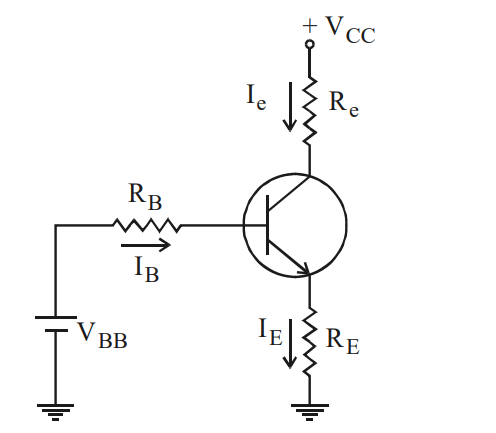
In a circuit given below the base current IB is
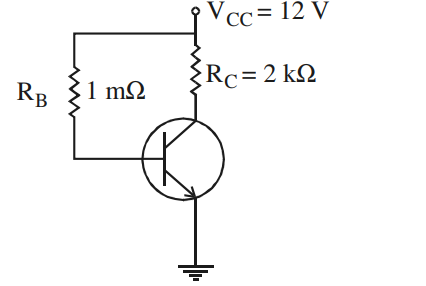
In a circuit shown below, the base current is
Important Questions from Biasing of Transistors
What is the operating point of a transistor as an amplifier known as?
When no ac input signals are connected to CE Transistor Load line can be plotted ______
In how many regions can the biased transistor work?
In a BJT, if the base-emitter junction is reverse-biased and the base-collector junction is reverse-biased, it is said to operate in
When transistors are used in digital circuits they usually operate in the:



