
In a circuit given below the base current IB is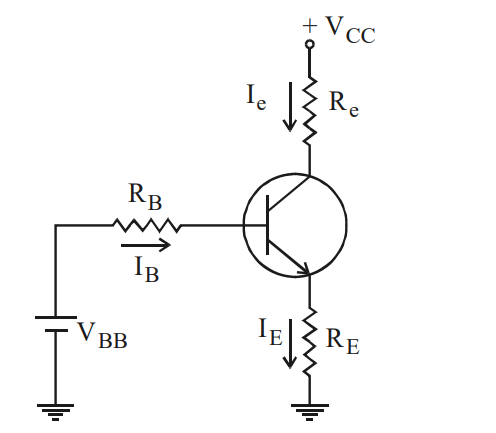
\(\dfrac{V_{BB}-V_{BE}}{R_B+(\beta+1)R_E}\)
To determine the base current \( I_B \) in the given circuit, we start by analyzing the transistor circuit in terms of voltages and currents. The circuit includes \( V_{BB} \) as the biasing voltage, and resistances \( R_B \) and \( R_E \). The transistor has a base-emitter voltage drop \( V_{BE} \), and an emitter current \( I_E \).
Using KVL (Kirchhoff's Voltage Law) in the base-emitter loop of the transistor:
\(V_{BB} = I_B \cdot R_B + V_{BE} + I_E \cdot R_E\)
Now, recall the relation between base current \( I_B \), collector current \( I_C \), and emitter current \( I_E \) in a transistor:
\(I_E = I_B + I_C\)
For a transistor, we also know:
\(I_C = \beta \cdot I_B\)
So,
\(I_E = I_B + \beta \cdot I_B = (\beta + 1) \cdot I_B\)
Substitute \( I_E \) in the KVL equation:
\(V_{BB} = I_B \cdot R_B + V_{BE} + (\beta + 1) \cdot I_B \cdot R_E\)
Rearrange this to solve for \( I_B \):
\(I_B \cdot (R_B + (\beta + 1) \cdot R_E) = V_{BB} - V_{BE}\)
Finally, the base current \( I_B \) is given by:
\(I_B = \dfrac{V_{BB} - V_{BE}}{R_B + (\beta + 1) \cdot R_E}\)
The correct option, as calculated, is:
\(\dfrac{V_{BB} - V_{BE}}{R_B + (\beta + 1)R_E}\)
This demonstrates that the correct choice among the given options is indeed the expression that accounts for both base bias resistance \( R_B \) and the influence of emitter resistance \( R_E \) scaled by \((\beta + 1)\).
Similar Questions
Assertion (A) : A self-biased circuit has a better stability than a fixed bias circuit.
Reason (R) : It provides negative feed back by the use of an additional resistor between the base and ground.
The basic purpose of biasing a transistor with a network is
For an Emitter Bias BJT configuration arrange stability factor S(Iw) in descending order if β = 50. RB is base resistance and RE is emitter resistance.
(A) RE = 0.1 RB
(B) RB = 60 RE
(C) RB = 100 RE
(D) RE = 10 RB
(E) RB = 30 REChoose the most appropriate answer from the options given below :
The quienscent state of transistor is when
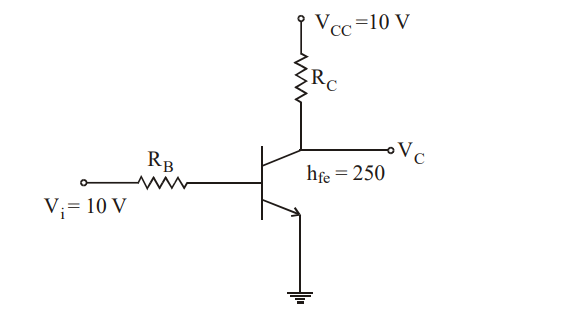
For a transistor inverter shown below, if IC sat is 10 mA, the value of RB and RC are
Assertion (A) : The bias instability occurs in transistors due to thermal variations.
Reason (R) : The reverse saturation current doubles for every 18 °C temperature rise. Due to this the reverse saturation current further heats the junction. As a result there is a thermal run-away.
Assertion (A) : Completion of the design in a transistor requires the check of quiescent-point variations due to temperature changes and unit to unit parameter differences.
Reason (R) : As the principle of operation of the BJT & FET differ, so do the associated methods of Q-point stabilization.
Select your answer using the codes given below :
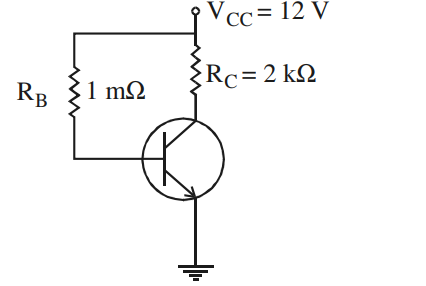
In a circuit shown below, the base current is
Important Questions from Biasing of Transistors
What is the operating point of a transistor as an amplifier known as?
When no ac input signals are connected to CE Transistor Load line can be plotted ______
In how many regions can the biased transistor work?
In a BJT, if the base-emitter junction is reverse-biased and the base-collector junction is reverse-biased, it is said to operate in
When transistors are used in digital circuits they usually operate in the:



