
In a circuit shown below, the base current is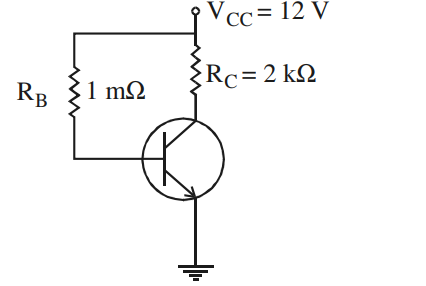
11.3 μA
Recognise the circuit. This is the classic fixed-bias (base-resistor bias) stage: one resistor RB from the supply to the base, one resistor RC from the supply to the collector, emitter grounded. Its defining feature is that the base current is set entirely by the base loop and does not depend on β at all.
Step 1 — write KVL around the base–emitter loop. Starting at VCC, through RB, across the base-emitter junction, to ground:
\(V_{CC}=I_B R_B + V_{BE}\)
Step 2 — solve for IB. A forward-biased silicon base-emitter junction sits at VBE ≈ 0.7 V:
\(I_B=\dfrac{V_{CC}-V_{BE}}{R_B}=\dfrac{12-0.7}{1\times10^{6}}\)
\(I_B=\dfrac{11.3}{10^{6}}=11.3\times10^{-6}\ \text{A}=11.3\ \mu\text{A}\)
Why RC plays no part. The collector resistor sits in a different loop. It fixes VCE once IC is known, but the base current is decided before the transistor's gain enters the picture. Knowing RC = 2 kΩ you could go on to find, for a typical β = 100, that \(I_C=\beta I_B=1.13\ \text{mA}\) and \(V_{CE}=12-(1.13\text{m})(2\text{k})=9.74\ \text{V}\) — comfortably in the active region.
Where the distractors come from. 12.0 μA is what you get by forgetting VBE altogether, i.e. taking 12 V across RB; the 0.7 V drop is exactly what turns 12.0 into 11.3. 0.7 μA is 0.7 V divided by RB, the discarded part rather than the answer. 6.0 μA would follow from halving the supply.
The weakness of this bias scheme. Since IB is fixed, \(I_C=\beta I_B\) drifts in direct proportion to β, which varies widely between devices and with temperature. That is why fixed bias, despite needing only one resistor, is replaced in practice by voltage-divider bias with an emitter resistor, whose stability factor is far smaller.
Hence, the base current is 11.3 μA.
Similar Questions
Assertion (A) : A self-biased circuit has a better stability than a fixed bias circuit.
Reason (R) : It provides negative feed back by the use of an additional resistor between the base and ground.
The basic purpose of biasing a transistor with a network is
For an Emitter Bias BJT configuration arrange stability factor S(Iw) in descending order if β = 50. RB is base resistance and RE is emitter resistance.
(A) RE = 0.1 RB
(B) RB = 60 RE
(C) RB = 100 RE
(D) RE = 10 RB
(E) RB = 30 REChoose the most appropriate answer from the options given below :
The quienscent state of transistor is when
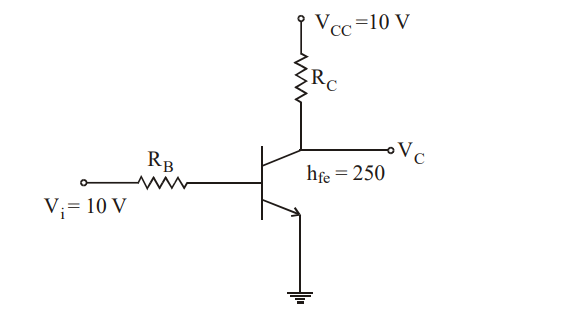
For a transistor inverter shown below, if IC sat is 10 mA, the value of RB and RC are
Assertion (A) : The bias instability occurs in transistors due to thermal variations.
Reason (R) : The reverse saturation current doubles for every 18 °C temperature rise. Due to this the reverse saturation current further heats the junction. As a result there is a thermal run-away.
In a circuit given below the base current IB is
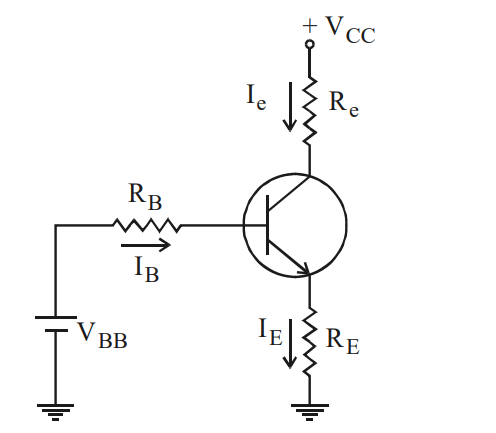
Assertion (A) : Completion of the design in a transistor requires the check of quiescent-point variations due to temperature changes and unit to unit parameter differences.
Reason (R) : As the principle of operation of the BJT & FET differ, so do the associated methods of Q-point stabilization.
Select your answer using the codes given below :
Important Questions from Biasing of Transistors
What is the operating point of a transistor as an amplifier known as?
When no ac input signals are connected to CE Transistor Load line can be plotted ______
In how many regions can the biased transistor work?
In a BJT, if the base-emitter junction is reverse-biased and the base-collector junction is reverse-biased, it is said to operate in
When transistors are used in digital circuits they usually operate in the:



