
The length of each side of a triangle is 12 cm. What is the length of the circumradius of the triangle?
4√3 cm
Understanding the Triangle and its Circumradius
The question asks for the length of the circumradius of a triangle where each side measures 12 cm. A triangle with all three sides of equal length is known as an equilateral triangle. Equilateral triangles have several special properties, including specific formulas for their area, height, inradius, and circumradius.
Identifying the Triangle Type
Given:
- Side length 1 = 12 cm
- Side length 2 = 12 cm
- Side length 3 = 12 cm
Since all sides are equal, the triangle is an equilateral triangle.
Circumradius of an Equilateral Triangle
The circumradius (\(\small R\)) of a triangle is the radius of the circle that passes through all three vertices of the triangle. This circle is called the circumcircle. For an equilateral triangle with side length \(\small a\), the formula for the circumradius is:
\(\small R = \frac{a}{\sqrt{3}}\)
Alternatively, you can also derive this from the general circumradius formula \(\small R = \frac{abc}{4K}\), where \(\small a, b, c\) are side lengths and \(\small K\) is the area. For an equilateral triangle with side \(\small a\), \(\small a=b=c\) and \(\small K = \frac{\sqrt{3}}{4} a^2\). So, \(\small R = \frac{a \cdot a \cdot a}{4 \cdot \frac{\sqrt{3}}{4} a^2} = \frac{a^3}{\sqrt{3} a^2} = \frac{a}{\sqrt{3}}\).
Calculating the Circumradius Length
Using the formula \(\small R = \frac{a}{\sqrt{3}}\) with the given side length \(\small a = 12\) cm:
\(\small R = \frac{12}{\sqrt{3}}\)
To rationalize the denominator, multiply the numerator and the denominator by \(\small \sqrt{3}\):
\(\small R = \frac{12}{\sqrt{3}} \times \frac{\sqrt{3}}{\sqrt{3}} = \frac{12\sqrt{3}}{3}\)
Now, simplify the expression:
\(\small R = 4\sqrt{3}\)
So, the length of the circumradius of the equilateral triangle is \(\small 4\sqrt{3}\) cm.
Comparing with Options
Let's compare our calculated circumradius with the given options:
- Option 1: \(\small 8\sqrt{3}\) cm
- Option 2: \(\small 2\sqrt{3}\) cm
- Option 3: \(\small 6\sqrt{3}\) cm
- Option 4: \(\small 4\sqrt{3}\) cm
Our calculated value \(\small 4\sqrt{3}\) cm matches Option 4.
Revision Table: Equilateral Triangle Properties
| Property | Formula (side = \(\small a\)) |
|---|---|
| Area (\(\small K\)) | \(\small \frac{\sqrt{3}}{4} a^2\) |
| Height (\(\small h\)) | \(\small \frac{\sqrt{3}}{2} a\) |
| Inradius (\(\small r\)) | \(\small \frac{a}{2\sqrt{3}}\) |
| Circumradius (\(\small R\)) | \(\small \frac{a}{\sqrt{3}}\) |
Additional Information on Triangle Centers
The circumcenter is the center of the circumcircle. It is the point where the perpendicular bisectors of the sides of the triangle intersect. In an equilateral triangle, the circumcenter coincides with several other important centers:
- Centroid: The intersection of the medians (lines from a vertex to the midpoint of the opposite side).
- Orthocenter: The intersection of the altitudes (perpendiculars from a vertex to the opposite side).
- Incenter: The intersection of the angle bisectors, and the center of the incircle (the circle tangent to all three sides).
In equilateral triangles, these four centers are all the same point. The ratio of the circumradius to the inradius (\(\small R:r\)) in an equilateral triangle is always \(\small 2:1\). In our case, \(\small R = 4\sqrt{3}\) cm, so the inradius would be \(\small r = \frac{R}{2} = \frac{4\sqrt{3}}{2} = 2\sqrt{3}\) cm. Using the inradius formula \(\small r = \frac{a}{2\sqrt{3}} = \frac{12}{2\sqrt{3}} = \frac{6}{\sqrt{3}} = \frac{6\sqrt{3}}{3} = 2\sqrt{3}\) cm, this confirms the ratio.
Similar Questions
If sides of a triangle are 12 cm, 15 cm and 21 cm, then what is the inradius (in cm) of the triangle?
In ΔPQR, PQ = PR and S is a point on QR such that ∠PSQ = 96° + ∠QPS and ∠QPR = 132°. What is the measure of ∠PSR?
In the figure, AB = AD = 9 cm and AC = AE = 13 cm and BC = 15 cm. Find ED?
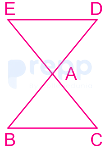
If m∠C = m∠Z and AC = XZ, then which of the following conditions is necessary for ΔABC and ΔXYZ to be congruent?
Let ABC, PQR be two congruent triangles such that angle A = angle P = 90°. If BC = 13 cm, PR = 5 cm, find AB.
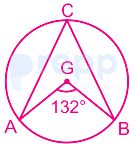
In the given figure, 'G' is the centre of the circle. Find the angle ACB when ∠AGB = 132°
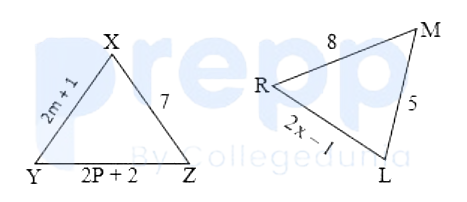
If Δ XYZ ≅ Δ LMR, then m + x + p = ____________.
ΔABC ~ ΔDEF and the perimeters of ΔABC and ΔDEF are 40 cm and 12 cm, respectively. If DE = 6 cm, then AB is:
If in acute-angled triangle ABC, AL, BM, and CN are the three altitudes of triangle ABC, then which of the following statements will be true?
The mid points of AB and AC of a ΔABC are X and Y, respectively. If BC + XY = 18 cm , then the value of BC - XY is:
Important Questions from Triangles, Congruence and Similarity
G is the centroid of the equilateral triangle ABC. If AB = 8√ 3 cm, then the length of AG is equal to:
If sides of a triangle are 12 cm, 15 cm and 21 cm, then what is the inradius (in cm) of the triangle?
What is the area of quadrilateral ABCD?
It is given that ΔABC ~ ΔXYZ and Area ΔABC : Area ΔXYZ = 81 : 25. If AB = 18 cm, BC = 10 cm, CA = 15 cm, then what is the side XZ (in cm)?
Sides of two similar triangles are in the ratio 4 ∶ 9. Area of these triangles are in the ratio:



