
If m∠C = m∠Z and AC = XZ, then which of the following conditions is necessary for ΔABC and ΔXYZ to be congruent?
BC = YZ
Understanding Triangle Congruence Conditions
The question asks what additional condition is needed for triangle ABC (\(\Delta\)ABC) and triangle XYZ (\(\Delta\)XYZ) to be congruent, given that the measure of angle C (m∠C) equals the measure of angle Z (m∠Z), and the length of side AC equals the length of side XZ (AC = XZ).
Analyzing the Given Information
We are provided with two pieces of information about the two triangles:
- An angle in \(\Delta\)ABC is congruent to an angle in \(\Delta\)XYZ: ∠C \(\cong\) ∠Z.
- A side in \(\Delta\)ABC is congruent to a side in \(\Delta\)XYZ: AC \(\cong\) XZ.
Exploring Triangle Congruence Rules
To determine if two triangles are congruent, we use specific congruence rules. The most common rules are:
- SSS (Side-Side-Side): If all three sides of one triangle are congruent to the corresponding three sides of another triangle.
- SAS (Side-Angle-Side): If two sides and the included angle (the angle between the two sides) of one triangle are congruent to the corresponding two sides and included angle of another triangle.
- ASA (Angle-Side-Angle): If two angles and the included side (the side between the two angles) of one triangle are congruent to the corresponding two angles and included side of another triangle.
- AAS (Angle-Angle-Side): If two angles and a non-included side of one triangle are congruent to the corresponding two angles and non-included side of another triangle.
- RHS (Right-angle-Hypotenuse-Side): Specifically for right-angled triangles, if the hypotenuse and one side of a right triangle are congruent to the hypotenuse and one side of another right triangle.
Applying Rules to the Problem
We currently have one pair of congruent angles (\(\angle\)C and \(\angle\)Z) and one pair of congruent sides (AC and XZ). Let's consider how these fit into the rules:
- The side AC is adjacent to angle C in \(\Delta\)ABC.
- The side XZ is adjacent to angle Z in \(\Delta\)XYZ.
- The angle C is included between sides AC and BC in \(\Delta\)ABC.
- The angle Z is included between sides XZ and YZ in \(\Delta\)XYZ.
Given that we have a side (AC), an angle (\(\angle\)C), and another side (BC is adjacent to \(\angle\)C), the SAS (Side-Angle-Side) congruence rule seems most likely to apply directly with one additional condition.
For SAS congruence, we need two sides and the angle included between them. We have side AC and angle C in \(\Delta\)ABC, and side XZ and angle Z in \(\Delta\)XYZ, with AC \(\cong\) XZ and \(\angle\)C \(\cong\) \(\angle\)Z. To satisfy the SAS rule, the second pair of congruent sides must be BC and YZ, because BC is the other side forming angle C in \(\Delta\)ABC, and YZ is the other side forming angle Z in \(\Delta\)XYZ.
Therefore, if we have the conditions:
- AC = XZ (Given)
- m∠C = m∠Z (Given)
- BC = YZ (Additional Condition)
These three conditions perfectly match the SAS congruence criterion: Side (AC) - Angle (\(\angle\)C) - Side (BC) in \(\Delta\)ABC are congruent to the corresponding Side (XZ) - Angle (\(\angle\)Z) - Side (YZ) in \(\Delta\)XYZ.
Evaluating the Options
Let's look at the provided options:
- 1. BC = AB: This condition relates two sides within \(\Delta\)ABC. It doesn't directly provide a corresponding side in \(\Delta\)XYZ that, when combined with the given information (\(\angle\)C = \(\angle\)Z, AC = XZ), guarantees congruence by a standard rule like SAS, ASA, or AAS.
- 2. AB = XY: This pairs sides AB and XY. With AC = XZ and \(\angle\)C = \(\angle\)Z, this would give us Side (AC), Side (AB), and Angle (\(\angle\)C). The angle \(\angle\)C is not included between sides AC and AB. This does not fit SAS. It could potentially lead to AAS or other congruence methods if more information were available, but it is not the condition that directly completes a standard congruence rule with the given information.
- 3. BC = YZ: This pairs sides BC and YZ. With AC = XZ and \(\angle\)C = \(\angle\)Z, this gives us Side (AC), Angle (\(\angle\)C), and Side (BC), which correspond to Side (XZ), Angle (\(\angle\)Z), and Side (YZ). Since \(\angle\)C is included between AC and BC, and \(\angle\)Z is included between XZ and YZ, this set of conditions satisfies the SAS congruence rule (\(\triangle\)ABC \(\cong\) \(\triangle\)XYZ). This is a necessary condition to apply SAS using the given information.
- 4. AB = AC: This condition relates two sides within \(\Delta\)ABC. Similar to option 1, it doesn't directly help establish congruence with \(\Delta\)XYZ based on the given information and standard rules.
Therefore, for \(\Delta\)ABC and \(\Delta\)XYZ to be congruent given m∠C = m∠Z and AC = XZ, the condition BC = YZ is necessary if we are using the SAS congruence criterion, which is the most direct fit for the given information.
Conclusion
Given that m∠C = m∠Z and AC = XZ, the condition BC = YZ is necessary for the triangles to be congruent by the SAS congruence rule. This rule requires two sides and the included angle to be congruent.
Revision Table: Triangle Congruence Rules
| Rule | Description | Conditions for \(\Delta\)ABC \(\cong\) \(\Delta\)XYZ |
|---|---|---|
| SSS | Three sides are congruent. | AB = XY, BC = YZ, AC = XZ |
| SAS | Two sides and the included angle are congruent. | AB = XY, ∠B = ∠Y, BC = YZ OR BC = YZ, ∠C = ∠Z, AC = XZ OR AC = XZ, ∠A = ∠X, AB = XY |
| ASA | Two angles and the included side are congruent. | ∠A = ∠X, AB = XY, ∠B = ∠Y OR ∠B = ∠Y, BC = YZ, ∠C = ∠Z OR ∠C = ∠Z, AC = XZ, ∠A = ∠X |
| AAS | Two angles and a non-included side are congruent. | ∠A = ∠X, ∠B = ∠Y, BC = YZ OR ∠A = ∠X, ∠B = ∠Y, AC = XZ (and other combinations) |
| RHS | (Right triangles) Hypotenuse and one leg are congruent. | ∠B = ∠Y = 90°, AC = XZ, BC = YZ OR ∠B = ∠Y = 90°, AC = XZ, AB = XY |
Additional Information: Importance of Included Angle/Side
In congruence rules like SAS and ASA, the term 'included' is very important. The included angle in SAS is the angle formed by the two congruent sides. The included side in ASA is the side connecting the vertices of the two congruent angles.
Consider the SSA (Side-Side-Angle) case. If you have two sides and a non-included angle (like side AB, side BC, and angle A), this combination (SSA) does NOT guarantee congruence. This is often called the "ambiguous case" because there might be zero, one, or two possible triangles that can be formed with those specific measures. The SAS rule avoids this ambiguity by requiring the angle to be strictly between the two sides.
In this problem, the given angle \(\angle\)C is between sides AC and BC. The given side AC is adjacent to angle C. The most direct way to achieve congruence using this setup is by applying the SAS rule, which requires the other side adjacent to the angle, BC, to be congruent to its corresponding side YZ.
Similar Questions
If sides of a triangle are 12 cm, 15 cm and 21 cm, then what is the inradius (in cm) of the triangle?
In ΔPQR, PQ = PR and S is a point on QR such that ∠PSQ = 96° + ∠QPS and ∠QPR = 132°. What is the measure of ∠PSR?
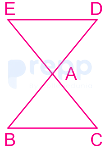
In the figure, AB = AD = 9 cm and AC = AE = 13 cm and BC = 15 cm. Find ED?
The length of each side of a triangle is 12 cm. What is the length of the circumradius of the triangle?
Let ABC, PQR be two congruent triangles such that angle A = angle P = 90°. If BC = 13 cm, PR = 5 cm, find AB.
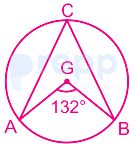
In the given figure, 'G' is the centre of the circle. Find the angle ACB when ∠AGB = 132°
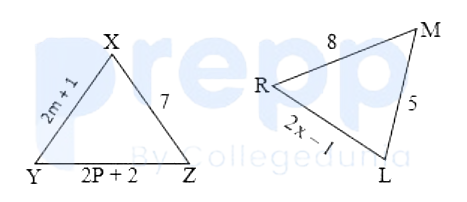
If Δ XYZ ≅ Δ LMR, then m + x + p = ____________.
ΔABC ~ ΔDEF and the perimeters of ΔABC and ΔDEF are 40 cm and 12 cm, respectively. If DE = 6 cm, then AB is:
If in acute-angled triangle ABC, AL, BM, and CN are the three altitudes of triangle ABC, then which of the following statements will be true?
The mid points of AB and AC of a ΔABC are X and Y, respectively. If BC + XY = 18 cm , then the value of BC - XY is:
Important Questions from Triangles, Congruence and Similarity
G is the centroid of the equilateral triangle ABC. If AB = 8√ 3 cm, then the length of AG is equal to:
If sides of a triangle are 12 cm, 15 cm and 21 cm, then what is the inradius (in cm) of the triangle?
What is the area of quadrilateral ABCD?
It is given that ΔABC ~ ΔXYZ and Area ΔABC : Area ΔXYZ = 81 : 25. If AB = 18 cm, BC = 10 cm, CA = 15 cm, then what is the side XZ (in cm)?
Sides of two similar triangles are in the ratio 4 ∶ 9. Area of these triangles are in the ratio:



