$Br(CH_2)_{12}-C\equiv CH \xrightarrow{NaNH_2} X \xrightarrow[\text{catalyst}]{H_2, \text{ Lindler}} Y$
Reaction Pathway Analysis
The reaction sequence involves two steps starting from a bromoalkyne.
-
Step 1: Reaction with Sodium Amide ($NaNH_2$)
The starting material is 1-bromododeca-1-yne ($Br(CH_2)_{12}-C\equiv CH$). Sodium amide ($NaNH_2$) is a very strong base. It preferentially removes the most acidic proton, which is the terminal alkyne proton.
Reaction: $Br(CH_2)_{12}-C\equiv CH + NaNH_2 \rightarrow Br(CH_2)_{12}-C\equiv C^-Na^+ + NH_3$
The intermediate, X, is the sodium acetylide: $Br(CH_2)_{12}-C\equiv C^-Na^+$.
-
Step 2: Reduction with $H_2$/Lindlar Catalyst
Intermediate X is then treated with hydrogen gas ($H_2$) and Lindlar's catalyst. Lindlar's catalyst is specifically used for the partial reduction of alkynes to cis-alkenes. For a terminal alkyne ($R-C\equiv CH$), this reduction yields a terminal alkene ($R-CH=CH_2$).
Assuming the alkyne is reduced (either directly or after transient protonation):
Reaction: $Br(CH_2)_{12}-C\equiv CH + H_2 \xrightarrow{\text{Lindlar catalyst}} Br(CH_2)_{12}-CH=CH_2$
The final product, Y, is the terminal alkene $Br(CH_2)_{12}-CH=CH_2$. Terminal alkenes do not exhibit cis/trans isomerism.
Product Identification
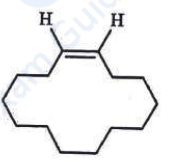
The structure of the product Y is $Br(CH_2)_{12}-CH=CH_2$. This structure is represented by the image in Option 2 and the text in Option 3. Based on the provided correct answer, Option 2 is the correct choice.
Similar Questions
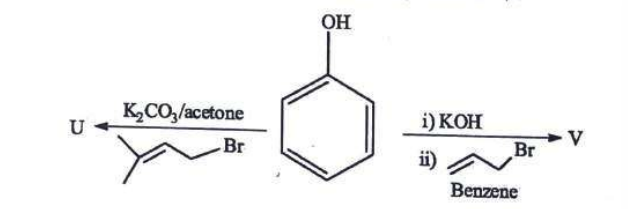
The major products U and V in the following reaction are
In the following sequence of reactions, what is the end product 'Z'?
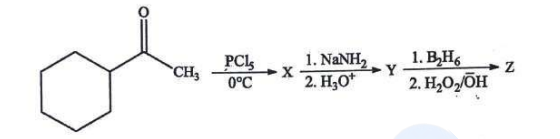
Indicate the major product of the following reaction:
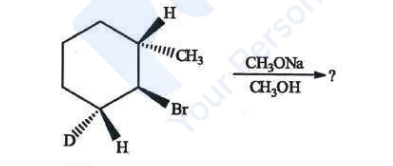
- How many isomers can a compound with molecular formula $\text{C}_{3}\text{H}_{5}\text{Br}$ have?
The increasing order of basicity of the following compounds is

The products X and Y in the following reaction sequence are
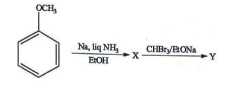
Which one of the following does not lose water even in conc. $H_2SO_4$?
Rank the following anions in order of decreasing nucleophilicity in a polar protic solvent (most $\rightarrow$ least nucleophilic).
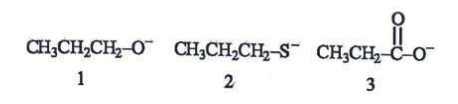
The major product in the following reaction is
$RO-CH_2-C\equiv CH \xrightarrow{X} \xrightarrow{Y} RO-CH_2-C\equiv C-CH_2CH_2-Br$
To carry out the above conversion X and Y are respectively
Important Questions from Organic Chemistry
- In Dumas method for estimation of nitrogen, 0.50 g of an organic compound gave 70 mL of nitrogen collected at 300 K and 715 mm pressure. The percentage of nitrogen in the organic compound is ______ %.
(Aqueous tension at 300 K is 15 mm). - $0.25 \text{ g}$ of an organic compound "A" containing carbon, hydrogen and oxygen was analysed using the combustion method. There was an increase in mass of $\text{CaCl}_2$ tube and potash tube at the end of the experiment. The amount was found to be $0.15 \text{ g}$ and $0.1837 \text{ g}$, respectively. The percentage of oxygen in compound A is ______ %. (Nearest integer)
(Given: molar mass in $\text{g mol}^{-1}$ $\text{H} : 1, \text{C} : 12, \text{O} : 16$) - Grignard reagent $\text{RMgBr (P)}$ reacts with water and forms a gas $\text{(Q)}$. One gram of Q occupies $1.4 \text{ dm}^3$ at STP. (P) on reaction with dry ice in dry ether followed by $\text{H}_3\text{O}^+$ forms a compound $\text{(Z)}$. 0.1 mole of $\text{(Z)}$ will weigh _________ g. (Nearest integer)
- Consider all the structural isomers with molecular formula $\text{C}_5\text{H}_{11}\text{Br}$ are separately treated with $\text{KOH(aq)}$ to give respective substitution products, without any rearrangement. The number of products which can exhibit optical isomerism from these is ___________.
The major products U and V in the following reaction are