
If chips are building up and not breaking during tapping, what should be done?
Back off the tap to break and clear chips
Tapping cuts an internal thread, and the chips produced must break into short pieces and escape through the tap's flutes; if they stay long they pack the flutes and the hole.
Packed chips wedge the tap, sharply raising the cutting torque and often snapping the slender tap inside the workpiece, which is very hard to remove.
The correct practice is to back off, that is reverse the tap by a part-turn every so often, so the cutting edges fracture the chip and let the pieces fall clear of the flutes before cutting resumes.
Applying more torque to a tap that is already loading up (option 1) only drives it toward breakage rather than clearing the chips.
Increasing the tapping speed (option 3) makes chips form faster and pack the flutes even more tightly, worsening the jam.
Reducing the cutting fluid (option 2) removes the lubrication and flushing that help chips slide out, so it hinders rather than helps chip clearance.
Hence, the answer is Back off the tap to break and clear chips.
Similar Questions
When cutting an ISO Metric thread for a coarse pitch, by how many degrees should the compound rest be swiveled to?
Taps are re-sharpened by grinding:
The type of thread used in lead screw of a lathe is ______
The surface connecting crest and root of a thread is termed as
Angle of Knuckle thread is ______
Which one of the following is used to rectify damaged or rusted threads?
The resistance of fine thread unscrewing is ______
Lead is equal to double the pitch value then this type of thread is called as _____.
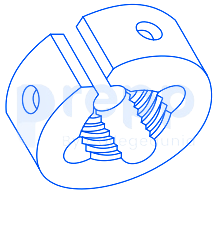
Identify the type of Die in the above Fig.
- The distance from a point on a thread to the corresponding point on the next thread of a screw is called ______.
Important Questions from Screw Threads
When cutting an ISO Metric thread for a coarse pitch, by how many degrees should the compound rest be swiveled to?
What is the blank size (diameter) for preparing a bolt of M12 × 1.5?
What is the relation between the lead (L) and pitch (P) of a two-start thread screw?
Taps are re-sharpened by grinding:
The form of thread in a saw tooth thread is



